Food
Food Categories, unlike tags, can have a hierarchy. You might have a Jazz category.
Search
Food Categories, unlike tags, can have a hierarchy. You might have a Jazz category.
Review Categories, unlike tags, can have a hierarchy. You might have a Jazz category.
Guides Categories, unlike tags, can have a hierarchy. You might have a Jazz category.
Travel Categories, unlike tags, can have a hierarchy. You might have a Jazz category.
By Oscar
There’s a moment — and you’ll know it when it happens — when a city stops being a place and starts being a meal.
Tbilisi did that to me on day one. Not gradually. Not politely. It grabbed me by the collar, sat me down at a table I hadn’t asked for, and started bringing plates before I could read the menu. Georgian hospitality doesn’t wait for you to be ready. It assumes you’re hungry. It’s almost always right.
I’d come here because Alex wouldn’t shut up about it. He’d been holed up in some coworking space near Fabrika, raving about the internet speed and the cheap SIM cards. Fine. Good for Alex. But buried in one of his texts — between a screenshot of a speed test and a photo of his laptop setup — was a single line: “Oscar, the food here is insane. You need to come.”
Alex doesn’t use words like that about food. So I booked a flight.
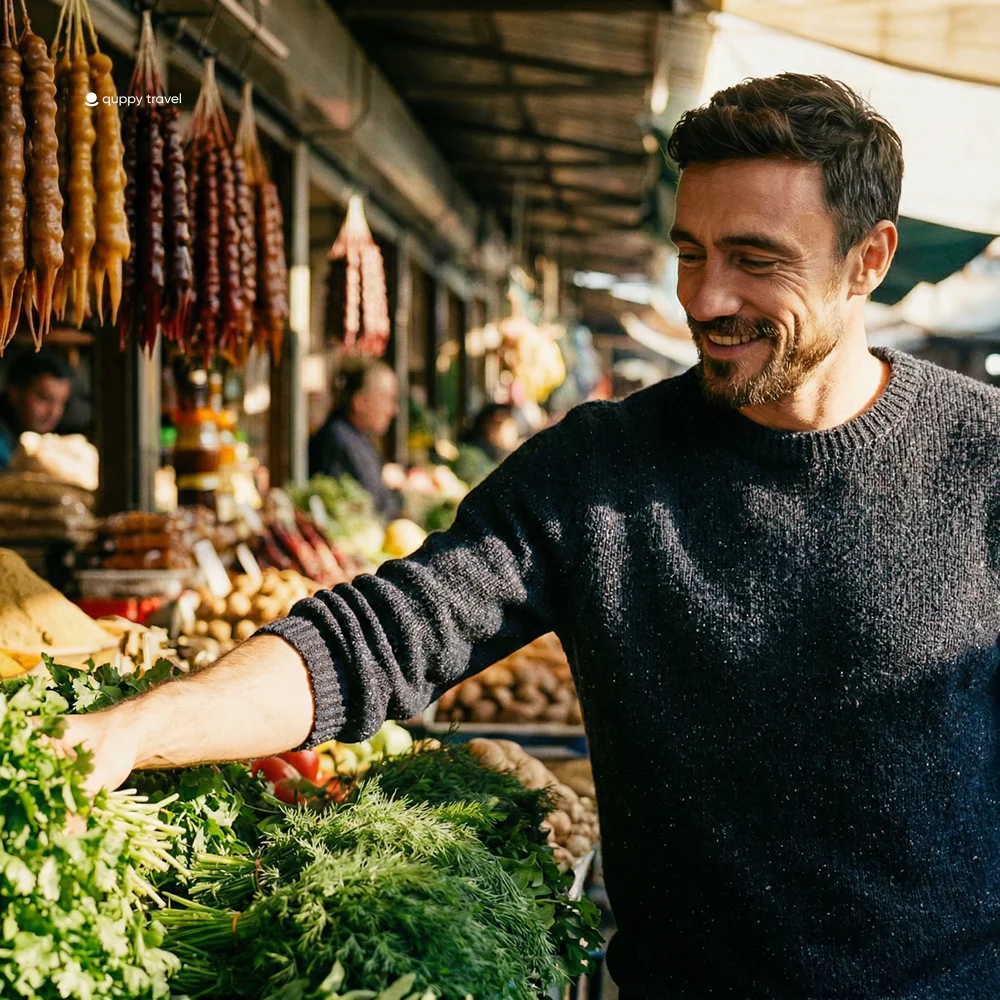
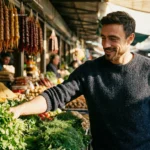
The Dezerter Bazaar is not a tourist attraction. I mean, technically it is — I saw two people with selfie sticks and a man in hiking sandals consulting a Lonely Planet. But at nine in the morning, it belongs to the grandmothers.
They’re everywhere. Small, formidable women in floral prints, carrying bags that weigh more than they do, moving through the stalls with the precision of someone who has done this exact walk every Thursday for forty years. They don’t browse. They select. There’s a difference.
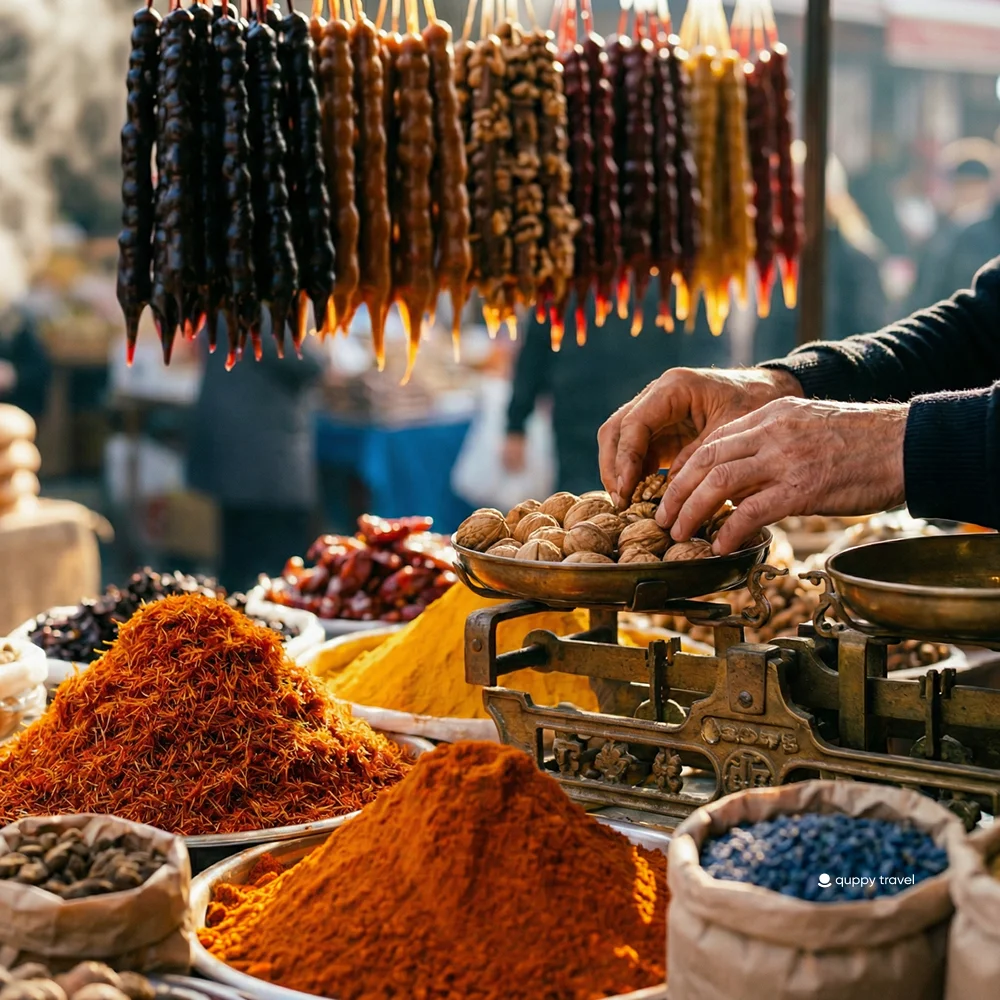
I followed one of them — not intentionally, at first — through the spice corridor. Saffron from Kakheti. Dried marigold petals ground into a powder the color of burnt sunset. Blue fenugreek, which smells like nothing until you crush it between your fingers and suddenly you’re inside every Georgian kitchen that ever existed.
I bought too much. I always buy too much at markets. Three types of dried pepper, a bag of adjika paste wrapped in newspaper, a fistful of tarragon so green it looked artificial. The woman selling it spoke no English. She weighed the herbs on a scale that predated the Soviet Union, named a price with her fingers, and handed me a sprig of basil for free. A gift. Or a test. In Georgia, it’s hard to tell.
The churchkhela hung from every third stall like edible chandeliers — grape must and walnuts pulled into long, waxy fingers. I bit into one and the outside cracked into something between fruit leather and caramel while the walnut inside was still slightly soft, almost creamy. I stood there chewing, blocking foot traffic, and didn’t care.
You cannot write about Tbilisi without writing about bread. You shouldn’t even try.
The tone — the teardrop-shaped bread baked against the inner wall of a clay oven — is not just bread. It’s architecture. It’s physics. The baker leans into the tone oven, a pit of heat that hisses when the dough hits the wall. The baker slaps it against the curved surface, and waits. What comes out is charred on the edges, pillowy in the centre, and slightly smoky from the fire. It tears like warm cotton.
I found a bakery near the bazaar — no name, no sign, just an open door and the smell. The baker was a man in his sixties with forearms like bridge cables. He pulled three loaves out in the time it took me to say “gamarjoba.” I bought one. Tore into it on the street. The crust crackled and the inside released a puff of steam that smelled like grain and wood smoke and something almost sweet.
I ate half of it before I reached the corner. The other half I carried like a prize, tucked under my arm, already planning what to pair it with.
Let me be honest: I’ve eaten dumplings in seventeen countries. Chinese jiaozi that made me rethink pork. Turkish manti the size of a thumbnail, drowning in yogurt and chili butter. Polish pierogi at a market in Kraków that I still dream about.
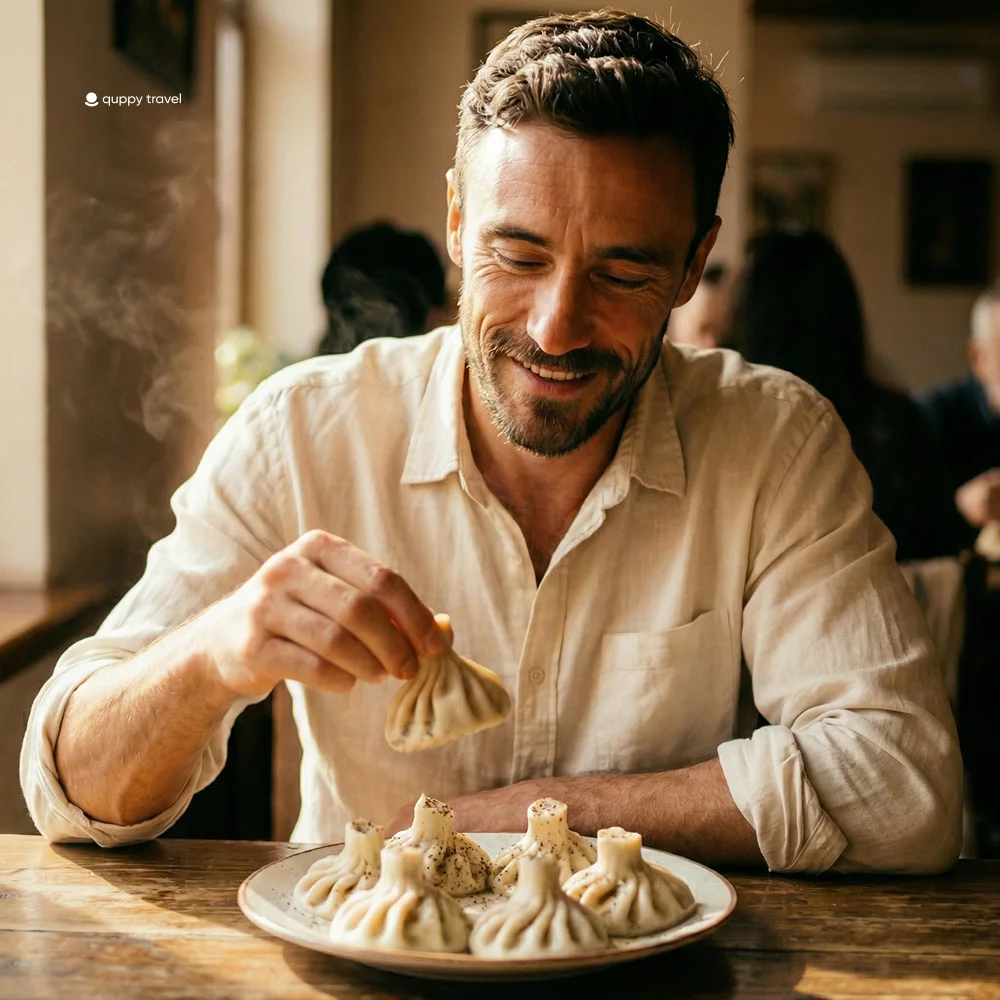
Khinkali are different. Not better — different. They’re ugly. Deliberately, beautifully ugly. Fat, pleated pouches of dough pinched at the top into a twisted knot that you’re supposed to hold like a handle. The filling — spiced meat, usually beef and pork — sits in a pocket of broth that forms during cooking. The knot is not eaten. It’s left on the plate. At the end of the meal, the pile of knots tells everyone at the table exactly how much you’ve had.
Mine was embarrassing.
The place Alex had recommended — Pasanauri on Dadiani Street — was packed at noon. Families, construction workers, two men in suits who’d clearly walked out of a meeting specifically for this. The khinkali arrived on a metal tray, sixteen of them, slick with butter, dusted with black pepper. I picked one up. Bit a small hole in the side. Drank the broth. Then ate the rest in two bites.
The meat was seasoned with cumin and coriander and something peppery I couldn’t name. The dough was thick enough to hold its shape but thin enough to yield. The broth — the soul of the thing — tasted like someone had slow-cooked a stock for hours and then trapped it inside a dumpling.
I ate nine. The man at the next table ate fourteen and looked disappointed in himself. We exchanged a nod. The universal language of overcommitment.
Mia had warned me about Georgian wine. “It’s not what you think wine is,” she’d said, in that quiet way she has of saying something enormous without raising her voice. She was right.
Qvevri wine — fermented and aged in clay vessels buried underground — is not wine the way I knew wine. It’s darker. Rougher. More honest. An amber wine from Kakheti had the colour of late afternoon and a taste that started with dried apricot, passed through honey, and finished with something tannic and almost savoury, like the memory of bread crust.
I drank it at a small bar in the Old Town — Vino Underground, a place barely wider than my arm span, where every bottle on the shelf was natural and every person behind the counter could talk about terroir for forty minutes without boring you. The bartender poured me three samples without being asked. “You look like someone who needs to understand this,” she said. I took that as a compliment.
The second glass was a Saperavi — the grape that owns this country. Deep, almost black-red, with a nose of dark cherry and wet earth. It tasted like someone had distilled a Georgian autumn into a bottle. I had a third glass. Then a fourth. The bartender didn’t judge. She joined me for the fifth.
I hadn’t planned to attend a supra. You don’t plan a supra — a supra plans you.
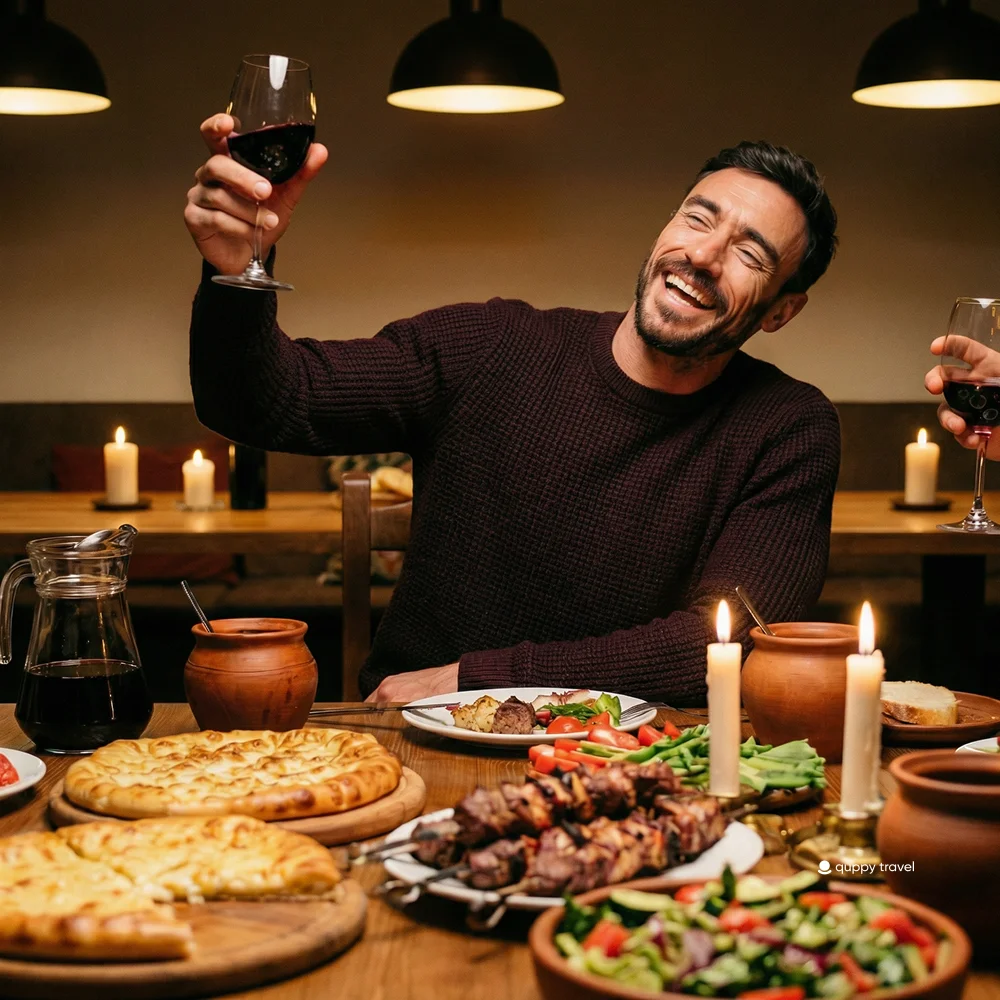
It happened through the bartender, who knew a winemaker, who was hosting dinner for twelve at his cousin’s restaurant in Sololaki. By eight o’clock I was sitting at a table that could seat twenty, watching dishes arrive in a procession that felt less like a meal and more like a slow, delicious landslide.
Badrijani — fried eggplant rolls filled with walnut paste and a whisper of garlic. Pkhali — spinach and beetroot pressed into small cakes, topped with pomegranate seeds that burst like tiny grenades of sweetness. Lobio bubbling in a clay pot, thick as mortar, smoky from the beans, sharp from the coriander. Mtsvadi — chunks of pork sizzling over grapevine embers, the fat rendered to a crisp shell while the inside stayed almost obscenely juicy.
And then the khachapuri. Adjarian khachapuri. The one shaped like a boat. The one with a lake of molten cheese and butter dripping in the centre and a raw egg cracked into it that cooks just enough from the residual heat. You tear the bread from the edges and drag it through the middle, and what you get is something between fondue and salvation.
The tamada — the toastmaster — raised his glass every ten minutes. To Georgia. To friendship. To the dead. To the living. To the grape. To the soil. Each toast required a full glass of wine, drained. By the fifth toast, I’d stopped counting. By the eighth, I was making one of my own — in broken Georgian that made the entire table roar with laughter and then, inexplicably, applaud.
I tapped my phone to settle my share at the end. The bill split four ways through Quppy took less time than the tamada’s shortest toast. Back to the wine.
It was almost midnight when I left. The streets of Sololaki were warm and quiet — that particular silence that follows a meal so large it needs its own moment of rest. I walked with no direction, past balconies that sagged under the weight of grapevines, past a churchyard where someone had left a candle burning, past a bakery already firing up the tone oven for tomorrow’s bread.
Tbilisi feeds you before it introduces itself. It doesn’t ask what you want — it brings what you need. And somehow, impossibly, it’s always right.
I thought about what Mia had written — that this city holds you loosely. Maybe. But I think it holds you the way a good host holds a dinner party: firmly enough that you feel welcome, loosely enough that you feel free.
I was already planning what to eat tomorrow.