In Tbilisi, the table was set for me. In Kakheti, I watched them set it — slowly, proudly, with the kind of patience that only people who grow their own food can afford. This is not a wine region you tour. This is a wine region that sits you down and doesn’t let you leave until you’ve understood something about clay, soil, and why your grandmother was right about everything.
I spent four days in the Alazani Valley — Telavi, Sighnaghi, and the unnamed villages in between where the road narrows to one lane and the grapevines press in from both sides like they’re trying to eavesdrop. What follows is not a ranked list. It’s a map of meals, drawn from memory and a stained notebook.
Morning: The Telavi Bazaar
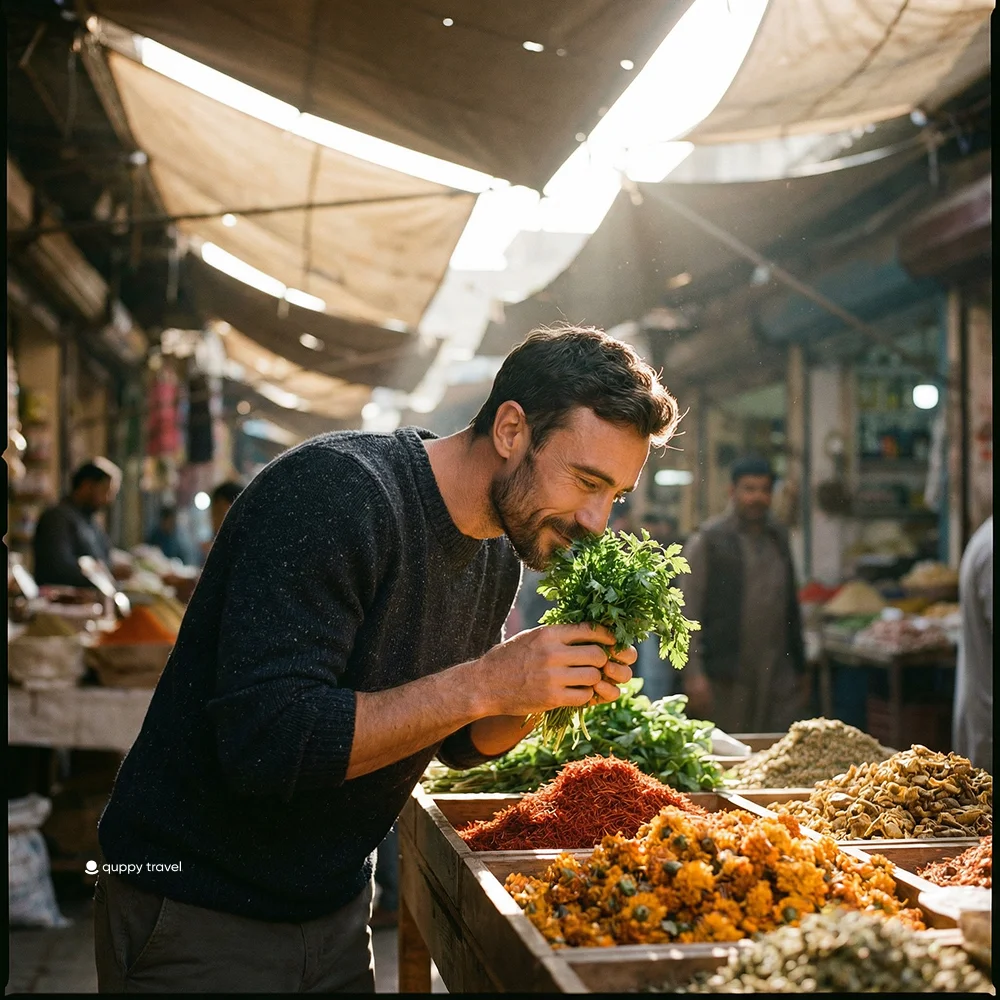
Skip breakfast at the guesthouse. Walk to the Telavi bazaar instead — the one behind the central square, past the statue, left at the pharmacy that may or may not still be a pharmacy. You’ll know you’ve found it when the air shifts from exhaust to dill.
The bazaar operates on a logic I deeply respect: everything is seasonal, nothing is labelled, and the prices are negotiated through eye contact and hand gestures. I arrived at seven-thirty on a Tuesday and a woman named Nana — I never got her last name — was already arranging pyramids of tomatoes so red they looked angry. She handed me one without asking. It was warm from the sun and tasted like the word August even though it was March.
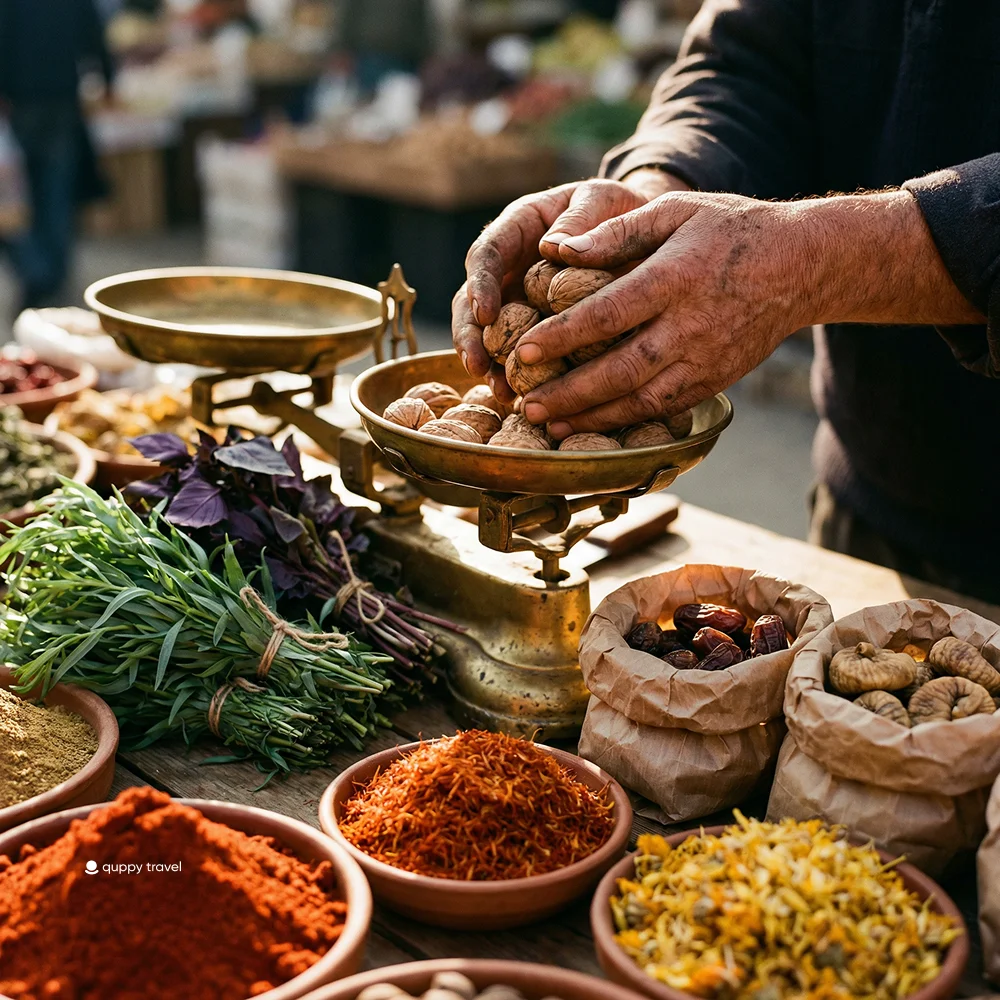
Three things to find here: the churchkhela stall near the east wall where they still dip by hand, the walnut vendor who will crack shells with his thumb while you watch, and the herb table where bundles of tarragon, purple basil, and coriander are tied with string and cost almost nothing. Buy all three. You’ll need them later. Trust me.
I left with two bags and the conviction that every city should be judged by the quality of its morning bazaar. Telavi scores absurdly high.
Mid-Morning: Vakho’s Cellar
From the bazaar I drove twenty minutes east to a village whose name I wrote down and immediately lost. The winery had no sign — just a metal gate, a dog who seemed personally inconvenienced by my arrival, and a man named Vakho standing in the courtyard with a glass in each hand.
Vakho Oqruashvili makes wine the way his grandfather did and his grandfather’s grandfather did before that — in qvevri, the clay vessels buried up to their necks in the cellar floor. He walked me downstairs. The cellar smelled like earth, damp stone, and something sweet and ancient I couldn’t place — a low drip echoed from somewhere deeper in the dark. Six qvevri sat in a row, sealed with clay and covered in a thin film of beeswax. He knelt, broke the seal on one, and dipped a long wooden ladle into the dark.
What came up was a Saperavi so dense it stained the glass before I’d even tasted it. Tannins like leather, a finish that went on for thirty seconds, and underneath all of it — fruit. Not the polished fruit of a bottled wine, but the raw, almost feral fruit of something that’s been sleeping underground since October.
“This one is named after my daughter,” Vakho said. “The next one is named after my wife. The one after that — the angry one — that’s named after me.”
We drank all three. The angry one was my favourite.
He poured chacha from a plastic bottle — grape brandy, homemade, the kind that strips paint and rewires your nervous system — and we sat in the courtyard eating fresh bread with white cheese and watching the vines shake in the wind. No tasting notes. No spitting. No clipboard. Just a man, his wine, and the quiet satisfaction of someone who knows exactly what he’s made.
Lunch: Elene’s Kitchen
Vakho called ahead. By the time I arrived at his cousin Elene’s house — a fifteen-minute drive through orchards — the table was already half-set. This is a pattern in Kakheti. You never arrive to an empty table. Someone has always started cooking before you confirmed you were coming.
Elene didn’t run a restaurant. She ran a kitchen that happened to feed anyone Vakho sent her way. The room was small: a long wooden table, a wood-fired stove the size of a small car, and a window that framed the Caucasus like a painting no one had hung properly.
What arrived, in no particular order: lobio in a clay pot still bubbling from the heat, its surface cracked and darkened like a lava field. Puri pulled from the tone oven — the bread hissed when she tore it in half and handed me the bigger piece. Badrijani — fried aubergine rolls stuffed with walnut paste and garlic so potent it announced itself from across the table. Sliced tomatoes with nothing but salt and oil. A plate of suluguni that squeaked against my teeth. And mtsvadi — pork skewers charred on vine cuttings, the fat still crackling from the embers, the smoke flavour baked so deep into the meat that you tasted the fire before the fat.
I ate until I couldn’t, and then Elene brought out the tkemali — sour plum sauce, green and sharp — and I ate more. That’s what tkemali does. It resets you. It cuts through everything and convinces your stomach that actually, you have room for one more skewer.
The bill didn’t exist. I tried. Vakho shook his head. “She’ll be offended,” he said. I left money under a plate and hoped she wouldn’t find it until I’d gone.
Afternoon: Sighnaghi and Pheasant’s Tears
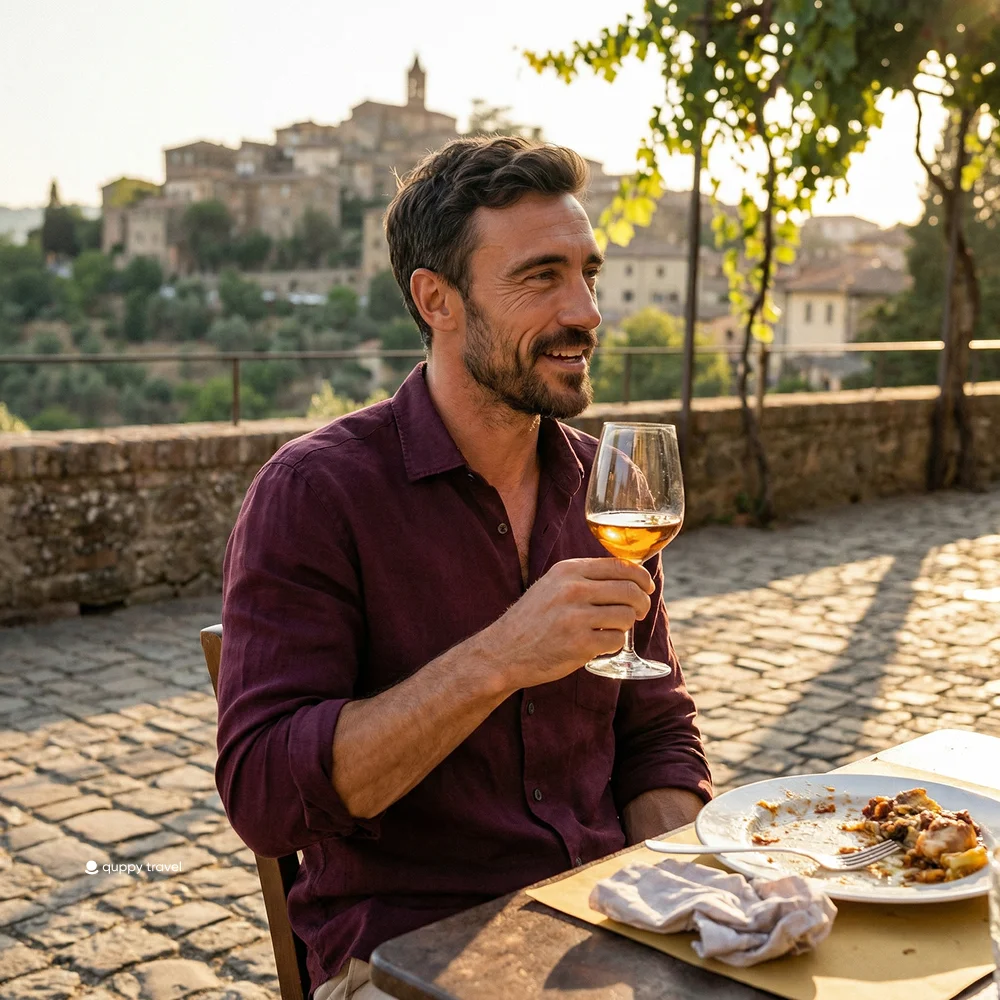
Sighnaghi sits on a hilltop above the valley like someone placed it there to make a point about beauty. The cobblestone streets are narrow, the balconies lean over the edge, and on a clear day you can see the snow line of the Caucasus from the town square. Mia would lose her mind here. She’d find a bench and sit until the light did something she liked. I found a restaurant.
Pheasant’s Tears is the kind of place that travel writers have already exhausted with praise, so I’ll keep it short: the wine list is entirely natural, the food is rooted in Kakhetian tradition, and the owner — an American painter named John Wurdeman who came for a visit in 1996 and never left — has spent decades doing something rare. He built a place that honours the old without pretending the new doesn’t exist.
I ordered the kuchmachi — a warm hash of chicken hearts, livers, and gizzards folded with walnuts, pomegranate seeds, and enough garlic to clear a room. It arrived sizzling in a clay pan, the surface glistening with rendered fat. It was, and I don’t say this often, perfect. Rich without being heavy, rustic without being rough, and seasoned with the kind of confidence that only comes from making the same dish ten thousand times.
The Rkatsiteli amber wine they poured beside it — skin-contact, qvevri-aged, faintly oxidized — was the colour of dark honey and tasted like dried apricot, beeswax, and the ghost of a walnut shell. You don’t sip this wine. You sit with it. You let it open. If you rush it, you miss everything.
I stayed for two glasses and watched the valley fill with shadow. Alex would tell you the Wi-Fi in Sighnaghi is surprisingly decent. I’ll tell you the wine is better.
Evening: The Table That Set Itself
Back in Telavi, my guesthouse host — a retired teacher named Giorgi — asked if I’d eaten. I said yes. He nodded, disappeared into the kitchen, and returned fifteen minutes later with a full supra.
This is the thing about Kakheti that no guide can prepare you for: the generosity is structural. It’s not hospitality in the way a hotel is hospitable — practised, calibrated, transactional. It’s the kind that fills your plate before you’ve said you’re hungry, pours wine before you’ve found your glass, and refuses payment with a wave of the hand that suggests the very concept of money is slightly rude.
Giorgi made a toast — to guests, to Georgia, to the vine. His Saperavi was darker than Vakho’s, rougher, with a tannic bite that grabbed the back of your throat and held on. We didn’t speak the same language, but wine has its own grammar. By the third glass, I understood everything he was saying.
Mia told me about a guesthouse woman in Kazbegi who spoke three words of English: “tea,” “room,” and “mountain.” Giorgi spoke four: “eat,” “drink,” “more,” and “good.” Between us, we had a complete vocabulary.
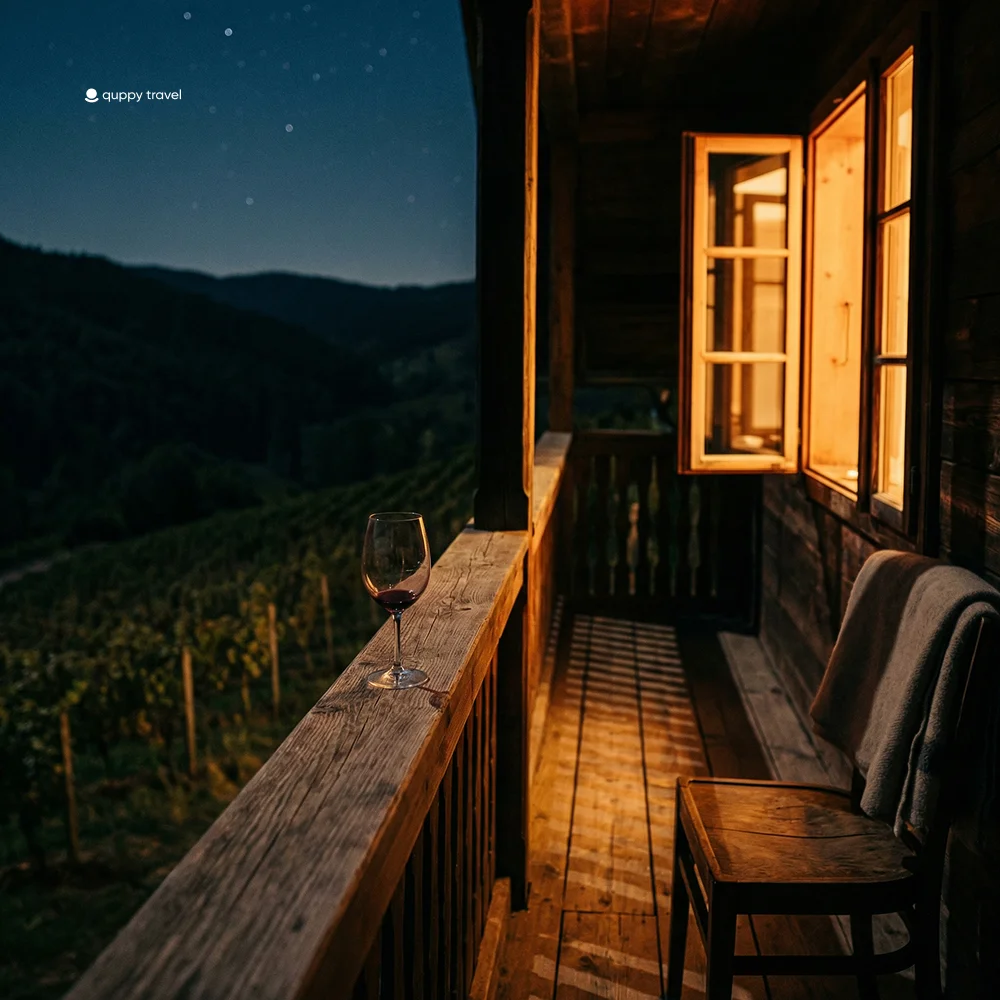
The table cleared itself at some point — I don’t remember when. I walked to the balcony and looked at the vines under the stars and thought about the fact that people have been doing exactly this, in exactly this valley, for eight thousand years. Not the tourism part. The drinking part. The sitting together part. The part where you pour someone a glass and wait for them to say it’s good.
I split the cost of the wine with Quppy — converted lari to my card in the time it took Giorgi to refill my glass. He didn’t notice. That’s the point.
If I Could Only Go Back to One
Vakho’s cellar. Not because the wine was the best — though it might have been — but because he named every glass. And because the dog eventually forgave me for arriving unannounced. And because when I left, he pressed a bottle into my hands and said, “This one doesn’t have a name yet. You give it one.”
I haven’t yet. I’m saving it.