Valencia is the consensus pick. Ask any nomad forum where to go in Spain and you get the same answer within two replies, usually with the same three reasons: cheap, coastal, connected.
I distrust consensus picks. Not because the crowd is wrong — it’s usually right — but because a ranking is a compression, and compression throws things away. I wanted to know what got thrown away.
So I gave Valencia twelve days.
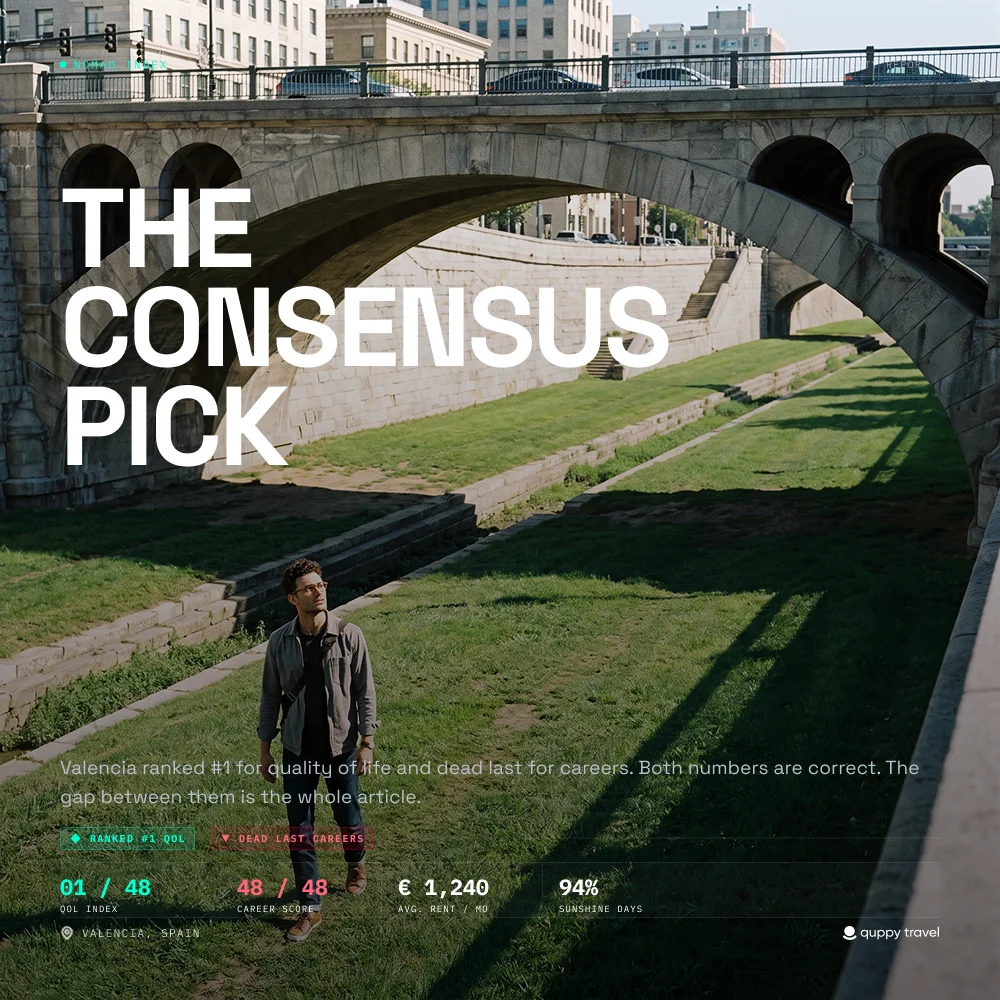
Here’s the number the consensus is built on. In the InterNations Expat City Ranking 2022 — 11,970 respondents, 177 nationalities — Valencia came first of fifty cities worldwide. Ahead of Dubai. Ahead of Mexico City. First for quality of life, first for cost of living, first for affordable housing. Ninety-two percent said they feel safe, against 81% globally.
Here’s the number nobody quotes. In that same survey, Valencia ranked fiftieth of fifty for career prospects. Last. Dead last. Working Abroad overall: 41st. Only 8% of the people living there had moved for work, against 36% globally.
Both numbers are correct. The gap between them is the whole article.

Connectivity: the boring chapter
I’m going to disappoint you here. Spain solved this.
Fibre reaches 95% of Spanish households — 94.79%, if you want the decimal — per the Ministry’s 2024 broadband coverage report. Gigabit-capable fixed lines: 94%. 5G: 96% of the population. And unlike most coverage statistics, the take-up matches the deployment: fibre is 90.3% of every active fixed broadband line in the country.
That is an absurd number. Ninety percent of a whole country’s fixed connections, on glass. (Ask anyone who has tried to file work from rural Germany.)
So no, I did not run speed tests in eleven cafés. There was no point. The connectivity question in Spain is answered, and answering it again is mostly a way of avoiding the harder ones. (The spreadsheet exists. It has a Valencia tab. The tab is empty, and I have made my peace with that.)
One thing worth knowing, because it re-rates your whole budget: business services here — coworking included — are quoted before VAT. Shops and restaurants show you the final price. A desk membership does not, and twenty-one percent lands at the end, after you’ve already done your sums.
The paperwork is the actual friction
This is where Valencia stops being first of fifty. In the same survey, 52% rated the local bureaucracy negatively (against 39% globally), and the city fell to 13th on the Expat Essentials index despite ranking 3rd for housing. The life is not the problem. The admin is.
The visa is real, though, and better than its reputation. Spain’s Startups Law — Ley 28/2022 — came into force on 23 December 2022, not 2023, whatever the blogs say. (The nomad provision isn’t even in that law’s own articles: its fifth final provision amends the 2013 entrepreneurs law to insert article 74 bis, teletrabajador de carácter internacional. I read it. It took an afternoon.)
The income threshold is where people get hurt. It’s written as 200% of the minimum wage — a multiple, not a euro figure. Which means it re-rates every year, whenever the SMI does. Any blog quoting you a fixed number is quoting a snapshot, and a stale snapshot means you under-document and get refused. Read article 74 bis and do the multiplication yourself, the week you file.
The rest is unglamorous and fine: visa up to a year, residence authorisation up to three, renewable in two-year blocks, permanent residence at five. The processing unit is meant to resolve in twenty days.
The riverbed
Now the part I actually came away thinking about.
On 14 October 1957 the Turia broke its banks through the middle of Valencia. Twice in one day: a morning wave around 2,700 cubic metres per second, a midday one over 3,700. The official toll under Franco was 81 dead. Contemporary chronicles put it past 300. The regime was not in the business of publishing numbers that indicted the state.
The answer was Plan Sur — Ley 81/1961, signed on 23 December 1961. It didn’t dam the river or wall it in. It moved it: a new channel cut around the south of the city, 12,692 metres long, 200 metres wide, rated for 5,000 cubic metres per second.
Construction began in February 1965. The channel opened on 22 December 1969 and was finished in 1973. One and a half million cubic metres of concrete. Three million tonnes of stone.
Which left a dry riverbed running straight through the middle of a city. Roughly nine kilometres of empty corridor — already cleared, already owned, already bridged.
You know what goes in a corridor like that.
The 1958 plan said it out loud: autopistas, estaciones ferroviarias y zonas industriales. Motorways, rail yards, industry. On any spreadsheet I have ever built, that is the correct answer. Free right-of-way through the centre of the city. Maximum throughput, minimum acquisition cost. The park was never the plan.
What stopped it was the neighbourhood associations and a sentence: “El llit del Túria és nostre i el volem verd.” The Turia riverbed is ours and we want it green. Las Provincias picked the campaign up in 1973 and carried it past the neighbourhoods into the city at large. The state handed the bed to Valencia by royal decree on 1 December 1976. The first democratic councils approved it as a park in 1979. The garden was founded in 1986, and its eighteen sections were built out over roughly the next twenty-five years.
Mia spent a week in a canyon in Galicia this month and filed a piece about a river that had been there first and set the pace for everything built near it. Valencia looked at its river and moved it around the south of the city. Same country, same month, opposite instinct.
I want to be precise about what I admire here, because it isn’t the aesthetics. Valencia’s own architects’ association calls the finished garden incongruent and unfinished, and they’re right — you can feel the seams where one section’s idea stops and the next one’s begins. It isn’t a masterpiece.
It’s a refusal, and it’s nine kilometres long.
What the water did in 2024
I can’t write about this riverbed in 2026 and treat water as a historical subject.
On 29 October 2024 a DANA — depresión aislada en niveles altos, the cut-off low that Spanish autumn runs on — killed more than 230 people, overwhelmingly in the Valencia area. It is one of the deadliest floods in modern European history.
The diverted Turia is credited with sparing the city centre. It did the job it was built for, fifty-five years on.
The water that killed people came down the Rambla del Poyo — a ravine that is dry most of the year, and built over. It burst at Torrent around half past six in the evening and ran at roughly 2,300 cubic metres per second past Paiporta.
I’m not going to turn that into a tidy lesson about infrastructure. More than two hundred people died, the judicial inquiry into what happened is still running, and a nomad with a spreadsheet has no standing to summarise it. The only thing I’ll say is the narrow, verifiable one: the channel cut after 1957 did the job it was built for, and the water that killed people came down somewhere else.
DANA season is September to November. I was here in July. In July the sea sits around 24 degrees — which is the part that makes the autumn possible. Warm water, warm air above it, all that ascent waiting for a trigger.
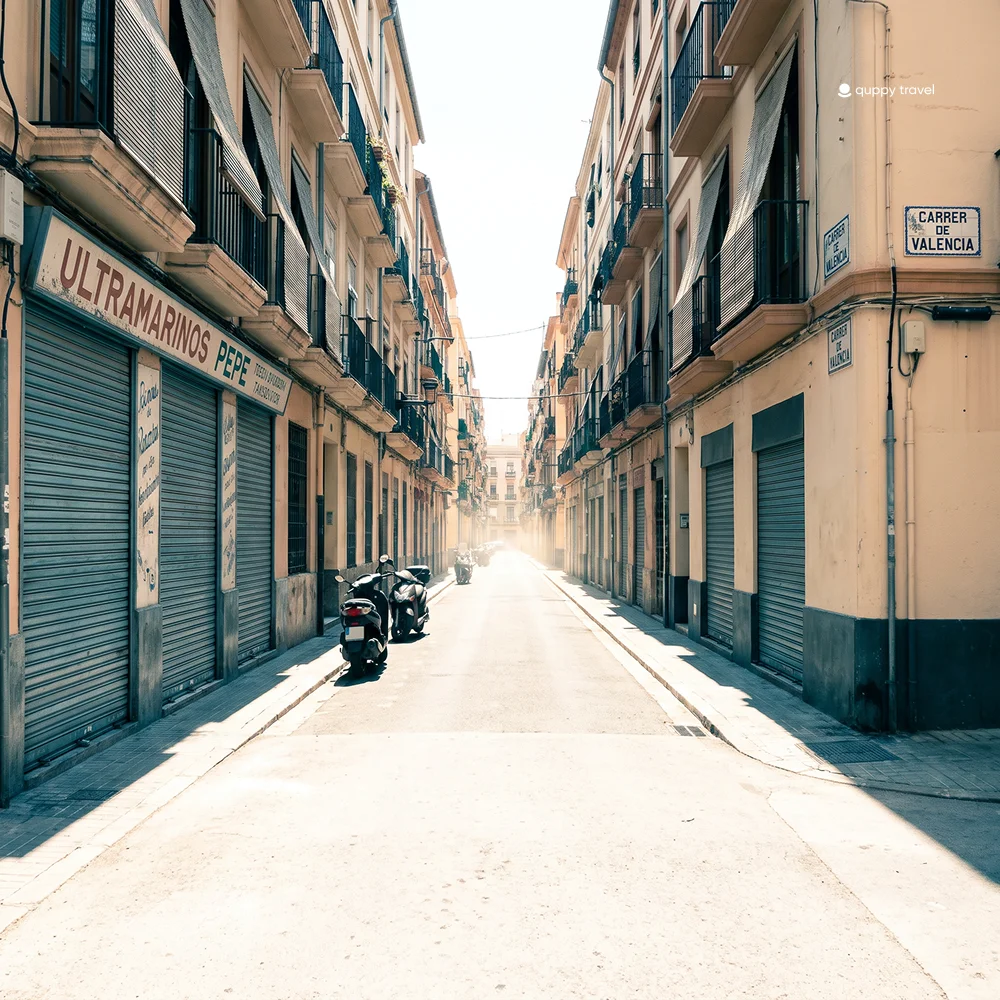
The shape of the day
July in the city: mean daily high 29.7°C, mean low 21.5°C, 67% humidity, 314 hours of sunshine, eight millimetres of rain for the entire month (AEMET, city station, 1981–2010 normals). The airport station reads hotter and drier. Trust the city numbers if you’re living in the city — the sea moderates the days and warms the nights.
The internet will tell you everything shuts for siesta. The internet is wrong about Valencia. The department stores trade straight through, ten to nine. What actually closes is the small independent — the butcher, the baker, the one-room shop — roughly two to five.
The thing that matters more, and that nobody puts in a city guide: from June to September a lot of Spanish offices run jornada intensiva. Eight to three. Seven hours, no lunch break, done.
Sunset in mid-July is at 21:27.
Sit with those two numbers together. The working day ends at 15:00. The light holds until half past nine. In mid-July that is six and a half hours of usable daylight AFTER the workday. It tapers as the summer goes — by late September you’re down to about five — but the shape of the thing holds from June through to the end of it.
That isn’t a lifestyle perk. That’s the product.
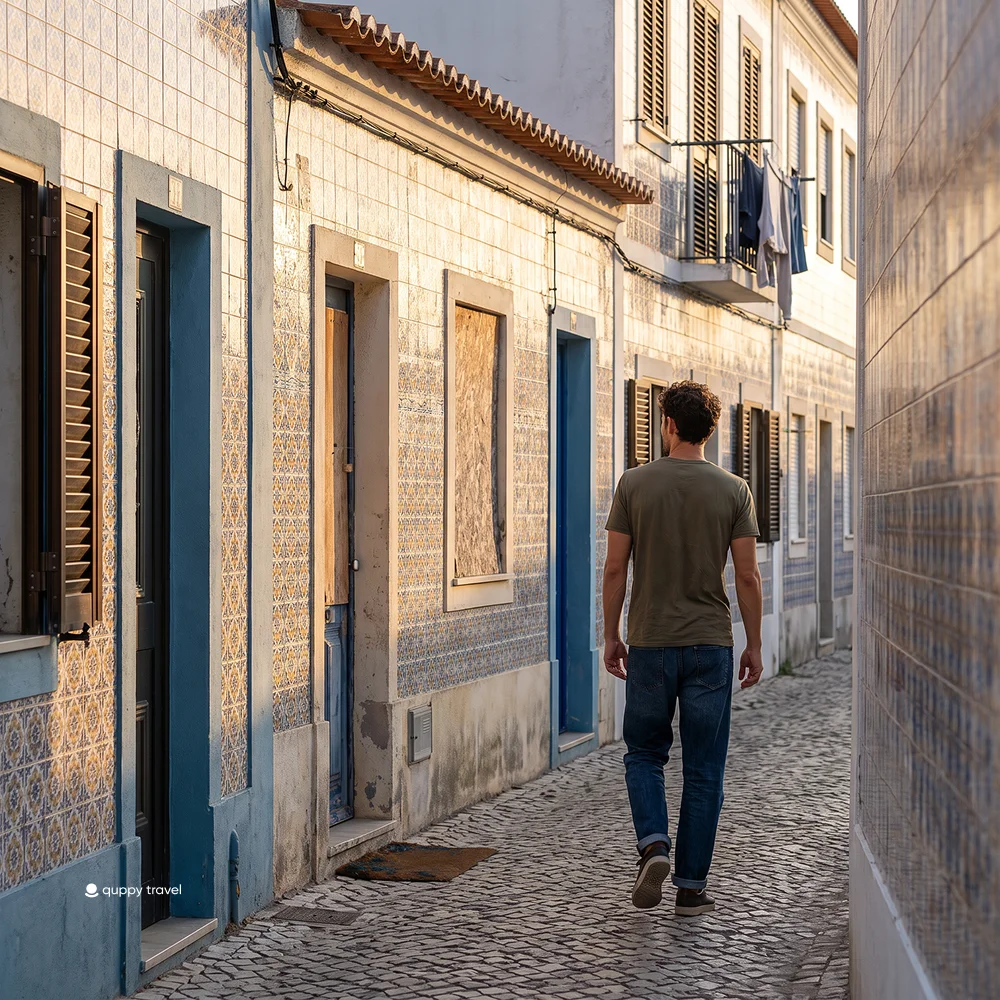
Cabanyal, and the second road
El Cabanyal was a fishing village for about eight centuries before it was a neighbourhood. It’s named for the cabanyes, the thatched barracas the fishermen lived in, in rows facing the sea. It burned to the ground in a night in February 1796 and was rebuilt. It was its own municipality — Poble Nou de la Mar, run by councillors who were representatives of the fishing societies — until Valencia annexed it in 1897. The Generalitat declared it a protected historic ensemble in 1993.
In July 1998 the city approved a plan to drive Blasco Ibáñez avenue straight through it to the sea. The plan implied the destruction of 1,651 houses.
The neighbourhood formed a platform, Salvem el Cabanyal, in April 1998. Then it did something I find genuinely hard to compute: they met every Wednesday at eight in the evening for twenty years. (I have never kept a recurring calendar invite alive past about eighteen months.) Hunger strikes running almost a month. People chaining themselves to their own front walls. In December 2009 the Ministry of Culture declared the plan an expolio of the historic ensemble and ordered it suspended. The avenue stops where it always stopped.
So: twice. Twice this city has been handed the efficient answer — put the road through it — and twice it has declined. Once through a dead riverbed, once through a live neighbourhood, twenty years apart. That isn’t sentiment. That’s a pattern, and patterns are the only thing worth carrying out of a place.
Now the honest part. I’m the next wave. Cabanyal is gentrifying, and the people doing it look a lot like me: laptop, flat white, a lease measured in months. Russafa already went — and the peer-reviewed version of that story (Cuadernos de Geografía, 2025) finds the city’s own regeneration plan drove rents up and displaced long-standing residents, and that the artists who made the barrio interesting accelerated the thing that priced them out of it.
City-wide asking rents averaged €1,633 a month in September 2025, up about 75% on 2019, per the UPV housing observatory. That’s the city-wide asking figure, not Cabanyal’s. Anyone quoting you a neighbourhood number is guessing.
Salvem el Cabanyal beat a bulldozer over twenty years. I don’t know that anyone has beaten a lease.
Verdict
Valencia is first of fifty for exactly the reason it is fiftieth of fifty.
It works if you bring your own work. The fibre is done. The day ends at three, the light runs to half nine, and the cheapness is still real — though less real every quarter, and the people it’s stopped being real for already live here.
It doesn’t work if you came to find work. The survey’s own respondents put career prospects last of fifty, and I read that as accurate rather than bitter. Only 8% of them moved here for a job. This is a city people move to despite the labour market, having solved that problem somewhere else first.
Budget patience for the admin, not for the money. Fifty-two percent of them rate the bureaucracy badly, and that’s the number I’d believe hardest.
The delta
Here’s the delta I keep turning over.
Same survey, same year, same 11,970 people: first of fifty, and fiftieth of fifty. Both true. A city that is very good at everything except the thing you’d traditionally move to a city to do.
The riverbed is the same answer in concrete. The efficient move was the motorway. Valencia declined, and the return on that refusal is nine kilometres long, and everyone in this city uses it.
I came to measure bandwidth, because bandwidth is what I know how to measure. I’m leaving with a worse instrument — slower, harder to score, impossible to put in a comparison table. I’ve started reading cities for what they refused to build.
Against that baseline, most of the places on my spreadsheet are still running the motorway.
— A.