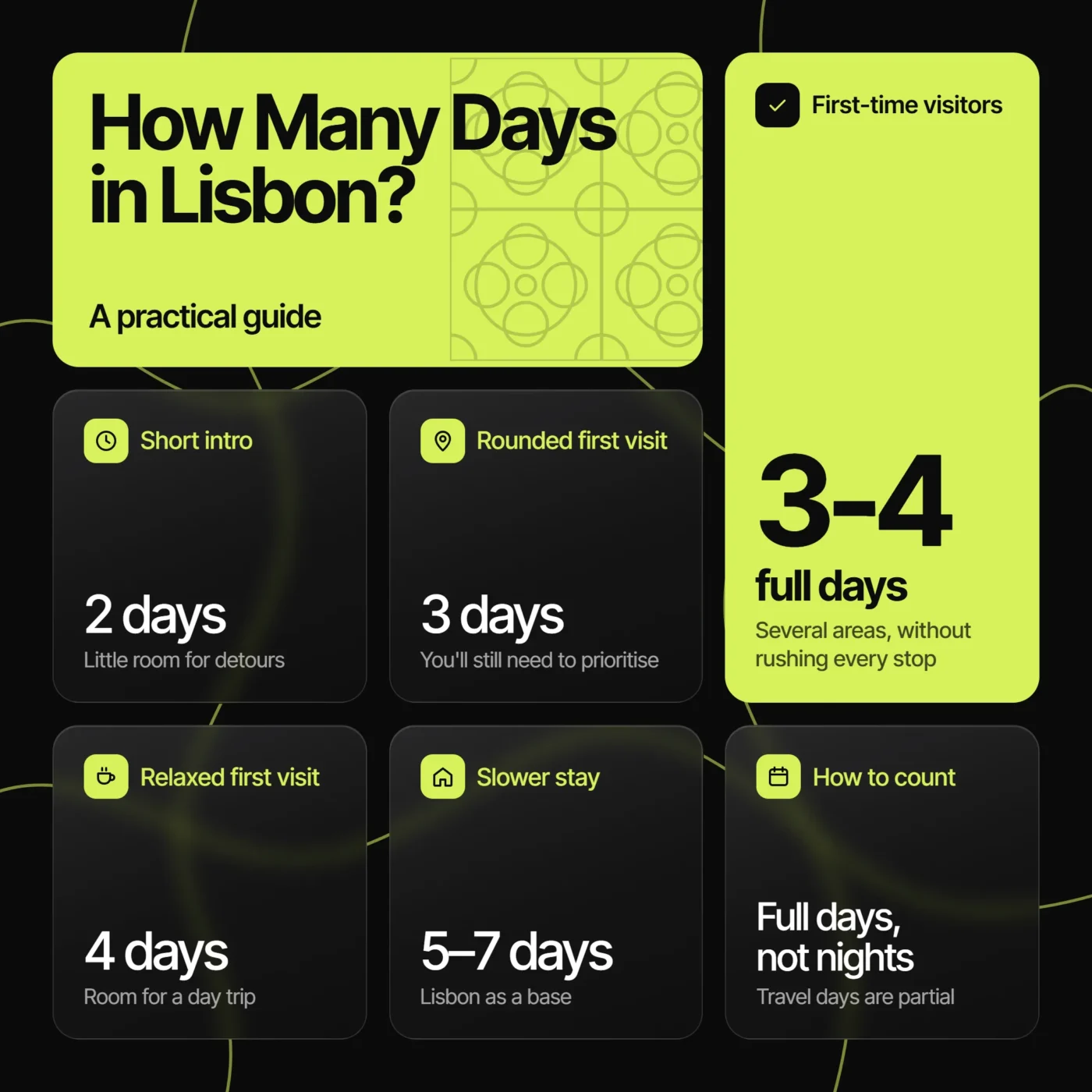
For most first-time visitors, three to four full days in Lisbon is a sensible starting point. Three days give you room to explore several distinct parts of the city without treating every stop as a race. A fourth day makes the visit more flexible: you can spend longer on what interests you, take more breaks, or leave time for an additional area.
Two full days can still be worthwhile if Lisbon is one stop on a wider trip. Five to seven days make sense if you prefer a slower pace, have several particular interests, or want to use Lisbon as a base for a trip to Sintra or Cascais. The key is to count the days you can actually spend exploring—not just the nights on your booking.
|
Full days available |
What that usually means |
Main trade-off |
|---|---|---|
|
2 |
A short introduction to a few areas |
Little room for detours or a substantial day trip |
|
3 |
A rounded first visit with some choice |
You will still need to prioritise |
|
4 |
A more relaxed first visit |
More time than you may need if you want only a quick overview |
|
5–7 |
A slower stay, deeper interests, and possible trips beyond Lisbon |
Some days may be better spent elsewhere if your interests are narrow |
These are planning ranges, not targets to fill. A satisfying visit depends as much on how you spend your time as on the number of days.
Is two days in Lisbon enough?
Yes—if you want an introduction and accept that you will leave things out. Two full days can give you a feel for Lisbon’s different areas, time to walk and stop, and a small number of places chosen around your interests. They are less suitable for someone who hopes to cover the city thoroughly.
The easiest way to make a short visit enjoyable is to choose a limited scope. You might spend time around Baixa and Chiado, then explore streets and viewpoints in Alfama or Graça. Belém offers another direction if its cultural sites appeal to you. These are examples of choices, not a list to complete in two days.
The trade-off becomes sharper when you add museums, long meals, or a trip outside the city. Each takes time that cannot also be spent wandering another neighbourhood. If Sintra is a priority, for example, two days in the Lisbon area would leave only a limited amount of time for Lisbon itself.
Two days may be the right decision when your wider Portugal trip has several stops or when you can return later. Plan around what you most want to experience, and leave gaps in the day. Even a short visit benefits from time that is not assigned to a sight.
Is three days enough for a first visit?
For many travellers, yes. Three full days usually allow a more rounded introduction than a weekend squeezed around flights. You can explore a few areas with different characters, include selected cultural stops, and still have time to pause between them.
That does not mean fitting every well-known place into three days. Lisbon’s historic areas are rewarding partly because you can move through them without a fixed sequence. Alfama’s steep streets, for example, can take more energy and time than a map suggests. A plan that looks light on paper may feel quite full once walking, transport, meals, and breaks are included.
With three days, it helps to set a priority for each broad part of the visit rather than build an hour-by-hour schedule. If your main interest is the city itself, keep all three days for Lisbon. If a trip to Sintra or Cascais matters more, you can use one of those days outside the city—but then you are planning two Lisbon days plus one day trip, with the same compromises as a shorter city visit.
Three days work particularly well for travellers who enjoy an active pace and are comfortable making choices. If you prefer to explore slowly, or if several museums and neighbourhoods are important to you, consider a fourth day.
Why four days may be the better choice
A fourth full day gives your first visit breathing room. It lets you spend longer in an area you like, add a museum or another interest, and adjust the plan if you need a quieter afternoon. You do not have to decide in advance that every day will be busy.
It also reduces the pressure to combine places simply because they appear close together on a map. You can give central areas, hillier historic streets, and somewhere such as Belém more appropriate time without treating travel between them as an inconvenience to overcome.
Four days are especially useful if you value unplanned time. Stopping for a long lunch, returning to an area in the evening, or choosing a single exhibition need not displace the rest of the trip. The extra day creates room for those decisions.
A day trip is possible within four full days, but it changes the balance. One day away leaves three days in Lisbon—a reasonable first visit for many people. If your aim is specifically four days exploring Lisbon, add the day trip on top rather than counting it as a city day.
When do five to seven days make sense?
A longer stay is useful when you want depth, flexibility, or both. Five to seven days let you spread your interests across the week instead of stacking them into a few long days. You might spend more time on museums, food, nightlife, or areas beyond your initial choices. You can also leave space for days that are deliberately light.
This length is a good fit if Lisbon is your main base rather than one stop among several. It gives you a practical way to include Sintra or Cascais while preserving several full days for the city. You could choose one trip beyond Lisbon, both on separate days, or neither. There is no reason to add an excursion solely because you have room for one.
A week is not automatically better than four days. If your interest is a concise first look at Lisbon, extra time may be more valuable elsewhere in Portugal. If you enjoy returning to a neighbourhood, following a particular subject, or changing plans as you go, the longer stay can be rewarding without needing a longer checklist.
Should a day trip count as a Lisbon day?
Count a day trip as part of your total trip, but not as a full day in Lisbon. That distinction prevents a common planning mistake.
Sintra and Cascais are two possible trips from a Lisbon base. Sintra has enough to occupy a substantial visit, while Cascais offers a different coastal setting. Both involve travel and decisions about what to do once you arrive. They are better treated as outings in their own right than as small additions to an already full Lisbon day.
For example, four full days in the area with one day trip means three full days in Lisbon. If you want four city days and one day in Sintra, plan for five full days. The same calculation applies to Cascais or any other excursion.
Think about why you want to go before assigning the day. If Lisbon is your main reason for travelling and time is limited, stay in the city. If Sintra or the coast is a high priority, give it proper space and accept the shorter Lisbon visit. Check current transport and any places you intend to enter when making your detailed plan; this article does not depend on a particular service or opening time.
How should you count arrival and departure days?
Start with the time between those two travel days. If you arrive on Monday afternoon and leave on Friday morning, Tuesday, Wednesday, and Thursday are your three full days. Monday may allow a walk or dinner, but it is not equivalent to an uninterrupted sightseeing day. Friday should not carry an essential plan if you need to leave for a flight or train.
An early arrival or late departure can add useful time, but treat it as a bonus until you know your actual travel arrangements. Getting to your accommodation, handling luggage, and recovering from the journey all use part of the day. Similarly, a departure day can feel shorter than it appears once you allow enough time to leave the city.
For planning purposes, make two counts:
- Full days: Days when you wake up in Lisbon and have no arrival or departure journey.
- Partial days: The usable portions of your arrival and departure days.
Build your essential choices around the full days. Give partial days flexible plans that you would be comfortable shortening or dropping. This is particularly helpful on a two- or three-night stay, when counting calendar dates can make the trip appear longer than it really is.
What might change the answer?
The same number of days can feel generous to one traveller and rushed to another. Before booking, consider what each day will require of you.
Your preferred pace. If you like long walks with few fixed stops, three days can cover a satisfying first visit. If you prefer leisurely meals, breaks, and time to return to places, four or more may suit you better. More days should give you freedom, not an obligation to add activities.
Hills and walking. Some historic areas have steep streets and uneven surfaces. Allow more time if hills are tiring, if you want frequent rests, or if your plans depend on routes you have not yet checked. Staying longer can reduce daily pressure, but it does not by itself resolve an accessibility barrier. Check the specific routes, transport, entrances, and facilities you expect to use.
Season and the hours you want to be out. Daylight, conditions outdoors, and how comfortable you feel walking can affect the shape of a day. Your tolerance for busy places also matters. Rather than assuming every day will support the same amount of activity, keep some flexibility—especially if much of your plan depends on being outside.
Your interests. A traveller drawn mainly to streets, viewpoints, and a few cultural stops may be content with three days. Someone planning several museums, food experiences, or late evenings may prefer four or more. It is useful to decide which interests deserve a substantial block of time and which are optional.
Your travelling group. Children, different energy levels, or accessibility needs can change how quickly a group moves. Add room for breaks and changes of plan. Avoid using another traveller’s busy schedule as the measure of what your group should accomplish.
The practical recommendation
Choose two full days for a worthwhile but selective introduction. Choose three full days if you want a rounded first visit and are happy to prioritise. Choose four full days if you would rather explore with more flexibility or include a day trip while keeping three days for Lisbon.
Choose five to seven full days when you want a slower base, several deeper interests, or one or more outings beyond the city. Before settling on a number, separate full days from travel days and decide whether “days in Lisbon” means time in the city or time in the wider area. That calculation will tell you more than a universal minimum ever could.
Editorial notes
- Core recommendation: Three to four full days is the editorial starting point for most first-time visitors. The article explains where two days or five to seven days may be a better fit; it does not present the range as an official rule.
- Potentially changeable claims: Transport arrangements, attraction access, and practical accessibility details can change. The article avoids specific services, fares, opening hours, and promises about accessible routes.
- Check immediately before publication: Confirm the title and slug do not duplicate an existing post; verify any internal link target before adding its URL; review any image’s rights, credit, alt text, and AI provenance if an image is selected. If the editor adds named attractions or transport instructions, check those details against current official sources.
- Possible future Quppy contextual block: A restrained block could sit near a future practical planning or trip-cost section, but only after an approved product use case and its current evidence are available. No product copy is included here.
- Possible related articles: Where to Stay in Lisbon; Getting Around Lisbon; Lisbon Airport to the City Centre; Lisbon Daily Budget; Paying in Lisbon; a dedicated Sintra or Cascais day-trip guide; and separate two-, three-, or four-day itineraries.
- Excluded because the evidence would need more specific verification: Exact journey times, fares, route numbers, attraction opening hours or closures, seasonal crowd predictions, and accessibility assurances for particular streets or sites.