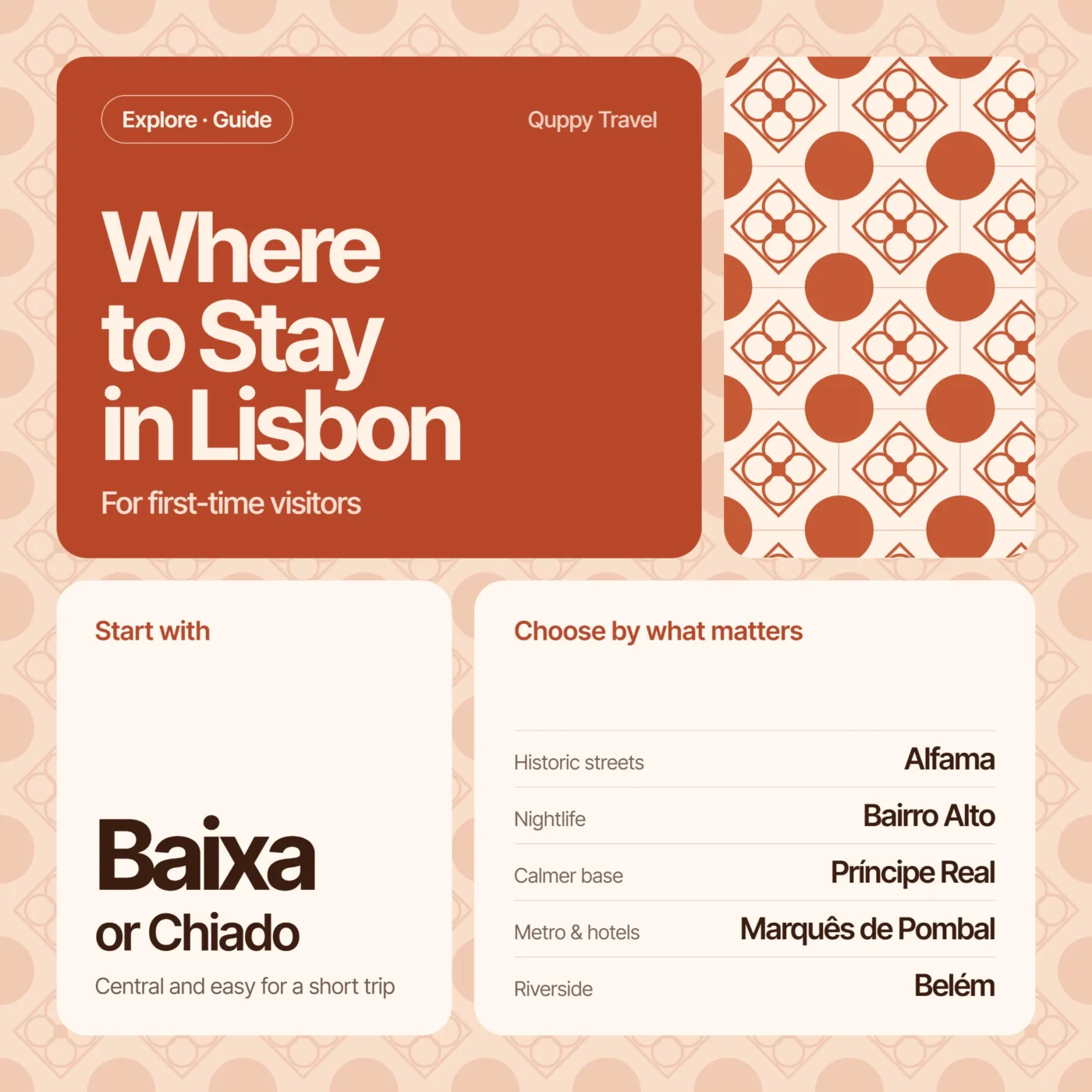
For a first visit to Lisbon, Baixa or Chiado is usually the simplest place to start your search. Both put you close to central sights, restaurants and transport, which is especially useful on a short trip. Baixa is the more straightforward choice if you want to minimise hills around your accommodation; Chiado suits travellers who want a livelier setting and do not mind some slopes.
Neither is the best choice for everyone. Alfama offers historic character but asks more of you when walking with luggage. Bairro Alto puts nightlife close to your door, along with a greater risk of noise. Príncipe Real, Avenida da Liberdade and Belém each offer a different balance of space, atmosphere and access to the rest of the city.
Choose the location of the actual accommodation, not just the name of its neighbourhood. A short distance on a map can involve a steep climb or steps, while two properties described as being in the same area can feel very different at night.
|
Area |
Good fit if you want… |
Main trade-off |
|---|---|---|
|
Baixa |
A central, practical base for a short first trip |
Busy, visitor-focused streets |
|
Chiado |
Restaurants, culture and a lively central setting |
Hills and activity around some streets |
|
Alfama |
Historic streets and a strong sense of place |
Steep routes, steps and less straightforward luggage access |
|
Bairro Alto |
Bars and late evenings close by |
Potential street noise |
|
Príncipe Real |
Restaurants and a somewhat calmer base near the centre |
Hills and more walking or transport to some sights |
|
Avenida da Liberdade / Marquês de Pombal |
Hotel choice and useful metro access |
A less intimate historic-neighbourhood feel |
|
Belém |
Riverside space and time around its cultural sites |
More travel to central Lisbon, especially for evenings out |
The table describes the general character of each area. Noise, room quality, accessibility and value still depend on the individual property and street.
Baixa: the easiest starting point for a short visit
Baixa is a practical choice when you have limited time and want to get your bearings quickly. It sits in Lisbon’s historic centre, with major squares, shops and places to eat nearby. Several central transport connections are within reach, making it a convenient base for exploring other parts of the city.
For a first visit of two or three full days, that convenience can matter more than finding the most distinctive street to sleep on. You can go out for a walk without first planning a journey across town, and it is relatively easy to return to your accommodation between activities.
The compromise is that Baixa is a popular visitor area. Expect an active central setting rather than the feeling of staying in a quiet residential pocket. Also, “Baixa” on a listing is not a promise that every route will be level: check the precise address and your likely walk from the nearest station or drop-off point.
Choose Baixa if: you want a simple, central base and plan to spend most days exploring different parts of Lisbon.
Chiado: central, lively and good for evenings out
Chiado works well for travellers who want to stay in the middle of the city while keeping restaurants, cafés, shops and cultural places close at hand. It is a natural choice if you expect to go out in the evening but do not specifically want to stay in a nightlife district.
Its position makes it easy to combine central walks with trips elsewhere. The neighbourhood feels different from Baixa: it has a busier social and shopping rhythm, and its streets sit higher up. That change in level is worth remembering if you expect to walk back after a long day.
Chiado can be an excellent first-time base, particularly for a couple or friends who want plenty of choices near their accommodation. The trade-off is the same quality that makes it appealing: some streets are active, and a central address may come with more passing activity than you want at bedtime.
Choose Chiado if: you want a central stay with restaurants and culture nearby, and hills are not a major concern.
Alfama: historic atmosphere with practical compromises
Alfama is the area to consider if the setting around your accommodation is a major part of the trip. Its older streets, small lanes and viewpoints offer a very different experience from Lisbon’s more regular central streets. Staying here can make it easy to begin or end the day with a walk through the historic neighbourhood.
That character comes with practical costs. Alfama has steep inclines, cobbled surfaces and steps. A property can look close to a station or road on a map but still require a demanding final walk. The exact route matters more here than a general claim that the accommodation is “central”.
If you have heavy luggage, use a stroller, or need a step-free route, investigate the property before booking. Ask where a vehicle can stop, whether you must climb stairs to reach the entrance, and whether there is a lift inside the building if you need one. Do not assume that transport to the edge of the neighbourhood solves the final stretch.
Alfama is rewarding for travellers who actively want its historic surroundings and are comfortable with the terrain. If effortless movement is your priority, visit Alfama during the day and stay somewhere easier for your needs.
Choose Alfama if: historic atmosphere matters more to you than simple door-to-door access.
Bairro Alto: close to Lisbon’s nightlife
Bairro Alto is a strong match for travellers who want bars and a lively evening scene nearby. It is an established nightlife area, so you can go out without making a long trip back to your accommodation afterwards.
That convenience has an obvious trade-off: a room on or near an active street may be noisy. The difference between a peaceful stay and a disrupted one may depend on the exact building, the direction the room faces and the time you expect to sleep. A listing that says “Bairro Alto” does not tell you enough on its own.
The area also involves hills. Consider the walk to your door as well as the evening atmosphere, particularly if you are arriving with luggage.
Bairro Alto is a deliberate choice for people who value nightlife. Travellers who only want to visit its restaurants or bars once or twice can stay elsewhere and come here in the evening.
Choose Bairro Alto if: being close to nightlife is worth the possibility of late street activity.
Príncipe Real: a more relaxed base near the action
Príncipe Real offers restaurants, shops, gardens and attractive streets within reach of central Lisbon. It can suit travellers who want an interesting area around their accommodation without staying in the busiest visitor streets or in the middle of Bairro Alto’s nightlife.
Think of it as a base for a slightly less hurried stay. You can spend time locally, then walk or take transport to other parts of the city. For some travellers, that balance is preferable to being beside the most familiar first-visit sights.
“Calmer” is relative, however. Príncipe Real has popular places to eat and drink, and one street may feel quite different from the next. It is also on higher ground, so a route that appears short may include a climb. Check the location of any property against the places you expect to visit most often.
Choose Príncipe Real if: you want restaurants and neighbourhood character near the centre, with less emphasis on being beside the main sights.
Avenida da Liberdade and Marquês de Pombal: transport and hotel convenience
Avenida da Liberdade and the area around Marquês de Pombal offer a different kind of first-time base. Rather than choosing narrow historic lanes, you are choosing a major avenue and a district with hotels and useful metro connections. This can appeal if predictable access and accommodation facilities matter more than a traditional neighbourhood atmosphere.
Marquês de Pombal is a metro interchange, which makes the area worth considering when you plan to use public transport regularly. Staying near a suitable station can also simplify a trip with several outings across the city. Check the exact walking route from the station to your property; an address “near the metro” may still be less convenient than it sounds.
This is also an area to investigate if you would prefer a larger hotel with particular facilities. That does not mean every building is modern, quiet or accessible. Confirm the features you need with the property itself, including a lift, entrance steps and room layout.
The main compromise is atmosphere. You may be happy to trade a small historic street outside your door for easier movement and a wider choice of accommodation styles. If your ideal evening is to step straight into Alfama or Chiado, you may prefer to stay closer to those areas instead.
Choose Avenida da Liberdade or Marquês de Pombal if: transport links and accommodation practicality lead your decision.
Belém: riverside space away from the central evening scene
Belém is a sensible base when its riverside setting and cultural sites are central to your plans. There is space to walk around its monuments, gardens and waterfront, and the area offers a different pace from central Lisbon’s denser streets.
The trade-off is location. If most of your days and evenings will be spent around Baixa, Chiado or Bairro Alto, staying in Belém means making that journey repeatedly. What seems like an appealingly quiet base can become inconvenient if you want to return to your room before dinner and then head back into the centre.
For many first-time visitors on a short trip, Belém works better as an area to visit than as the default place to stay. It becomes a stronger accommodation choice when you particularly want to spend time there, prefer its setting, or do not mind using transport for central activities.
Choose Belém if: the riverside and local cultural sites matter more to you than quick access to central evenings.
Which area fits your trip?
For a short first visit, start with Baixa and Chiado. They reduce the amount of location planning you need to do and make it easier to divide your time between different parts of the city. Choose Baixa for a more straightforward central base; choose Chiado if its restaurants and lively streets appeal more.
For historic atmosphere, look at Alfama—but check the exact approach to the property before paying. Visiting the neighbourhood and staying in it are different decisions. If the terrain would make every return to your room difficult, another base may make the whole trip more comfortable.
For restaurants and nightlife, Chiado and Bairro Alto meet different needs. Chiado offers a lively central setting with varied evening options. Bairro Alto puts you closer to late-night activity, with a greater need to check potential noise. Príncipe Real is another option if you want restaurants nearby without making nightlife the focus of your stay.
For families or travellers who prefer quieter evenings, consider a suitable street in Príncipe Real, around Avenida da Liberdade or Marquês de Pombal, or in Belém if the location fits your plans. No neighbourhood guarantees a quiet room. Read recent property reviews for comments about nighttime noise and check whether the room faces the street.
For frequent public-transport use, Baixa and the Marquês de Pombal area are useful places to begin comparing properties. What matters most is the route from your specific door to a station that serves your plans. A well-positioned room a little farther from a famous sight may save effort over several days.
Check the route before you book
Lisbon’s terrain can change the meaning of “five minutes away”. A short line on a map may cross a steep street or steps, and a convenient station may have an exit on the wrong side of a climb for your accommodation. Check the walking route, not only the distance.
Before you commit to a property, confirm:
- The exact address and final approach. Look at the route from the station or the place where a car can drop you off, especially in Alfama and other hillier streets.
- Steps and lifts. Ask about the entrance, reception, room and any internal stairs. A lift inside the building may not eliminate steps outside it.
- The room’s position. If sleep matters more than nightlife, ask whether the room faces a busy street and read recent reviews about noise.
- Your actual transport needs. Use the current network map to check the station and connections relevant to your plans. If you need step-free travel, check station accessibility and lift status close to your travel date.
- The total value of the booking. Compare real properties that meet your requirements, rather than assuming one whole neighbourhood is always cheaper or more expensive.
Heavy luggage, a stroller or limited mobility make these checks especially important. Do not rely on a neighbourhood label or an accessibility icon alone: the complete journey includes the pavement, the property entrance and the room.
The best place to stay in Lisbon is the one that removes your biggest difficulty
For most first-time visitors, Baixa is the simplest default, with Chiado a strong alternative if you prefer a livelier base. Pick Alfama for historic character when you are comfortable with its terrain, Bairro Alto for nightlife, or Príncipe Real for restaurants and a somewhat less hectic setting. Choose Avenida da Liberdade or Marquês de Pombal when transport and hotel practicality matter most; choose Belém when its riverside location is a reason for the trip.
Once you have narrowed the choice to two areas, compare actual properties and their routes. The best neighbourhood on paper is less useful than a room you can reach comfortably and return to happily each evening.
Sources used
Accessed 22 October 2026. The area recommendations and trade-offs are Quppy Travel Team’s editorial judgement based on these sources; the sources do not declare one neighbourhood “best” for every traveller.
- Baixa — Visit Lisboa — checked the area’s central location and visitor-focused character.
- Chiado — Visit Lisboa — checked its shops, cafés and cultural setting.
- Alfama — Visit Lisboa — checked its historic character, cobbled streets and steep inclines.
- Bairro Alto — Visit Lisboa — checked its established nightlife character.
- Príncipe Real — Visit Lisboa — checked its restaurants, shops, gardens and location.
- Belém — Visit Lisboa — checked its cultural sites and riverside setting.
- Avenida da Liberdade — Visit Lisboa — checked the avenue’s hotel, restaurant and shopping context.
- Diagrams and maps — Metropolitano de Lisboa — checked the network and the availability of an accessibility diagram.
- Using the Metro — Metropolitano de Lisboa — checked the operator’s advice to verify step-free stations and lift operation before travel.