Three full days give you time to see several sides of Lisbon without turning the visit into a race. This route keeps each day in one broad area: Baixa and Chiado on day one, the hills around Alfama on day two, and Belém on day three. You will still make choices. The aim is to enjoy the city you are in, not complete a list of every famous stop.
The itinerary assumes three days when you wake up in Lisbon and have no arrival or departure journey. Morning, lunchtime, afternoon and evening are guides rather than appointments. Allow extra time for meals, transport and places where you decide to stay longer.
Most of the route is outdoors and can be enjoyed without buying an attraction ticket. Where an interior visit is suggested, it is optional. Choose one substantial paid visit at a time rather than planning several and hoping every queue will be short.
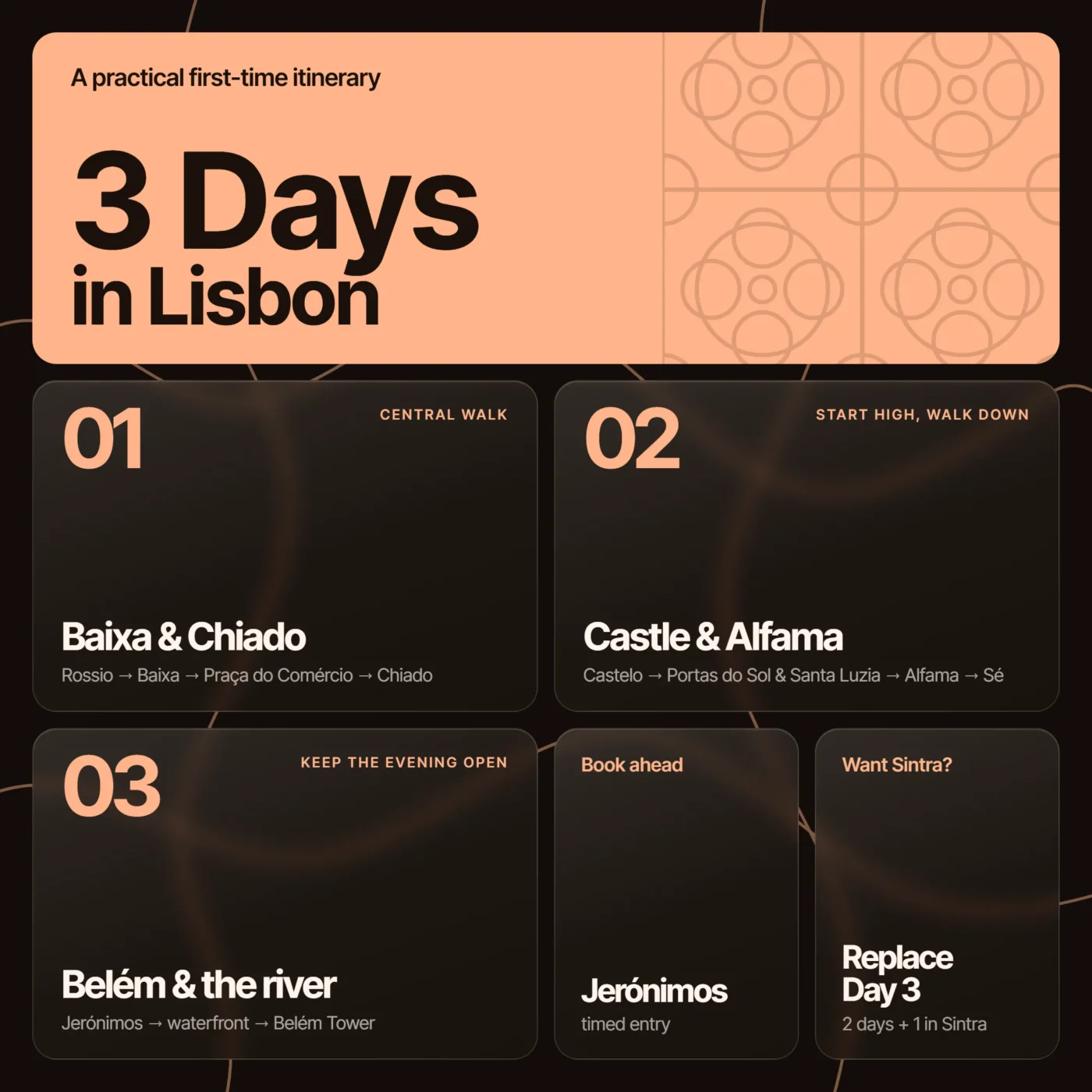
3-day Lisbon itinerary at a glance
|
Day |
Main area and order |
Keep flexible |
|---|---|---|
|
1 |
Rossio → Baixa → Praça do Comércio → Chiado |
A visit to the Carmo ruins or more time around Chiado |
|
2 |
Castelo de São Jorge area → Portas do Sol and Santa Luzia → Alfama → Sé area |
Entering the castle; the length of the walk downhill |
|
3 |
Belém → Jerónimos Monastery area → riverside → Belém Tower area |
Entering the monastery; how far you walk along the waterfront |
You do not need to follow every arrow precisely. Day one is mainly a central walk. On day two, getting to the higher ground first can spare you a long uphill start; you can then explore downhill. Day three needs a journey to and from Belém, so keep its evening open.
Day 1: Baixa, Praça do Comércio and Chiado
Morning: begin around Rossio and walk through Baixa
Start near Rossio, where you can get oriented before heading through Baixa towards the river. Give this first stretch roughly 90 minutes to two hours, including stops. The route is more useful as an introduction to the shape of the centre than as a sequence of buildings you must enter.
Walk south through the central streets towards Praça do Comércio. You will pass shops, cafés and busy public spaces; stop where something interests you. Praça do Comércio gives you a clear sense of the river and makes a natural end to the morning walk. Spend a little time around the square and waterfront rather than immediately turning back.
There is no need to add a paid viewpoint or museum just because it is nearby. If you have arrived in Lisbon only recently, a simple walk and an unhurried lunch will probably make the first day more enjoyable.
Lunchtime and afternoon: move up to Chiado
Choose somewhere to eat in Baixa or Chiado, allowing about an hour. Afterwards, head up towards Chiado. The change in elevation is noticeable: take the route at your own pace, or use transport if the climb is not appealing. A short distance on the map can still feel demanding after a morning on foot.
Spend two to three hours around Chiado’s streets, shops and cultural surroundings. You can leave that time entirely open. If you want one defined interior stop, the Carmo Archaeological Museum and ruins are an option nearby. Check its official visiting information, ticket price and opening day before making it part of your plan. If a visit would squeeze out the relaxed afternoon you wanted, see the surrounding area and move on.
Keep the evening in or near Chiado for dinner, or return to your accommodation for a break first. Bairro Alto is close enough to consider if you want a livelier evening, but there is no need to make nightlife part of the itinerary. Day two has more demanding walking.
Easy cut if you are tired: Skip the Carmo interior and shorten the shopping or café time. Keep the Baixa-to-river walk and a manageable portion of Chiado.
Day 2: the castle hill, viewpoints and Alfama
Alfama rewards a slower day. Its streets include steep inclines, steps and cobbled surfaces, so leave more time than the map might suggest. The simplest walking logic is to reach the higher part of the area first, then work gradually downhill. Check your route before setting out; the best starting point depends on your accommodation and mobility needs.
Morning: start high and decide whether to enter the castle
Make your way towards Castelo de São Jorge by a suitable public-transport or car-based route, then walk the final stretch. The castle’s official visitor information sets out ways to reach it. Check current services rather than building the day around a particular route number.
If the castle itself is a priority, allow about 90 minutes to two hours for the visit, plus any wait to enter. It is a paid attraction. Check the official site for the current ticket, visiting hours and access conditions before you go; some parts of a site can have different access from the main grounds. Online tickets are available through the operator’s authorised seller, but you do not need to make the castle compulsory to enjoy this day.
If you would rather spend the time in the neighbourhood, skip the interior. You can still begin on the higher ground and continue towards the nearby viewpoints. This is the day’s largest choice: doing both a long castle visit and an extensive walk through Alfama may be too much for travellers who prefer a gentle pace.
Late morning and lunchtime: pause at the viewpoints
Continue towards Portas do Sol and Santa Luzia. These viewpoints are close to the upper part of Alfama and give you a reason to stop before descending through its streets. Allow around 45 minutes to an hour, more if you want a substantial break.
Choose lunch in the wider Alfama area or wherever the next part of your walk takes you. Avoid fixing a restaurant so tightly that you must hurry through the streets to reach it. A meal and a rest are part of the day’s pace, particularly after the hills.
Afternoon: explore Alfama downhill
From the viewpoints, follow a route down through Alfama towards the Sé area. Give yourself roughly 90 minutes to two hours for this stretch, excluding lunch. The point is to notice the streets and choose your own pauses, not to collect every church or lookout along the way.
Some lanes lead to steps or steep sections. If you are travelling with a stroller, have limited mobility, or simply do not want a long descent, choose a shorter accessible segment and use transport for the rest. Do not assume that a route suitable for one person will work for everyone in your group.
Finish when you have had enough walking. You can continue towards the lower streets and river, or return to your accommodation. Keep the evening light: dinner near where you are staying is a perfectly good conclusion to a hillier day.
Easy cut if you are tired: Choose either the castle interior or the longer Alfama walk. Keep one viewpoint and a shorter descent.
Day 3: Belém and the waterfront
Belém deserves its own day rather than being squeezed between two central neighbourhoods. Travel there in the morning; the suburban rail line connects Cais do Sodré with Belém, but check the current journey before you leave. The right transport choice depends on where you are staying and on any accessibility requirements. Allow time for the trip and the walk from your stop.
Morning: choose your monastery visit
Begin around Jerónimos Monastery and Praça do Império. If you want to see the monastery’s cloister, make it your main interior visit of the day and allow around 90 minutes to two hours, including some margin for entry. Its official visitor rules use dated entry slots. If going inside matters to you, check availability and arrange a suitable ticket in advance through the official channel. Confirm the current opening day and price as well; the monastery does not follow the same schedule every day of the week.
If you do not want an interior visit, spend less time here and enjoy the area outside. The itinerary still works. Do not treat a long queue as an obligation to wait simply because the monastery appears in a guide.
Pause for lunch in Belém. Keep this part flexible: you have an afternoon of outdoor walking ahead, and there is no benefit in rushing a meal to fit another ticketed stop.
Afternoon: follow the river at your own pace
After lunch, head towards the waterfront and the Padrão dos Descobrimentos area, then continue west towards Belém Tower if you have the energy. Allow around two hours for the riverside portion, longer if you enjoy lingering or take several breaks.
This is a walk for context and views, not a requirement to enter every monument. The tower makes a useful point to aim for, but seeing its exterior is enough for this itinerary. If you decide to go inside, check the operator’s current entry conditions and timed-ticket availability first. Make that visit a deliberate substitution for part of the waterfront time rather than an extra item added to a full afternoon.
If you want a shorter day, turn back before the tower or use transport for part of the return. Belém’s open spaces can feel particularly pleasant at a slow pace; walking farther is not automatically the better choice.
Evening: leave the last decision open
Return to central Lisbon or your accommodation and decide on the final evening after a break. Revisit an area you enjoyed on the first two days, choose a dinner near where you are staying, or simply stop sightseeing. An open evening gives you room for a delayed return from Belém without making the day feel unsuccessful.
Easy cut if you are tired: Limit Belém to the monastery area and a shorter stretch of waterfront. Skip the walk to the tower.
How to adapt the route
If it rains: Swap the days around when possible rather than pushing through the longest outdoor walk in poor conditions. On day one, a suitable museum visit can replace some wandering in Chiado. On day three, the monastery interior can be the focus if admission is available. Check opening days before switching: a paid attraction may be closed on the day you move it to. Alfama’s uneven surfaces deserve extra care when wet.
If it is hot: Begin outdoor sections earlier, take a longer break around lunch and shorten exposed walks when needed. On the Alfama day, reaching the higher ground by transport and walking down may be more comfortable than climbing through the hottest part of the day. In Belém, you can reduce the waterfront distance without losing the character of the area.
If hills or steps are difficult: Treat the route as three area-based days, not a mandatory continuous walking path. Choose the sections you can comfortably manage and connect them by appropriate transport. Check the complete route from station or drop-off point to entrance; the final streets may be the hardest part. The metro operator advises travellers who need step-free access to check both station accessibility and the current operation of lifts. Confirm accessibility directly with any attraction you plan to enter.
If your group moves slowly: Keep only one substantial visit or long walk per half-day. Children, varied energy levels and meal breaks can change the pace more than the distance suggests. The optional stops are there to help you adjust, not to become a second checklist.
Practical choices before you set out
Book only what is important enough to shape your day. Jerónimos Monastery’s timed entry is the clearest decision to make ahead if you want to visit the cloister. For the castle, check its official ticket seller and current conditions if entering is a priority. Carmo remains optional; check its opening day and ticket information before going. Prices and access arrangements can change, so use each attraction’s official site rather than an old figure in an itinerary.
Check the day’s transport once you know where you are staying. A route that is simple from Baixa may be less convenient from another base. Keep a little margin for the journey to Belém and avoid relying on an exact connection time to make an entry slot.
Count three full days in Lisbon, not three calendar dates that include your arrival or departure. If one of these is a partial day, trim the relevant route. Day one is easiest to shorten; a late arrival is a poor fit for a pre-booked interior visit.
Finally, give yourself permission to stop. A long lunch, a viewpoint where you stay longer, or a change of plan because of weather is part of a realistic trip. The route succeeds if it helps you enjoy three distinct areas of Lisbon—not if you complete every optional stop.
What if you want a day in Sintra?
Sintra is a substantial outing with its own travel and sightseeing decisions. Adding it to the end of one of these days would make both places feel rushed. With only three full days available, the clearer choice is to replace one Lisbon day with a Sintra day.
Keep days one and two if this is your first visit and you want the central streets and Alfama. Replace Belém on day three with Sintra. You would then have two days in Lisbon plus one day in Sintra, not the three-day city itinerary described above. If Belém is more important to you, keep it and plan Sintra for a longer trip.
A realistic three-day first visit
This route gives you a central introduction, a slower day in historic Alfama, and a separate day around Belém. Walk where walking adds to the experience; use transport where it saves a difficult climb or connects distant areas. Choose your paid visits, leave room for meals and rests, and drop an optional stop when the day is already full.
Sources used
Accessed 22 October 2026. Approximate time allowances and the decision to group these places into three days are editorial planning estimates, not published attraction visit times.
- Lisboa Centro — Visit Lisboa — checked the geographical sequence from Rossio through Baixa to Praça do Comércio and the relationship with Chiado.
- Praça do Comércio — Visit Lisboa — checked the square’s riverfront location and suitability as a starting point.
- Carmo Archaeological Museum: visitor information — checked its Chiado location, paid admission and visiting-day information.
- Alfama — Visit Lisboa — checked the neighbourhood’s steep inclines, cobbled streets and viewpoints.
- Getting to Castelo de São Jorge and visiting hours — checked access to the higher ground, the castle’s visiting arrangements and the need to verify access before going.
- Castelo de São Jorge: tickets — checked that the operator offers online tickets through its authorised seller.
- Belém — Visit Lisboa — checked the grouping of Jerónimos Monastery, Padrão dos Descobrimentos, Belém Tower and the waterfront.
- Jerónimos Monastery and Belém Tower: official visitor rules — checked opening-day rules, timed tickets, entry restrictions and areas with mobility limitations.
- Lisbon–Cascais urban train timetable — CP — checked that Belém is on the line from Cais do Sodré; travellers should verify current service before departure.
- Using the Metro — Metropolitano de Lisboa — checked the operator’s advice to verify step-free access and lift operation.
- Discovering Sintra — Turismo de Portugal — checked that Sintra merits a dedicated outing rather than being treated as a brief add-on.