
I’m writing this from a fourth-floor window in Funchal, looking at an Atlantic that has nothing on the other side of it for about 950 kilometres. The next landmass west is Newfoundland. The next landmass south is Cape Verde. North-east, where the cargo plane I came in on came from, is Portugal proper — about 1,000 km of nothing, then Lisbon, then Europe.
Madeira is one of those places where the physical distance and the digital distance suddenly diverge.
The internet here is fine. Average download on the apartment Wi-Fi: 188 Mbps. The CoLab coworking on Rua dos Aranhas: 320 Mbps, peak 410. My phone — Vodafone Madeira on a roaming plan — pulls 80 Mbps in the centre of town and 12 in the laurissilva forest where I went hiking yesterday (which is, frankly, more bandwidth than the laurissilva should have to provide).

So the bandwidth is there. The latency is the surprise.
A speed test from Funchal to a Frankfurt server: 47 ms. To New York: 92 ms. To Lisbon (the obvious neighbour): 38 ms. These numbers are not bad. They are not GREAT either. For a city ON the Portuguese mainland I’d expect 5-10 ms to Lisbon and 20-30 to Frankfurt. So the cable hop adds about 25-30 ms across the board.
Twenty-five milliseconds doesn’t sound like much. It is much.
(For the audio call I had yesterday morning with Berlin, the lag was just enough to step on every other sentence. We adapted. We always adapt. But it took the first ten minutes to find a rhythm.)
The caveats
What I came here to find out is whether Madeira works as a long-stay base for someone who runs strategy calls four times a week.
The honest answer: yes, with caveats. The caveats are interesting.
The wind. When the nortada picks up, which is roughly two days a week, signal stability drops. Not the speed — the stability. Packet loss spikes. My VPN reconnects every ninety seconds. This is a physical-infrastructure-meets-Atlantic-weather problem and there is no software fix for it. Every nomad I’ve talked to here has confirmed it.
The hour. Madeira is on UTC, same as Lisbon during winter. In summer it goes to WEST (UTC+1), still aligned with Lisbon. So the timezone is convenient for European calls. American calls are workable but late. Asian calls are basically impossible without sleep debt.
The supplier monoculture. Two main ISPs: NOS and MEO. If one has an outage — and one had a four-hour outage last Tuesday — about half the island’s coworking traffic goes down. There is no third option. There is no backup terrestrial fibre to mainland because there is no terrestrial fibre to mainland. It’s all undersea cable.
The cable, by the way, is called CAM (Continente-Açores-Madeira). It went into service in 2010. It’s been cut twice — once by a fishing trawler, once by an earthquake. Both times Madeira lost the internet for the better part of a day.
That’s a sentence I find unreasonably interesting.
The case for a little friction
There’s a category of nomad — usually the Bali / Chiang Mai / Medellín trio of cities — for whom this would be a deal-breaker. I understand the position. If your work depends on always-on connectivity to a Slack channel that will eat you alive if you go silent for ninety minutes, Madeira is the wrong choice.
But there’s another category — the one I’m increasingly sympathetic to — for whom the occasional forced disconnection is, accidentally, a feature.
I’ve been on the island twelve days. I have lost connectivity three times — once for fifteen minutes, once for forty, once for nearly two hours. I closed the laptop. Walked outside. Came back to find nothing had been on fire. The Slack messages had self-resolved. The decisions I’d been agonising over had clarified themselves while my brain was off-the-grid. Once or twice I’d missed a meeting; rescheduling it was, if anything, a relief.
I’m not arguing that bad infrastructure is good. I’m arguing that infrastructure that occasionally fails in a clearly bounded way might be more humane than infrastructure that’s so reliable it removes the option of being unreachable.
That’s a Funchal-specific argument. I don’t think it generalises.
The costs
The cost ratio is not as good as Tbilisi but better than Lisbon, which is what I expected.
A reasonable one-bedroom in Funchal centre, two-month lease, furnished: €1,150/month. Coworking at CoLab: €180/month. Groceries: about €250/month if you cook, double that if you eat out. Bus pass: €40. Coffee — and Madeira coffee is unexpectedly good, the cafés are descended from 19th-century returning emigrants who imported the Brazilian habit — €1.20 a bica.
Total monthly burn rate at the lower end: ~€1,700. At the upper: ~€2,400.
For comparison: my Lisbon equivalent two years ago was running about €2,300 at the low end, €3,000 at the upper. Madeira is roughly 25% cheaper for similar quality of life, with the trade-off being that it is, again, an island in the middle of the Atlantic.
(The trade-off is: sometimes you cannot leave on short notice. The flights are expensive on short notice. The ferries are slow. If your life requires the option of being in Frankfurt by tomorrow, Madeira is not your base.)
CoLab — the coworking

The CoLab coworking deserves a paragraph.
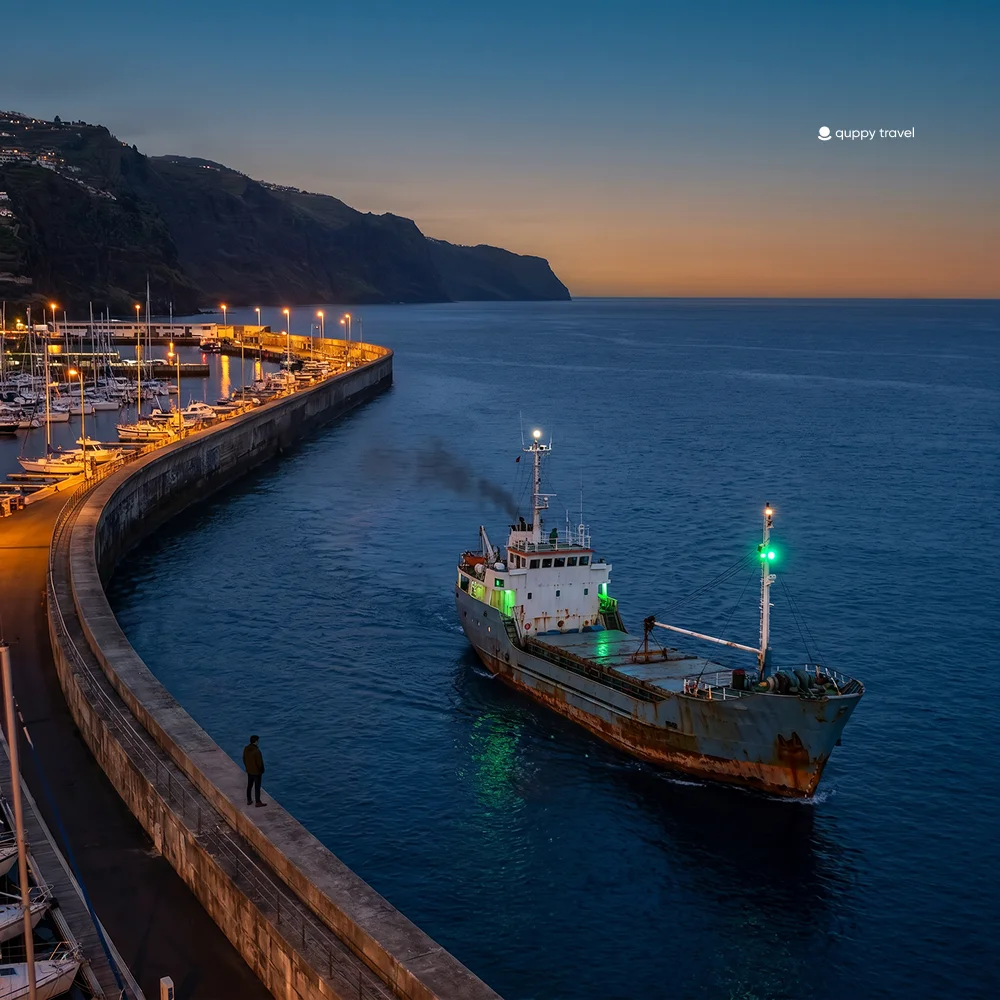
It’s in a converted commercial building on the second and third floors. Open plan, about forty desks, a quiet room for calls, a kitchen with proper espresso, and — the actual unique selling point — a terrace overlooking the bay where you can take a call standing up in the sun. The terrace Wi-Fi held a 45-minute screen-share with my product team yesterday — from a deck chair, looking at a cargo ship working its way around the breakwater.
The community is small but interesting. About thirty regulars when I visited, mostly European — Portuguese mainland, Dutch, German, a couple of Brits running e-commerce out of London but living here. Two Madeiran developers who’ve stayed instead of leaving for Lisbon (they were in the minority, by their own count).
The conversation tilts toward the meta of nomad life — gentrification, sustainability, whether the Madeiran government’s “Digital Nomads Madeira” programme has been a net good or a net problem for the island’s housing. (Short answer: it depends who you ask. The Lisbon arrivals say good. The Madeirans say it’s complicated.)
The money side
About the money side.
A client paid me in USDC last week — long-running fintech consulting, they prefer crypto-rails for compliance reasons that aren’t worth explaining here. The transfer landed in my Quppy account in about eleven minutes after the on-chain confirmation. From there I let the EUR balance sit for the day and converted at the close — EUR 4,200 cleared, the IBAN line item arrived overnight, and the morning after I paid the apartment landlord by SEPA from the same account.
The mechanic worth flagging: I never had to bridge through three apps. The crypto landed, the conversion happened, the IBAN withdrawal was a single SEPA send from the same balance. The whole flow was four taps and one overnight wait. That’s the boring measurement of good financial infrastructure. Boring is the goal.
What I’m taking back

What I’m taking back from the island, beyond the data points.
The conviction that not every nomad city has to be optimised for hyper-connectivity. The realisation that twenty-five milliseconds of cable latency, twice-a-week wind-induced packet loss, and the occasional cut undersea fibre can — under the right circumstances — be the correct amount of friction in a working life.
A book recommendation from a Madeiran developer I met at CoLab — Bernardo, who writes Go for a German fintech and rides his bike up the hills on weekends — that I’m halfway through. (It’s about the early Portuguese Atlantic crossings. It’s better than I expected. The man knew what he was doing.)
Two pairs of muddy boots. A small bottle of Madeira wine I’m not allowed to bring on the flight as carry-on but will declare in my checked luggage. The phone number of a marisqueira in Câmara de Lobos that Oscar would tell me to visit, that I will visit before I leave, that I will not write about because it’s his lane.
I’m not sure if Madeira is my next base. I’m sure it’s a place I’ll come back to. There’s a difference. I think I’m starting to learn it.
— A.