You wouldn’t think Aveiro had its own register. Most of the articles I had read called it the Venice of Portugal, which was the first thing the city itself disagreed with. By the second morning I had begun to see what the city meant — the water here is shallow, the light is Atlantic-cool not Adriatic-warm, and the canals do not perform. They simply work.
Aveiro is, properly, a lagoon town. The river Vouga slows down before it reaches the sea, fans out across a long shallow basin, and gives the geography about twelve kilometres of patient water before the first proper Atlantic wave. The town sits in the middle of this slowness. The slowness is the point.
Have you ever come to a place that does not perform itself for you?
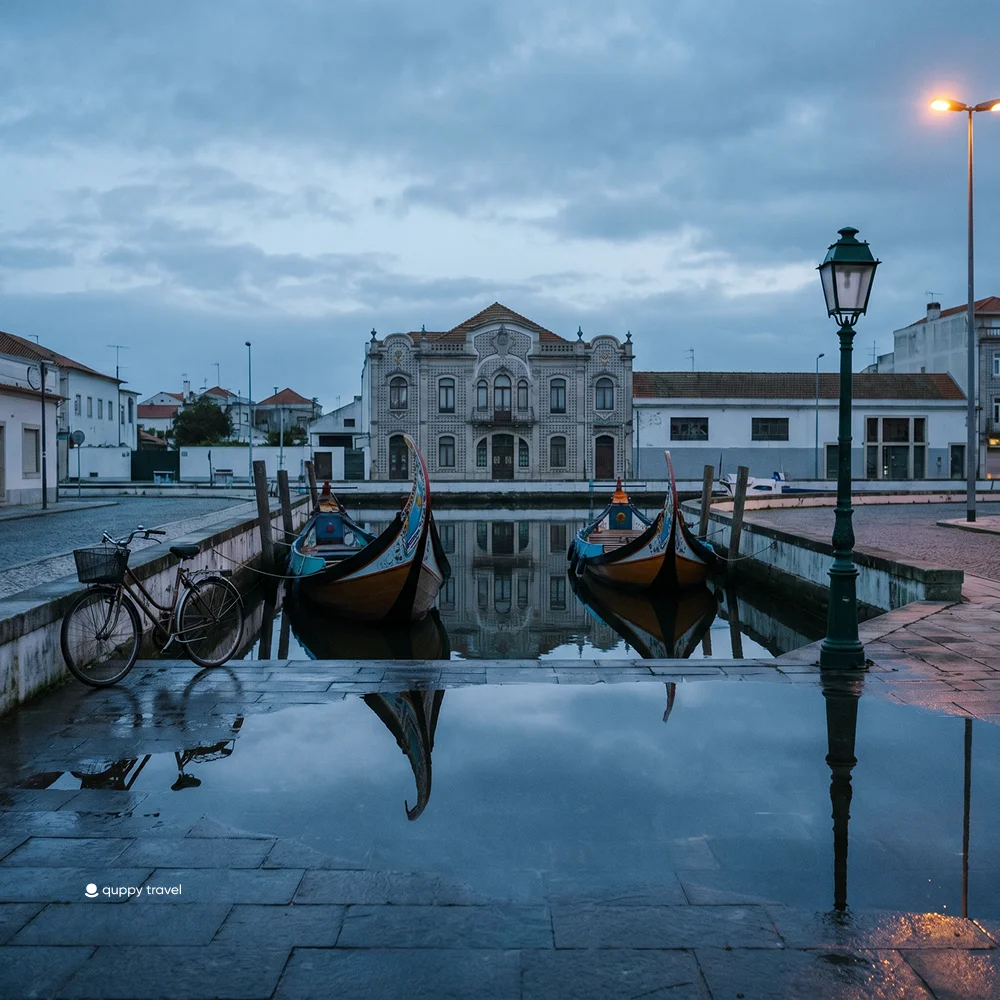
The canal at quarter to six is the version of Aveiro nobody photographs.
The boats — the moliceiros, the long flat-bottomed ones with the painted prows that the postcards make their entire argument about — are still moored. The wet pavement holds the sky in pieces. There is one café open, the kind with a single chrome espresso machine and a man behind the counter who has accepted that the first hour of his day is for fishermen and people who have not slept and one or two strangers who could not.
He pours me a bica without my asking — I am holding a paperback I have already finished, the borrowed one from the small shop in Coimbra last month, the one that has decided to stay with me a while longer — and he gestures at a pastel-tile wall behind me. Three azulejos high, painted blue-on-white, a scene of a woman bringing flowers to a doorway. He says one word, isto, and goes back to the counter.
The tile is from 1903. He told me the year, later, when he caught me looking at it for the second time. I had not asked.
Costa Nova, and the stripes
I walked to Costa Nova on the second afternoon.
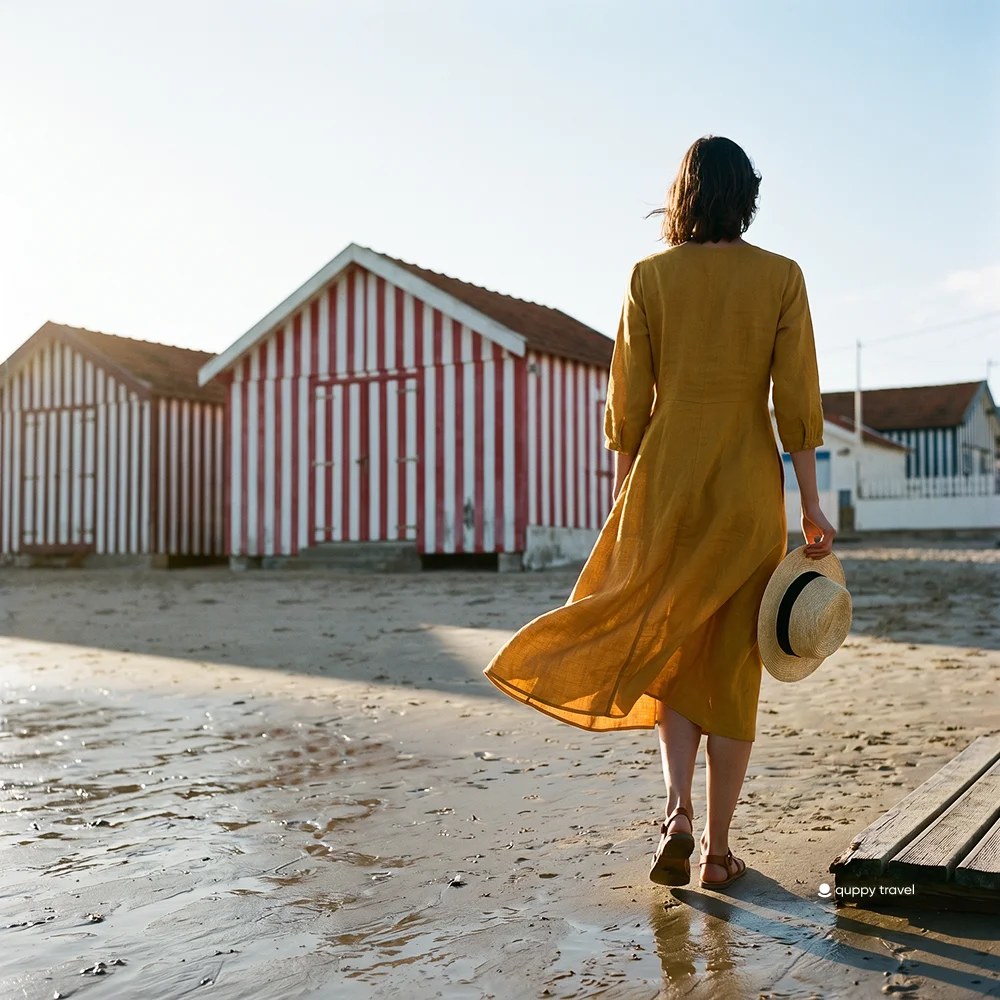
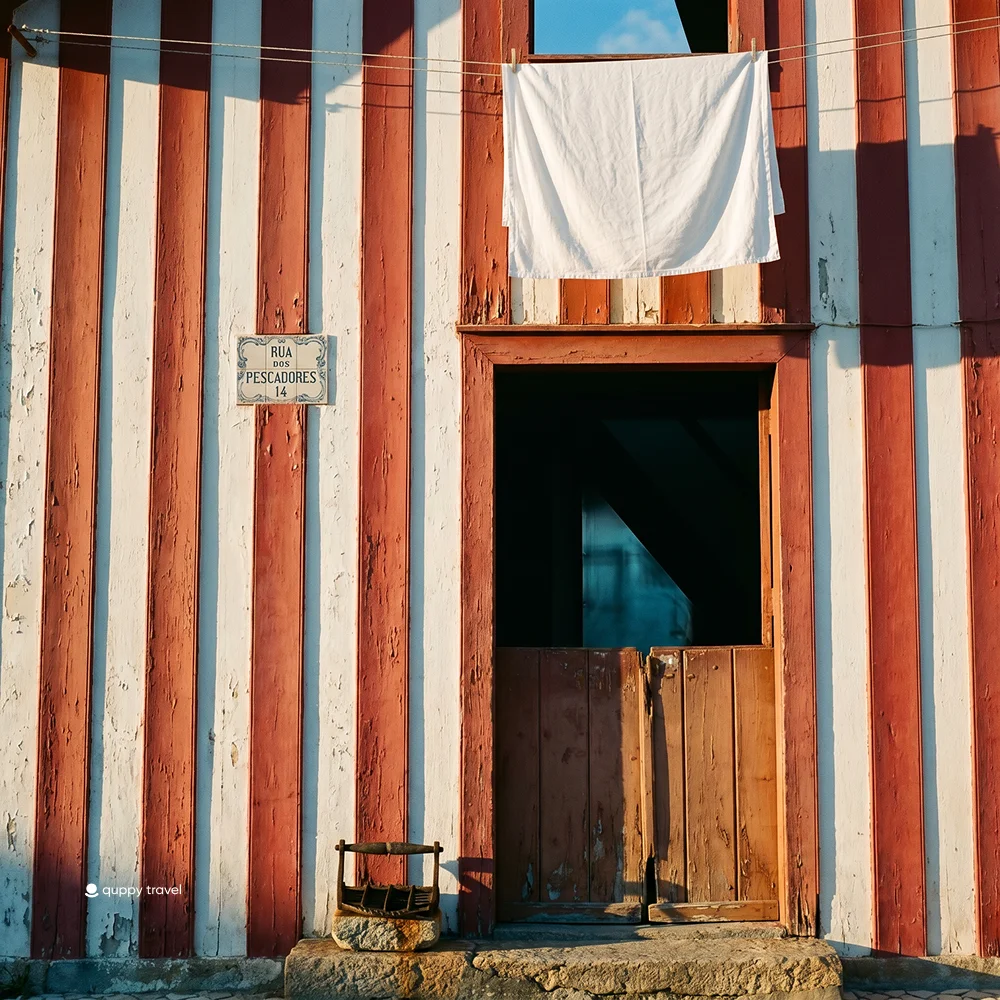
You take a small ferry across the lagoon — €1.40, paid in coins, a wooden seat on the upper deck — and you arrive on the long sand bar that separates the lagoon from the Atlantic. The houses on this side are striped. Vertical stripes, every house, in pairs of colours that have been the same colours since the 1830s when the fishermen painted them so they could be seen from the boats: red-white, blue-white, yellow-white, green-white. Each house chooses one pair and keeps it.
The stripes are the photograph everyone takes. The stripes are not the thing.
The thing is that the houses are still lived in. Not all of them — some have been bought by Lisbon money over the last decade, and you can tell which because the curtains are the wrong density of cotton — but most. There are washing lines between them. There are old men on the benches. There is a butcher who has been on the corner since 1971 and who closes for ninety minutes at lunch the way butchers used to do across most of Europe and now do almost nowhere.
I sat on the wooden boardwalk with my back to the stripes and watched the sea. The sea was grey-blue, deeply patient, the wave-rhythm slower than I remembered Atlantic rhythm being.
A man and his dog walked past. He nodded once. I nodded back. We had agreed on something.
A short list of things I did not do in Aveiro:
I did not ride a moliceiro. I did not photograph the canal between two ornate bridges, which is the photograph nine out of ten Instagram travel accounts make of this town. I did not eat the ovos moles — the small egg-yolk-and-sugar pastries shaped like seashells — which a kinder version of myself would have, but Oscar would have eaten more of them than I could have without complicating things, and Oscar will be writing about Aveiro in his own way next month. I did not buy a souvenir.
I did spend two hours one afternoon walking the salt pans.
The salt pans
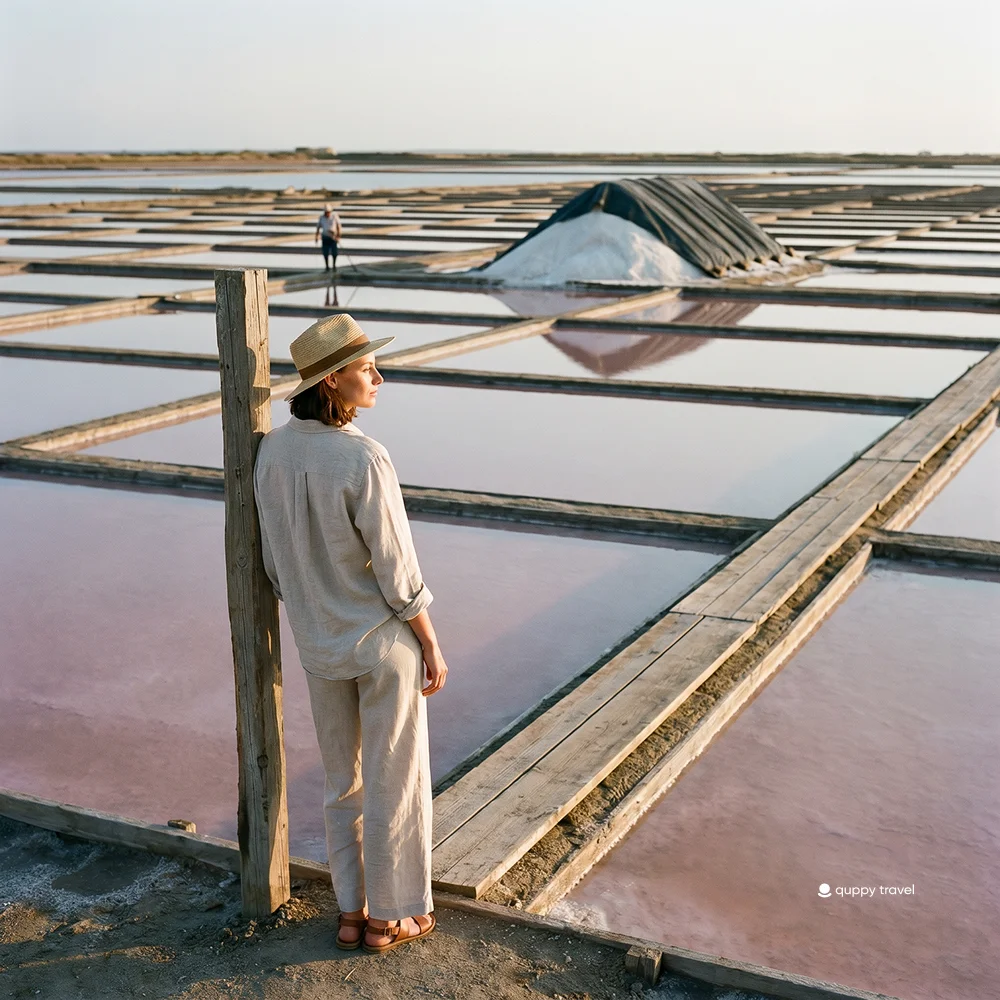
The salinas are about three kilometres west of the centre. The walk is unmarked. You take a small road past a soccer field, you pass a fence that says propriedade privada in a tone the property no longer enforces, and you arrive at a geometric grid of shallow water rectangles separated by narrow paths. The grid was laid down in approximately the year 1700. It has not changed shape since.
The water in each rectangle is a different colour. Some are pale grey. Some are pink — that’s the algae that begins to bloom as the salinity rises through evaporation. Some are nearly white where the salt has crystallised at the surface. At the centre of the grid, where the oldest pans are, there are small mountains of harvested salt, white-grey, covered with ridged tarps to keep the dew off.
A woman was working alone at the far end. Sixty, maybe sixty-five, wearing a long-brimmed hat and a faded blue apron over jeans, holding a wooden rake with a long handle. She moved slowly between two pans. The motion was the same motion she had been making since at least seven that morning, possibly earlier. I did not interrupt.
The sound of the salt grid is small. The sound is the sound of water arriving and leaving very slowly through wooden gates. I have been near louder silences. I have not been near a quieter geometry.
What Aveiro doesn’t teach
Have you noticed that some places teach you how to look at them?
Aveiro does not teach. Aveiro just keeps doing what it does and waits for you to lower the bar of what you came to find. By the third morning I had stopped reaching for my phone. By the fourth I had stopped composing the day in the back of my head. By the fifth I had begun, very slightly, to disagree with the shape of my own travel.
The shape of my own travel has been: arrive, observe, find the angle, write. Aveiro suggests a different shape. Arrive. Stay. Stop trying to find the angle. The angle is what you are doing now.
The last evening
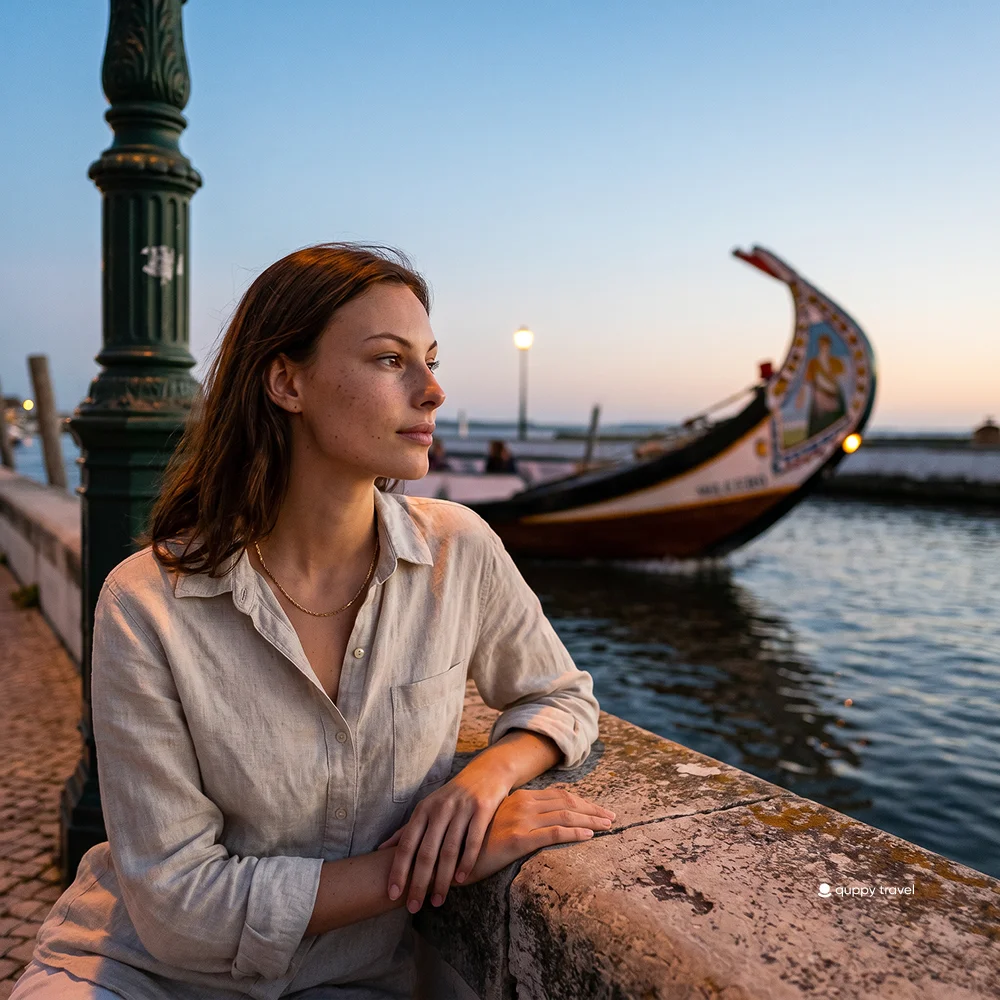
I came back to the canal on the last evening at the same hour I had been there for the dawn. The boats were returning. The same painted prows, the same wet pavement, the same chrome-machine café — except now the man behind the counter was a younger man, his son, who had taken over the last shift.
He poured me another bica and gestured at the same azulejo of the woman with the flowers. He said one word, bonita. Beautiful. He went back to the counter.
The borrowed book is still in my bag. I do not think I am going to return it before I leave Portugal. The bookseller, in Coimbra, knows. The arrangement was always going to fail in this direction.
There is, I am beginning to understand, a kind of slow-water travel that the loud cities cannot teach. Aveiro does not concentrate itself into a single postcard. Aveiro spreads.
The lagoon has its own hour. The salt grid has its own century. The striped sand-bar town is still, for now, mostly its own.
I will write again from somewhere I have not yet been told the name of.
— M.