I came to Cantabria to look at a room I would not be allowed to enter. It seemed a strange thing to build a week around, and I built the week around it anyway. The rain up here has its own name — calabobos, the one that soaks fools — and it does not so much fall as hang in the air until your sleeves are wet without your having noticed. It rained on five of my seven days, and somewhere around the fourth I gave up on the hood.
The village that lies three times
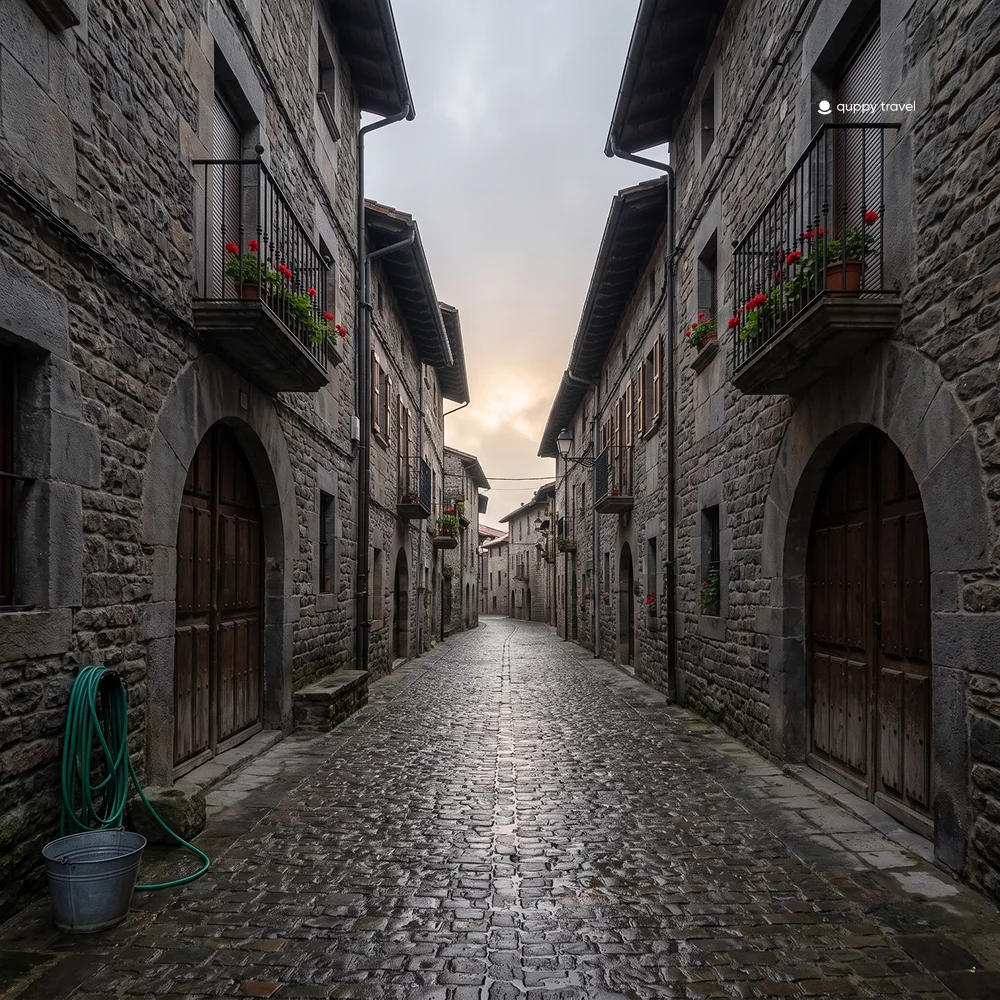
Santillana del Mar tells three lies in its own name. It is not holy, it is not flat, and there is no sea — the coast is a few kilometres north, out of sight behind a hill. The village has been on lists of Spain’s prettiest places for so long that it has learned to perform, and between eleven and five it performs: coach parties, ice cream, embroidered aprons hung out in the windows.
Come at eight instead.
The cobbles are still dark from the night’s drizzle, the shutters are shut, and you can hear your own shoes. The ground floors along these lanes were byres — you can still read the wide arched doorways where the cattle went in, with the family living directly above them and taking the animals’ heat up through the boards. Nobody has scrubbed that out of the stone. At the top of the street the Colegiata de Santa Juliana keeps a twelfth-century cloister, and at that hour the light crosses its carved capitals almost sideways, so each one has a lit face and a dark one.
August up here does not behave like August. The people who can leave the south come north for it, and the north hands them twenty-two degrees and a sky that changes its mind twice an hour.
I ate lunch in a room with four tables and a menu written out by hand. Oscar was five hours west of here in July, working out how Ourense came to cook the best octopus in a province with no coastline. A thing that arrived by road, from somewhere else, and stayed until it counted as local. Cantabria has its own version of that trade. I found it the next morning, twenty-three kilometres inland.
What three euros buys
The Museo de Altamira stands on the hill above the village, fifteen minutes up through wet grass, and entry costs three euros. Three. I paid it through Quppy at the desk the way you pay for a coffee, without thinking about it at all.
It is the smallest sum I have spent on anything this year, and it bought me a cave that people came back to paint for twenty thousand years.
Not the cave. The copy of it.
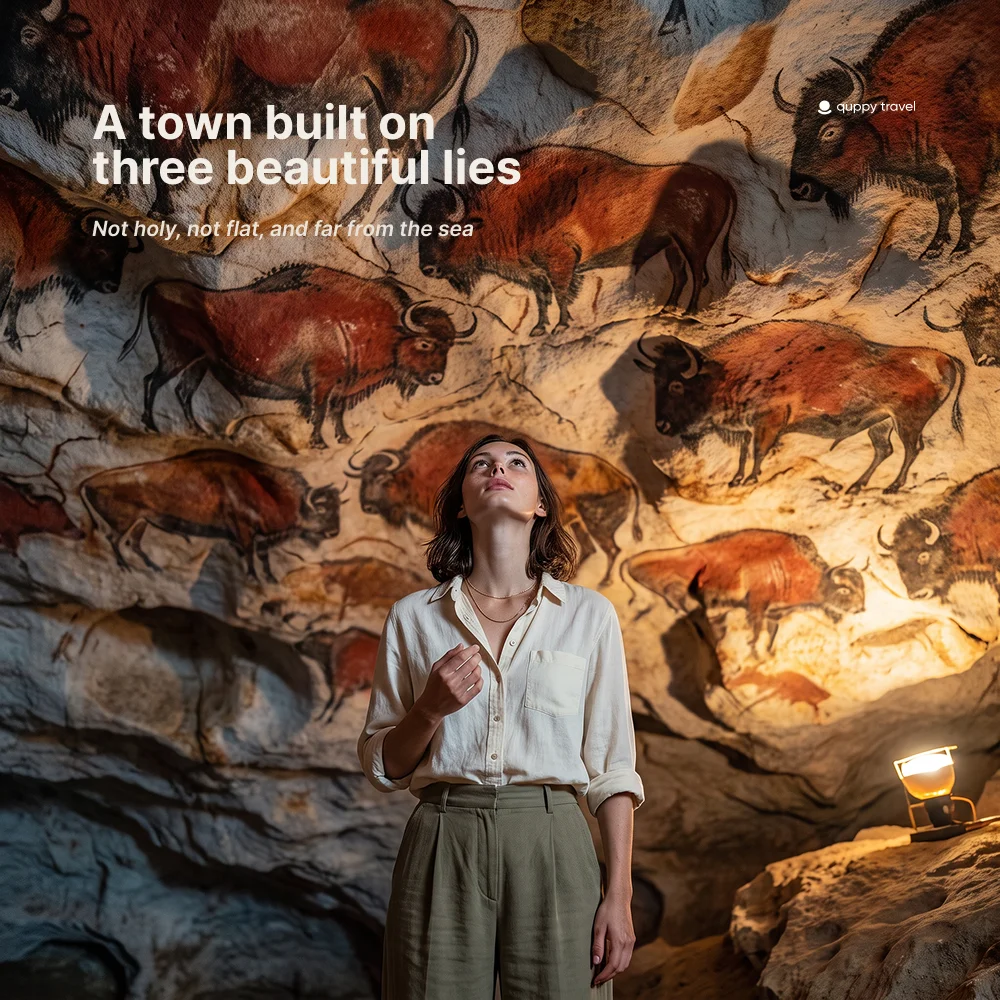
The Neocueva opened in 2001. It was built off a three-dimensional survey of the real chamber and follows its architecture to the millimetre, with two deliberate exceptions: the painted ceiling hangs higher than the original, and the tight places have been widened. You can stand up straight in here. In the cave itself you could not.
So the bison are comfortable to look at, which is the one thing they were never meant to be. They are up there in red ochre and charcoal, packed shoulder to shoulder, most of them curled with their legs folded under them. Whoever made them used the swellings already in the rock as the animals’ shoulders and haunches.
The stone was the shape of a bison first. Someone came along and agreed with it.
I had expected the replica to feel like a postcard of itself. It does not, and I think that is because it never once pretends. Nothing in that room claims to be old.
The list closed before anyone told you
Here is the part I had not understood before I came.
Altamira was open once, and it was loved to death. Through the nineteen-seventies it took as many as a hundred and seventy-four thousand people a year — breath, warmth, the things we carry in on our skin — and in 1977 it shut. It opened again in 1982 with a ceiling of eight and a half thousand visitors a year. In 2002 green mould came up on the paintings and it shut again.
Since August 2020, five people go in per week. Saturdays, thirty-seven minutes, only a handful of those directly beneath the polychrome ceiling, in white overalls with hoods, masks, and shoes that never leave the site.
A hundred and seventy-four thousand, then eight and a half thousand, then about two hundred and sixty a year. You can watch a place close in three numbers.
And you cannot join the queue. Those five come off a waiting list drawn up between 1999 and 2002, before the cave shut — more than four and a half thousand applications, worked through in strict order, one Saturday at a time. By late 2023 the museum had reached the first four hundred and fifty names on it. The list has taken no new ones for years. This is not a thing you can simply decide to want.
Twenty-three kilometres to the older dark
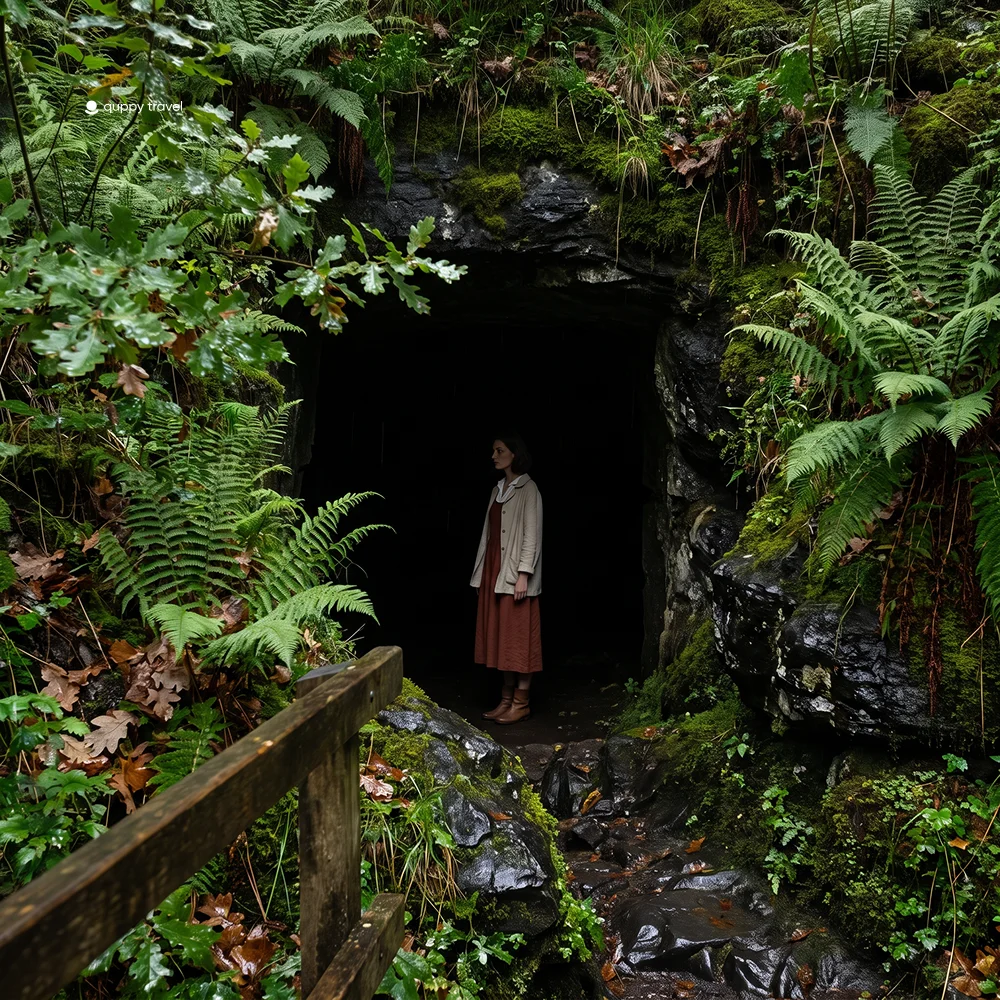
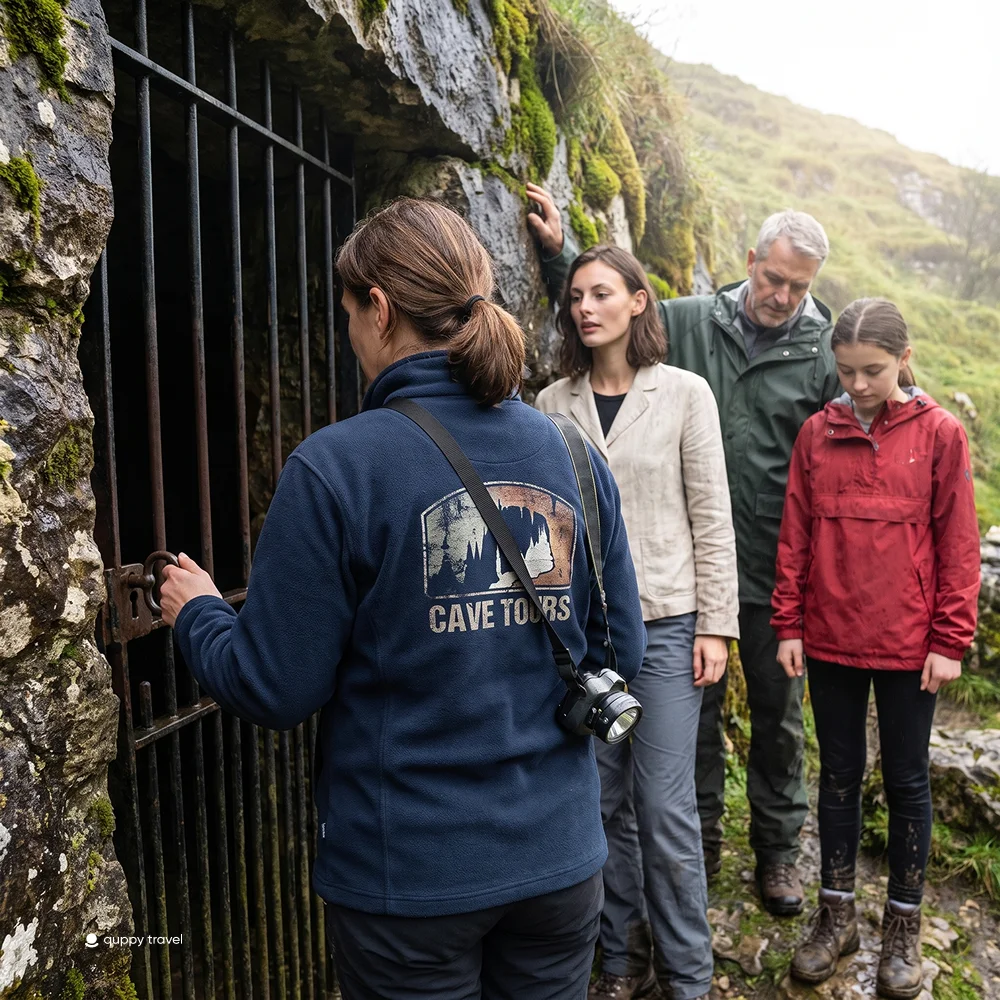
At Puente Viesgo a limestone hill called Monte Castillo has four caves inside it. Two are open to anyone who books — El Castillo and Las Monedas, six hundred and twenty metres of footpath apart. A ticket is five euros. The group is thirteen at most in summer, the visit runs forty-five minutes, and in August you want to book several days ahead; if you mean to do both caves, leave an hour between the two times.
The woman who took us in wore a fleece with the site’s name across the back and carried her lamp on a strap over one shoulder. She waited at the gate until the group had gone quiet on its own. Nobody had told us to. There is a moment at the mouth of these caves when a group stops behaving like a group.
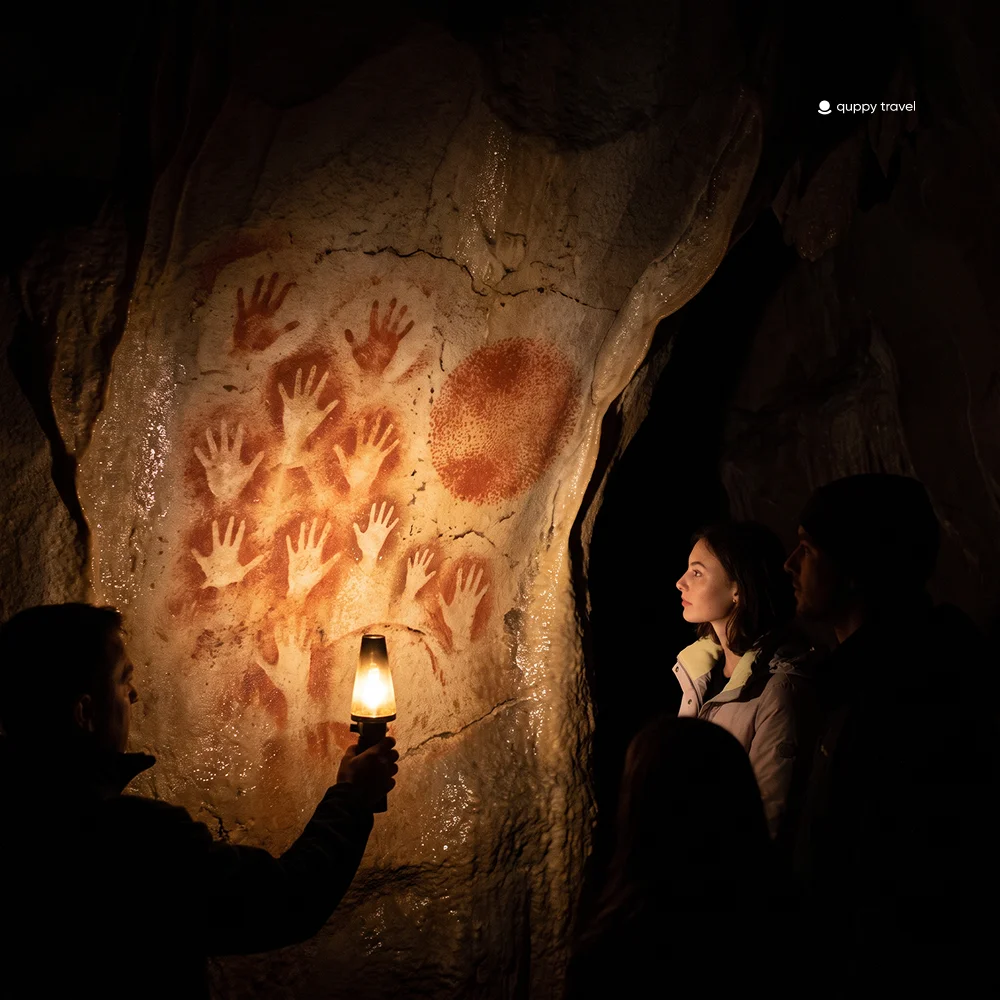
Inside El Castillo the cold does not move. You go down, and the sound of the valley stops rather suddenly, as though a door had been shut behind you instead of left open. The guide walks her lamp along the wall and finds hands — dozens of them, sprayed in red, each one the gap left where somebody’s palm had been.
In 2012 a team dated the thin calcite skin growing over one of the red discs on that wall and got a minimum age of forty thousand eight hundred years. For a while that made it the oldest dated cave art known anywhere; Indonesia has taken the title since. The local arithmetic has not changed, though. No date anyone has yet got out of Altamira is that old.
That is the sentence I keep turning over.
The older cave takes thirteen people every forty-five minutes for five euros. The younger one takes five a week, by an appointment made a quarter of a century ago. Age is not what closed Altamira. Fame is.
The man they called a liar
There is one more shut door here, and it is the one I did not expect to think about for the rest of the week.
Marcelino Sanz de Sautuola went into the cave on his own land in 1879 with his young daughter, who looked up while he was digging and saw the ceiling. He published what they had found the following year. The prehistorians of the day did not merely disagree with him — they decided the paintings were a forgery, and that he had commissioned them.
The colours were too fresh. The animals were too well drawn. Nobody in the Stone Age could have done this, therefore somebody last year had.
He died in 1888, at fifty-seven, still carrying it.
Fourteen years after that, the French prehistorian Émile Cartailhac — who had been among the loudest of them — published a short article titled Mea culpa d’un sceptique. It is an honest piece of writing and it arrived far too late for the only person who needed it. He was not disbelieved because of the evidence. He was disbelieved because he was a landowner from a small northern province and not a professor in Paris, and standing is its own kind of gate.
I went back to the Neocueva on my last morning, and it was better the second time, which I had not expected. The copy is not competing with the cave. It is the last honest look at a room that now has to be left alone in the dark, unbreathed on, for a very long time. There is something close to tenderness in that — building an exact double of a thing so the thing itself can rest.
But my arms remembered the other one.
Under the copied ceiling I could see everything and feel nothing. In the older cave I could barely see, the cold had come through my sleeves inside a minute, and it stayed in my forearms for an hour after I was back out in the wet green light. Something in me still wants to argue that the real one counts for more. What I can actually stand behind is smaller than that, and colder: one of them gave me the picture, and one of them gave me the temperature.