At four o’clock Jerez does not exist. Every shutter on Calle Larga is down. The heat comes up off the paving and sits at chest height, and the only thing moving is a cat with a plan.
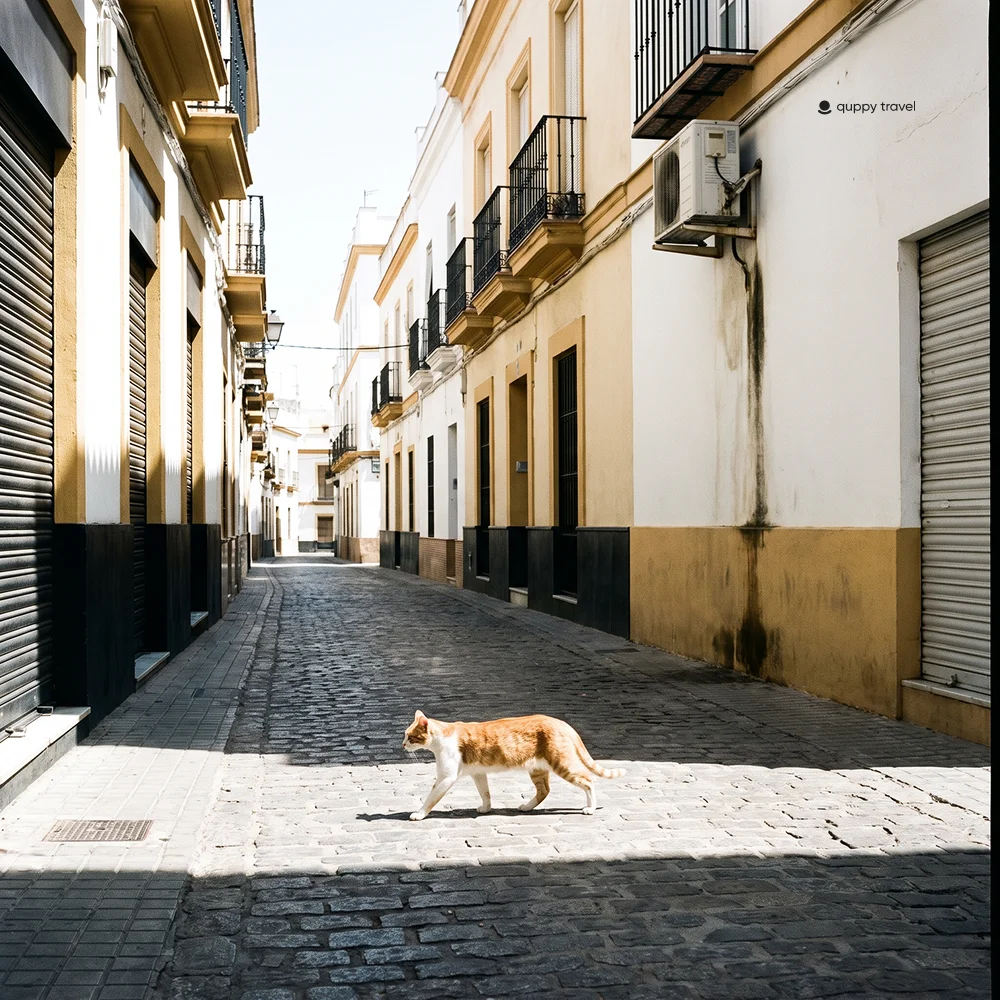
Thirty-six degrees. I had been here three days and had not yet eaten a hot meal before ten at night.
You do not fight this. You do what the town does, which is give the afternoon away and take the evening back with both hands. But there is one place working at four, behind walls built to keep August outside, and it is the reason the town is here at all.
The building is for the yeast, not for you
Walk into a bodega in August and the first thing that happens is your skin stops complaining. Outside, thirty-six. Inside, about eighteen, and it will be about eighteen tomorrow.
That is not air conditioning. There isn’t any. It is architecture doing a job.
The big cellars went up in the late nineteenth century and they were built the way cathedrals were built, for the same reason cathedrals are cool — a roof high enough that the volume of air above you takes all summer to warm. The floor is albero, the sandy pale clay they use in bullrings, and twice a week in summer somebody walks it with a hose. The water goes into the sand and comes back out as damp air. The windows are high on the walls and they are not arranged for the view. They open to the west, to catch the poniente coming off the Atlantic, and they shut against the levante, the dry easterly that arrives off the land and would strip the moisture out of the room in an afternoon.
Every one of those decisions is made on behalf of a fungus.
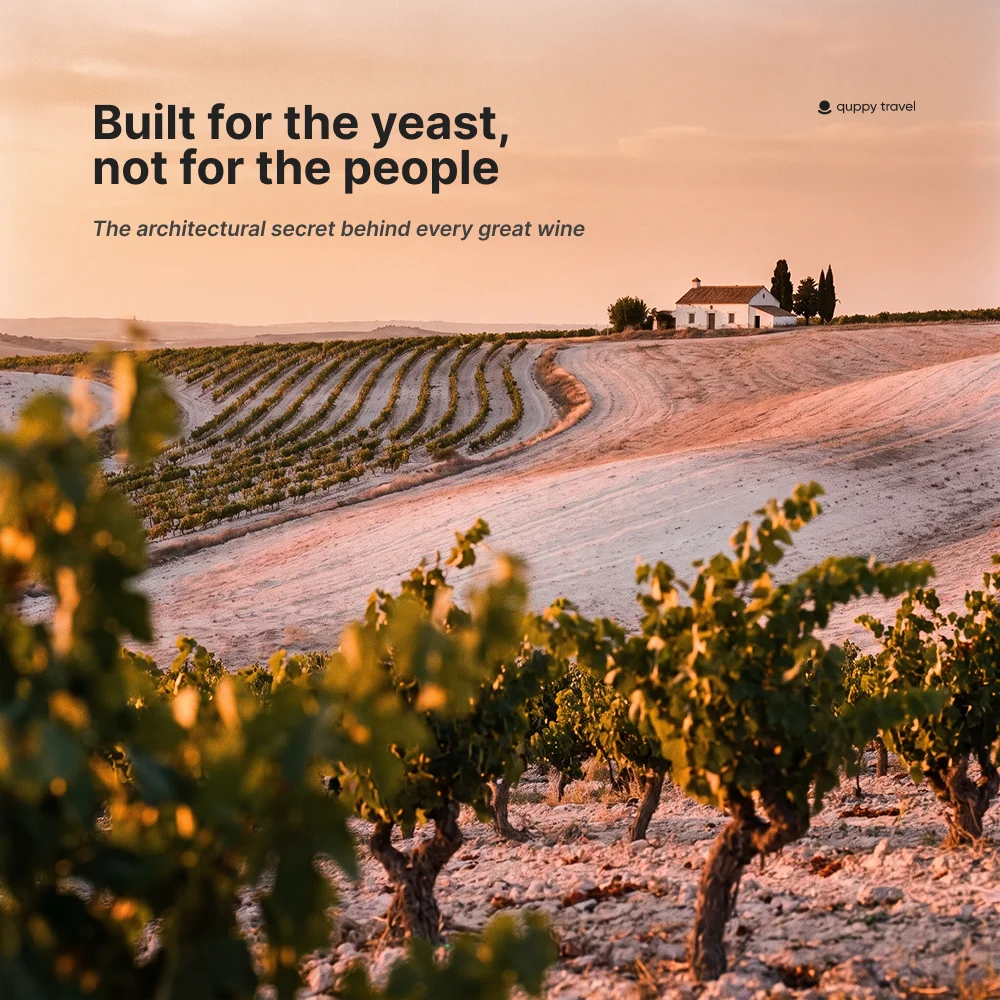
The wine in the barrels here is under flor — a living veil of yeast, a couple of centimetres thick, floating on the surface and sealing the wine from the air. It eats what it needs and it protects what is underneath. And it is fussy. It wants around eighteen degrees, humidity over seventy percent, and something like eighteen cubic metres of air per barrel to breathe. Get it wrong and the veil thins, breaks, and sinks. The whole building — the height, the wet sand, the west-facing windows — exists so that a layer of yeast on top of a barrel does not have a bad summer.
I have eaten in restaurants that thought less about their customers.
The rule, delivered in a silver cup
Curro has worked this floor for thirty-one years and he walks it like a man crossing his own kitchen. He carries a venencia — a thin flexible rod, longer than your arm, with a small silver cup at the end. He takes the bung out of a barrel, and the movement he makes next takes years to learn: he drops the cup down through the veil of yeast in one clean stroke and brings it back up without tearing it.
Then he pours. From up here, into a glass down there, a thin bright line of wine falling a long way and not one drop landing on the sand.
Pale. Cold. Salty.
Not salty like the sea. Salty like an almond.
I asked how much of this barrel goes out in a year, expecting a number about production.
“A third,” Curro said. “Never more. It is not permission. It is the rule.”
A third. Never. Ever.
He meant it literally. The Consejo Regulador sets it: no more than a third of the bottom row’s volume may be drawn in a year. Not a third of the harvest — a third of that barrel, the one in front of me, and then it gets topped up.
What the rule is protecting
Here is the part that took me a day and two glasses to properly understand.
The barrels are stacked in rows, and the rows are not decoration. The bottom row is the solera — from suelo, the floor. Above it sit the criaderas, the nurseries, numbered upward. When they draw wine for bottling, they take it from the bottom row only. That row is then refilled from the row above, which is refilled from the row above that, and so on to the top, where the new wine of the year goes in.
Nobody bottles a barrel. They bottle a fraction of a barrel and hand the barrel back.
They call the refilling rocío. Dew. Which tells you the intended rhythm — small, regular, more or less silent.
So the wine in your glass has no birthday. It is not from a year. It is a running average of every year that has ever passed through that stack, weighted toward the recent ones and never quite free of the old ones. A fino solera in Jerez gets drawn from two to four times a year. Down in Sanlúcar, where the sea air keeps the flor thicker and hungrier, they will draw four to six.
And before all this, Jerez made vintage wine like everybody else. Vinos de añada. Year on the label, this one better than that one, the whole apparatus of good years and bad years that the entire wine world runs on and argues about.
Jerez looked at that and built a machine to make it impossible.
That is the thing I keep turning over. Every wine region I have ever eaten my way through sells you the year. Burgundy sells you the year. Barolo sells you the year. Here they built a system whose entire purpose is to guarantee that no year is allowed to matter. A bad harvest gets absorbed. A glorious one gets diluted, on purpose, forever, so that what reaches you tastes like the house and not like the weather.
You cannot have a masterpiece. You can only have consistency, and continuity, and a thing that never finishes.
Nine o’clock, and the town comes back
By nine the shutters are going up and Plaza Plateros has people in it. By ten it is loud. The heat has let go of the stone and the whole city is outside eating standing up, which — regular readers will know — is my favourite condition for a city to be in.
The paperwork is the actual friction
This is where Valencia stops being first of fifty. In the same survey, 52% rated the local bureaucracy negatively (against 39% globally), and the city fell to 13th on the Expat Essentials index despite ranking 3rd for housing. The life is not the problem. The admin is.
The visa is real, though, and better than its reputation. Spain’s Startups Law — Ley 28/2022 — came into force on 23 December 2022, not 2023, whatever the blogs say. (The nomad provision isn’t even in that law’s own articles: its fifth final provision amends the 2013 entrepreneurs law to insert article 74 bis, teletrabajador de carácter internacional. I read it. It took an afternoon.)
The income threshold is where people get hurt. It’s written as 200% of the minimum wage — a multiple, not a euro figure. Which means it re-rates every year, whenever the SMI does. Any blog quoting you a fixed number is quoting a snapshot, and a stale snapshot means you under-document and get refused. Read article 74 bis and do the multiplication yourself, the week you file.
The rest is unglamorous and fine: visa up to a year, residence authorisation up to three, renewable in two-year blocks, permanent residence at five. The processing unit is meant to resolve in twenty days.
The riverbed
Now the part I actually came away thinking about.
On 14 October 1957 the Turia broke its banks through the middle of Valencia. Twice in one day: a morning wave around 2,700 cubic metres per second, a midday one over 3,700. The official toll under Franco was 81 dead. Contemporary chronicles put it past 300. The regime was not in the business of publishing numbers that indicted the state.
The answer was Plan Sur — Ley 81/1961, signed on 23 December 1961. It didn’t dam the river or wall it in. It moved it: a new channel cut around the south of the city, 12,692 metres long, 200 metres wide, rated for 5,000 cubic metres per second.
Construction began in February 1965. The channel opened on 22 December 1969 and was finished in 1973. One and a half million cubic metres of concrete. Three million tonnes of stone.
Which left a dry riverbed running straight through the middle of a city. Roughly nine kilometres of empty corridor — already cleared, already owned, already bridged.
You know what goes in a corridor like that.
The 1958 plan said it out loud: autopistas, estaciones ferroviarias y zonas industriales. Motorways, rail yards, industry. On any spreadsheet I have ever built, that is the correct answer. Free right-of-way through the centre of the city. Maximum throughput, minimum acquisition cost. The park was never the plan.
What stopped it was the neighbourhood associations and a sentence: “El llit del Túria és nostre i el volem verd.” The Turia riverbed is ours and we want it green. Las Provincias picked the campaign up in 1973 and carried it past the neighbourhoods into the city at large. The state handed the bed to Valencia by royal decree on 1 December 1976. The first democratic councils approved it as a park in 1979. The garden was founded in 1986, and its eighteen sections were built out over roughly the next twenty-five years.
Mia spent a week in a canyon in Galicia this month and filed a piece about a river that had been there first and set the pace for everything built near it. Valencia looked at its river and moved it around the south of the city. Same country, same month, opposite instinct.
I want to be precise about what I admire here, because it isn’t the aesthetics. Valencia’s own architects’ association calls the finished garden incongruent and unfinished, and they’re right — you can feel the seams where one section’s idea stops and the next one’s begins. It isn’t a masterpiece.
It’s a refusal, and it’s nine kilometres long.
What the water did in 2024
I can’t write about this riverbed in 2026 and treat water as a historical subject.
On 29 October 2024 a DANA — depresión aislada en niveles altos, the cut-off low that Spanish autumn runs on — killed more than 230 people, overwhelmingly in the Valencia area. It is one of the deadliest floods in modern European history.
The diverted Turia is credited with sparing the city centre. It did the job it was built for, fifty-five years on.
The water that killed people came down the Rambla del Poyo — a ravine that is dry most of the year, and built over. It burst at Torrent around half past six in the evening and ran at roughly 2,300 cubic metres per second past Paiporta.
I’m not going to turn that into a tidy lesson about infrastructure. More than two hundred people died, the judicial inquiry into what happened is still running, and a nomad with a spreadsheet has no standing to summarise it. The only thing I’ll say is the narrow, verifiable one: the channel cut after 1957 did the job it was built for, and the water that killed people came down somewhere else.
DANA season is September to November. I was here in July. In July the sea sits around 24 degrees — which is the part that makes the autumn possible. Warm water, warm air above it, all that ascent waiting for a trigger.
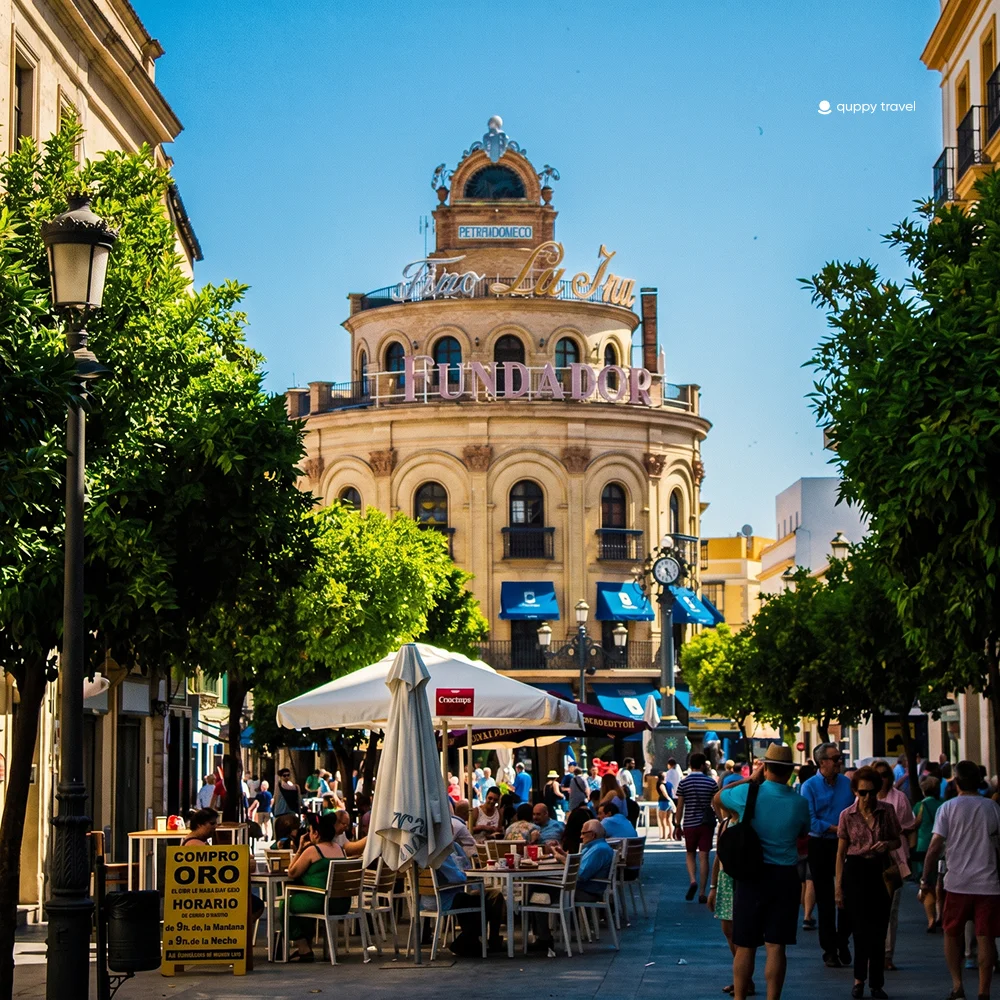
A tabanco is what Jerez calls the kind of bar that sells wine from the cask. They nearly died out. Now there are enough of them to walk a route between, and the oldest, El Pasaje on Calle Santa María, opened in 1925 and still puts on flamenco three times a day, the last at half past nine.
I went to a smaller one two streets over, because I wanted to hear the room and not the guitar.
Manuel poured from the barrel behind him into a small straight glass, filled two-thirds, no ceremony at all, and put it down without a coaster or a comment. You sip it standing, because everybody else is standing. A glass of manzanilla here costs less than a coffee in most of the cities I write about. Nobody is impressed by it. That is the whole point of it.
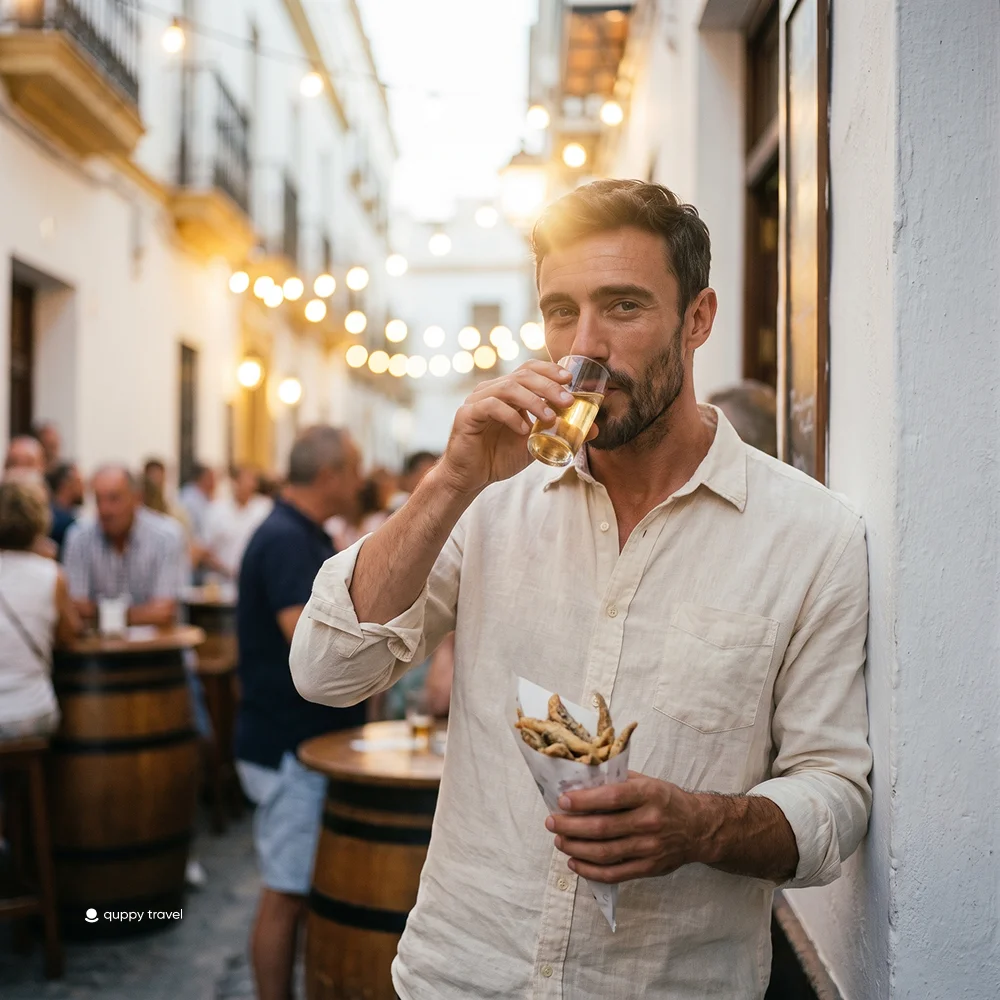
The food came the way it should, in the wrong order and without being asked for. Papas aliñás — cold potatoes dressed in oil and sherry vinegar with strips of mojama, tuna cured until it is dark and dense and shaves like a hard cheese. A plate of chicharrones from Cádiz, pork pressed and cut in sheets so thin you can see the light through them, with lemon. Wedges of payoyo, the goat cheese from the mountains up behind the town. And then tortillitas de camarones, the shrimp fritters, batter gone lacy at the edges with the whole tiny shrimp still in there, hissing when they land.
Crisp. Hot. Gone.
I asked Manuel about berza jerezana, the chickpea-and-pork stew everyone tells you is the dish of this town.
He gave me the look you give a tourist who has asked for something reasonable at an unreasonable time. “In August?” Then he explained, kindly, that the stews — the berza, the puchero, the riñones al jerez — are winter. You come back in November and the town cooks differently. In August you eat cold things and fried things and you drink something that came out of a barrel an hour ago.
Which is its own kind of solera, when you think about it. Nobody here is trying to have the best possible plate. They are trying to have the correct plate for the week it is.
The number nobody puts on a label
I want to be honest about the other half of this, because a place that refuses to let any year matter has been having a very hard fifty years.
In 1978 the vineyards of the Marco de Jerez covered around twenty-two and a half thousand hectares. Today it is under seven thousand. That is roughly two-thirds of the vineyard gone inside a working lifetime — sherry fell out of fashion, got sold cheap, got sweetened for export markets that then abandoned it, and the growers pulled up the vines.
So the system built to survive bad years has been quietly living through a bad half-century, and the reason it is still here is the same reason it exists: nothing was ever a finished batch. There was no vintage to fail. The stack kept getting topped up in smaller and smaller quantities, and the wine in the bottom row went on being partly older than everybody in the room.
Mia spent this month in Cantabria in front of a cave that was sealed shut in 2002 to save it, where five people a week are let in and everyone else is given an exact copy. Two ways of keeping something. Jerez chose the opposite one. Nothing here is sealed. It is opened three times a year, a third at a time, and topped up before the level has a chance to drop.
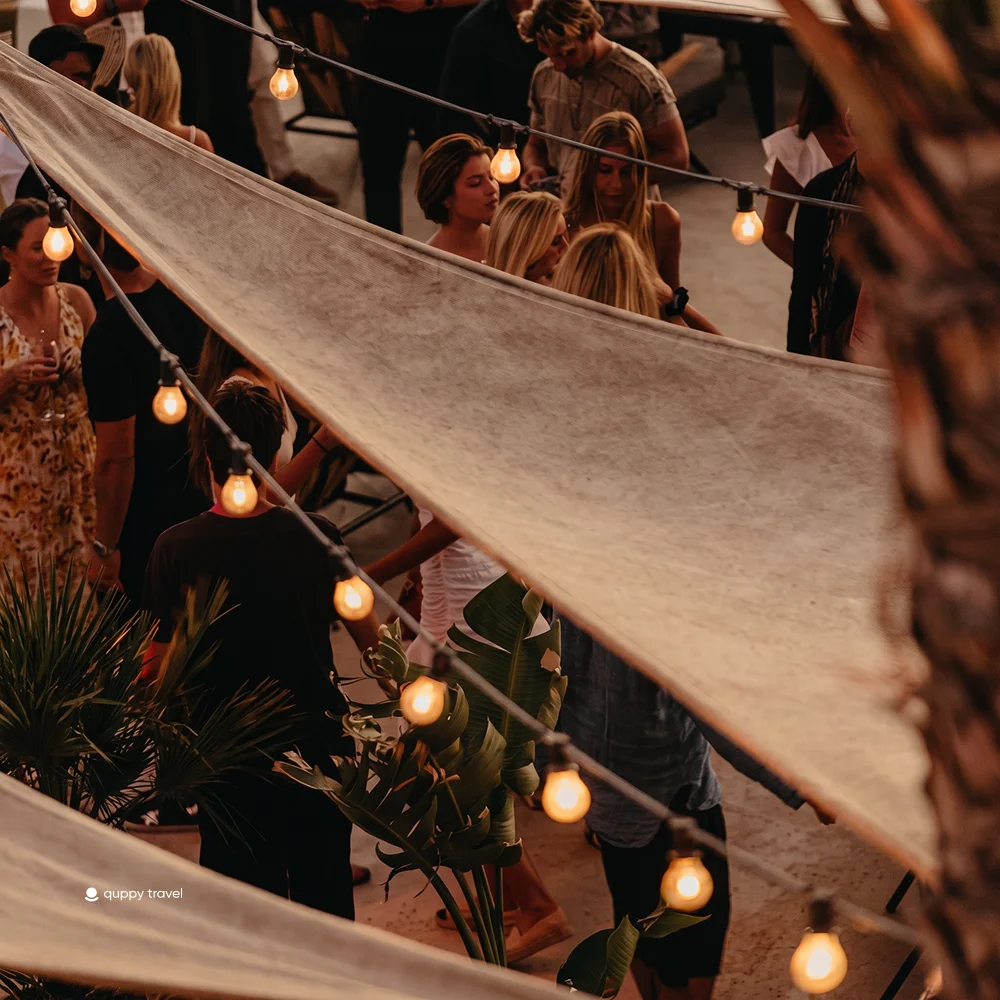
Near midnight Manuel refilled my glass without being asked and told me the barrel it came from was started before his father was born. I have no way to check that. It is also, mechanically, almost certainly true — that is what the stack does, and he knew it, and he said it the way you would mention the age of a table.
That is the thing I will take out of this town. Not a bottle. You can take a bottle, but this is the one wine that punishes you for saving it — open a fino and it goes flat and dull within days, which is another way it refuses to be a souvenir.
What I will take is the arithmetic of it. A third out, the rest stays, top it up before the level drops. Do it for two hundred years and what you get is not a great wine from a great year. What you get is a cold glass, a plate of fritters still hissing, and a man who is not related to you refilling it because your glass was empty and he was standing there.