
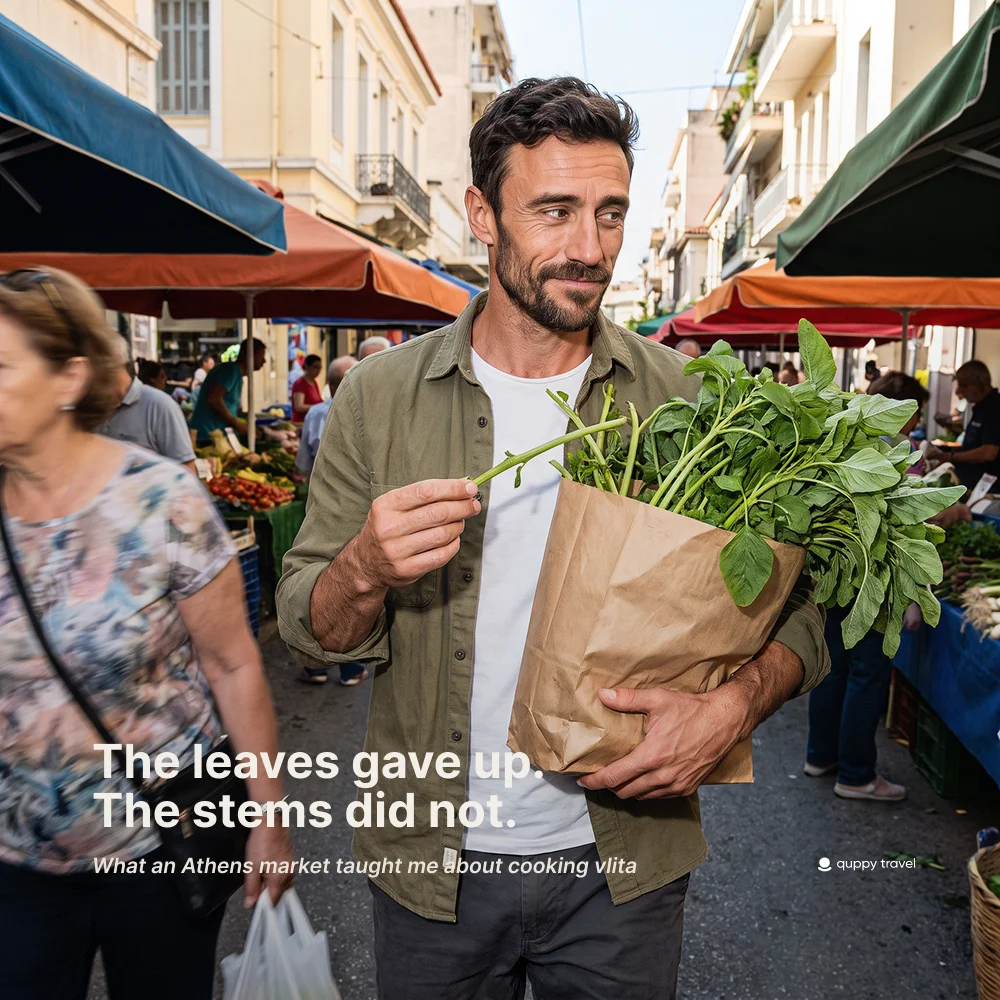
Vlita in English means amaranth greens. In Greece, the name usually refers to tender amaranth leaves and shoots boiled until soft, then served with olive oil, lemon and salt. That translation is accurate enough to buy them. It is not accurate enough to cook the bag in front of you.
Three weeks into Athens I decided to stop eating other people’s cooking for one evening and make the simplest dish in Greece myself. Greens. Water. Oil. Lemon. A child could do it, and in this country a great many children have.
I produced a bowl in which the leaves had collapsed into grey sludge and the stems still fought back against a fork.
The recipe was not the problem. Most versions are a paragraph long and broadly correct. What I had missed was everything before the pot: which greens, from whom, in which month, and how mature the stems were. For vlita, that is most of the recipe.
What vlita means in English
The clean translation is amaranth greens. Vlita is not the same thing as horta. Horta is the larger Greek category of edible greens, wild or cultivated; vlita is one summer member of that category.
The botanical label is less tidy. Many sources identify Greek vlita as Amaranthus blitum. Food writer Diane Kochilas uses Amaranthus viridis, or slender amaranth. A modern taxonomic review of Greek Amaranthaceae notes that the name A. viridis has historically been misapplied to A. blitum in influential Greek floras, which helps explain why both names continue to appear.
So I would not use the disagreement to claim that vlita has no English name or no botanical identity. It does. The useful point is narrower: market names do not always arrive with herbarium precision, and the age and condition of the plant matter more in the kitchen than the Latin label on a web page.
The broader category really is enormous. An ethnobotanical study in central Crete documented fifty-five wild green plants through thirty-one interviews. A study on Ikaria documented fifty-six. Many came from the daisy and cabbage families and were eaten boiled, fried in oil or folded into pies.
Fifty-five plants. One everyday category. Amaranth greens is a translation of vlita. Wild greens is a translation of horta. Neither tells you what the stem will do in a pot at the end of September.
Where to buy vlita in Athens
Nobody I asked had strong feelings about the recipe. Everybody had strong feelings about where you buy.
Athens runs on the laiki agora, the people’s market. A laiki appears in a neighbourhood on a fixed weekday, sets up in the morning and leaves when the selling is done. Athens and Piraeus have about 195 of them. You do not go to one permanent market. The market comes to your street, once a week, and then it is someone else’s turn.
Two licensed kinds of seller work there. Producers sell goods from their own production. Professional sellers buy goods for resale. Both are legitimate. The distinction matters when you want to know when a green was cut and how far it travelled.
Fotini was a producer, and she let me know it within about four seconds of my arrival, in the tone of a woman who has explained this before. Her vlita came in loose heaps rather than banded bunches, the leaves still gritty, the stems still wet where they had been cut. Two stalls down, Thanasis had the same greens, trimmed and rubber-banded and frankly better-looking. He told me cheerfully that his came from the market at Rentis at five that morning.
Nobody was hiding anything. It simply had not occurred to me that fresh greens was a supply-chain question. I bought from Fotini, which is why the next part is my fault and not hers.
When vlita is in season
Vlita is a summer green. It is common in Greek markets from early summer into September, although the exact window varies with region, weather and cultivation. The useful buying test is not the calendar alone. It is the stem.
I had arrived at the end of the run. Fotini picked up a stem, bent it and showed me the way it resisted instead of snapping. The plant had spent its summer growing upward and the stalks had gone from tender to something with a grain in it. She said something about the stems that I understood as these need longer, and then repeated it, because my Greek is a disgrace and she could see it arriving slowly.
She was telling me the recipe. I heard weather commentary.
This is the part a fixed cooking time cannot hand you. Young leaves and shoots may cook together. Mature stems need a head start or need to be removed. The condition of the ingredient that morning decides which method is correct.
How to clean and boil vlita
The method is short. The judgement is in the stems.
First, trim any woody ends and separate thick stems from the leaves. Soak the greens briefly in plenty of cold water, lift them out so grit stays behind, and rinse again until the water is clean.
Bring a generous pot of salted water to a rolling boil. If the stems are thick, add them first and test them with a fork after several minutes. Add the leaves when the stems are close to tender. Depending on their age, the leaves may need roughly three to ten minutes. The plant is ready when the stems yield without the leaves dissolving around them.
Drain the vlita and cool it promptly in cold water if you want to stop the cooking and hold the colour. Dress it with olive oil, lemon or vinegar, and salt. Exact times vary across Greek recipes because the greens vary. A late-season stem and a young June shoot are not the same ingredient just because they share a name.
I put the whole heap in at once and waited for the pot to solve the difference. The leaves were ready first. I left them there while the stems continued negotiating. The steam smelled faintly of beetroot and iron, which is correct and which I took as encouragement. By the time the stems gave in, the leaves had passed the point where wilted was a useful word.
Honest verdict: edible. I ate all of it standing up. I would not have served it to anyone.
Why horta matters in Greek food culture
A cuisine does not maintain names and uses for dozens of edible greens by accident. Geography, season, household knowledge, poverty, agriculture and religious practice all contributed. It would be too neat to choose one cause.
Greek Orthodox practice includes four main fasting periods, along with most Wednesdays and Fridays outside designated fast-free weeks. The traditional rules restrict meat and dairy and, depending on the day and local practice, may also restrict fish, olive oil and wine. Shellfish is often permitted.
The Dormition Fast runs from 1 to 14 August, inside the summer vlita season. That overlap does not prove the fast created the repertoire of greens. It does help explain why vegetable knowledge remains practical rather than decorative. Research on Greek Orthodox fasting finds higher consumption of fruit, vegetables and legumes among people who observe it.
The greens are not a substitute reluctantly waiting for meat to return. They have their own calendar, names and techniques. Fifty-five documented plants is what that depth looks like when somebody finally counts it.
Can you drink the vlita cooking water
Yes. Many Greek households keep the green cooking liquid, cool it and drink it with lemon. It is often referred to simply as the broth or zoumi. The habit is not universal, but it appears often enough in Greek accounts of horta to be more than an eccentric footnote.
Fotini looked at my pot with the flat disappointment of a woman watching a foreigner throw away the good part, so I kept it. I drank it the next morning, cold, out of the jug. It tastes like the smell of the pot. Mineral. Bitter. Steadying, in a way I did not expect and cannot defend. I have had more enjoyable drinks. I have not had many that felt so much like the logical end of a meal.
The short version
- Vlita in English means amaranth greens. Horta is the larger category of Greek edible greens.
- Buy stems that bend and snap easily. Thick late-season stems need more cooking or should be removed.
- Separate mature stems from leaves and boil the stems first. Judge tenderness with a fork instead of trusting one universal time.
- Cool the greens promptly, then dress them with olive oil, lemon or vinegar, and salt.
- Keep the cooking water if you like. It can be cooled and drunk with lemon.
Alex was in this city the same month, working out that Athens charges you in mornings rather than euros. I would add that the market charges in the same currency and gives change. Fotini’s heaps were uglier, grittier and half an hour more work than the bunches two stalls down. They were also the greens that told me what week it was.
I will get the stems right in June. That is nine months away, which in this dish is not a delay. It is the recipe telling you when to come back, and the woman who sold them to me had already said so twice while I stood there nodding at the wrong thing.
Vlita questions answered
What is vlita called in English
Vlita is normally translated as amaranth greens. Most botanical references connect Greek vlita with Amaranthus blitum, although Amaranthus viridis also appears in food writing and older naming traditions.
Is vlita the same as horta
No. Horta is a broad Greek term for edible greens. Vlita is one type of horta, especially associated with summer.
How long should vlita boil
Tender leaves often need about three to ten minutes. Thick or mature stems take longer and should go into the pot first. Test the stems rather than relying on one fixed time.
Can you eat vlita stems
Tender stems are edible. Trim woody ends, separate thick stems from the leaves and give them a head start in the boiling water. Discard stems that remain fibrous after cooking.
When can you buy vlita in Greece
Vlita is primarily a summer green and commonly appears from early summer into September. Availability varies by region and weather, while later-season stems are usually tougher.
Sources
- Taxonomic review of Amaranthaceae in Greece and neighbouring countries
- Diane Kochilas on amaranth leaves and vlita
- Central Crete ethnobotanical study of horta
- Ikaria ethnobotanical study of wild greens
- Official Athens Guide to laiki markets
- Greek government licensing information for professional laiki sellers
- Greek recipe guidance on separating vlita stems and leaves
- Greek Orthodox fasting calendar and fast free periods
- Study of Orthodox fasting and the traditional Cretan diet