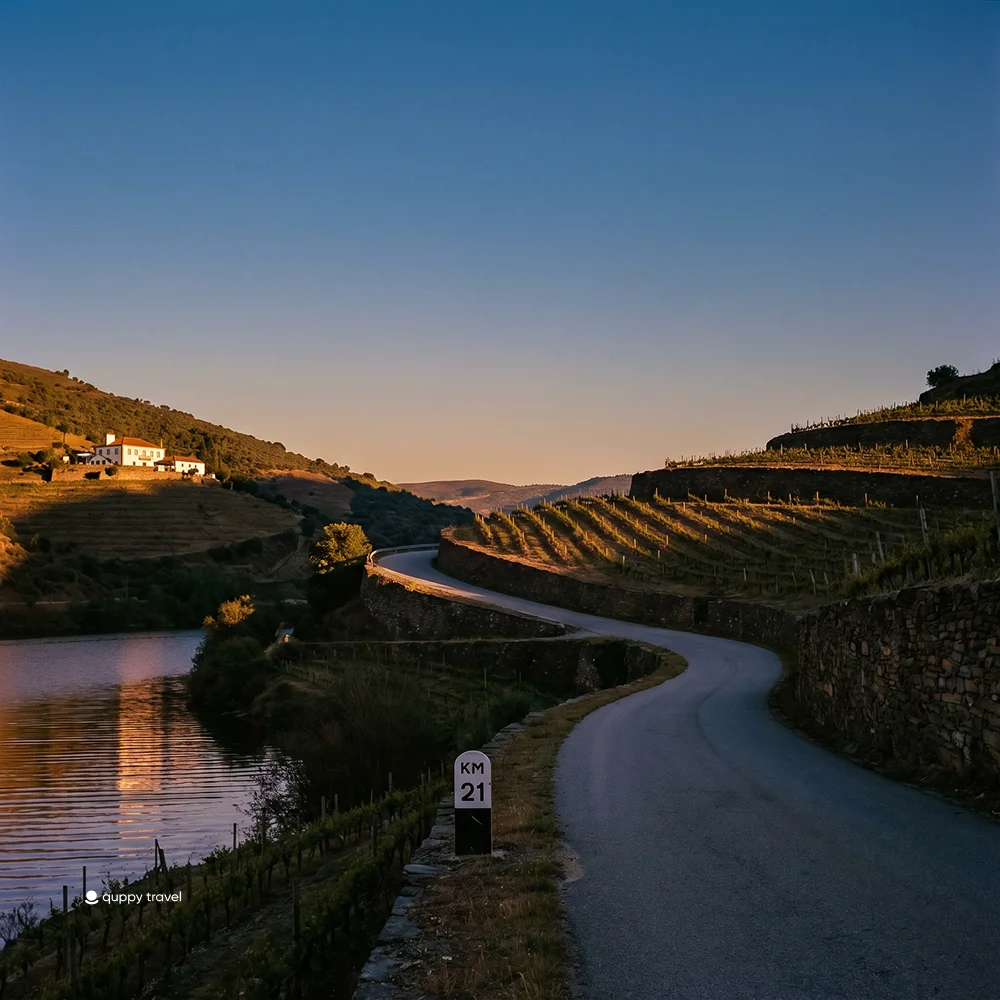

I have a rule: one rental per country. Not a car collection — a deliberate driving experience, the single road that a country does better than anywhere else. Austria got the Grossglockner. Italy got the Amalfi. Romania got the Transfăgărășan. Portugal got the N-222 between Peso da Régua and Pinhão, and this weekend I finally put it in the logbook.
The rule exists because I came up through sim-racing — iRacing, two seasons in an online league — and I learned early that a simulator teaches you geometry but not feel. Real roads have weight. Rental cars have insurance. You don’t rack up laps; you get one careful run at a thing, and you notice what the version in your head got wrong.
Porto was a good excuse. Oscar was already in town, three hours deep into a tasca lunch somewhere off the Cardosas ramp, so the meal side of the weekend was handled. My side was the road.
The Rule (and Why Portugal)
Portugal qualifies for a specific reason. Avis actually ran a Driving Index a while back — bends, acceleration, cruising, braking, a sweet spot at a 10:1 ratio — and the 21-km N-222 section between Régua and Pinhão scored 11.3:1. It was ranked the best driving road in the world. You can argue with the methodology. You can’t really argue with 93 bends in 21 kilometres clinging to a river gorge lined with vertical vineyards.
So: one weekend, one rental, one road. No podcast, no playlist, no calls. The phone stays in the glovebox from the moment I pull out of the rental lot until I stop for lunch.
That’s the whole brief.
The Pickup
Porto has three rental options for anything interesting: the airport (Francisco Sá Carneiro), the Campanhã station desk, or one of the boutique luxury operators near Boavista. The airport has the widest premium fleet. Campanhã is easier if you’re coming in from Lisbon by train.
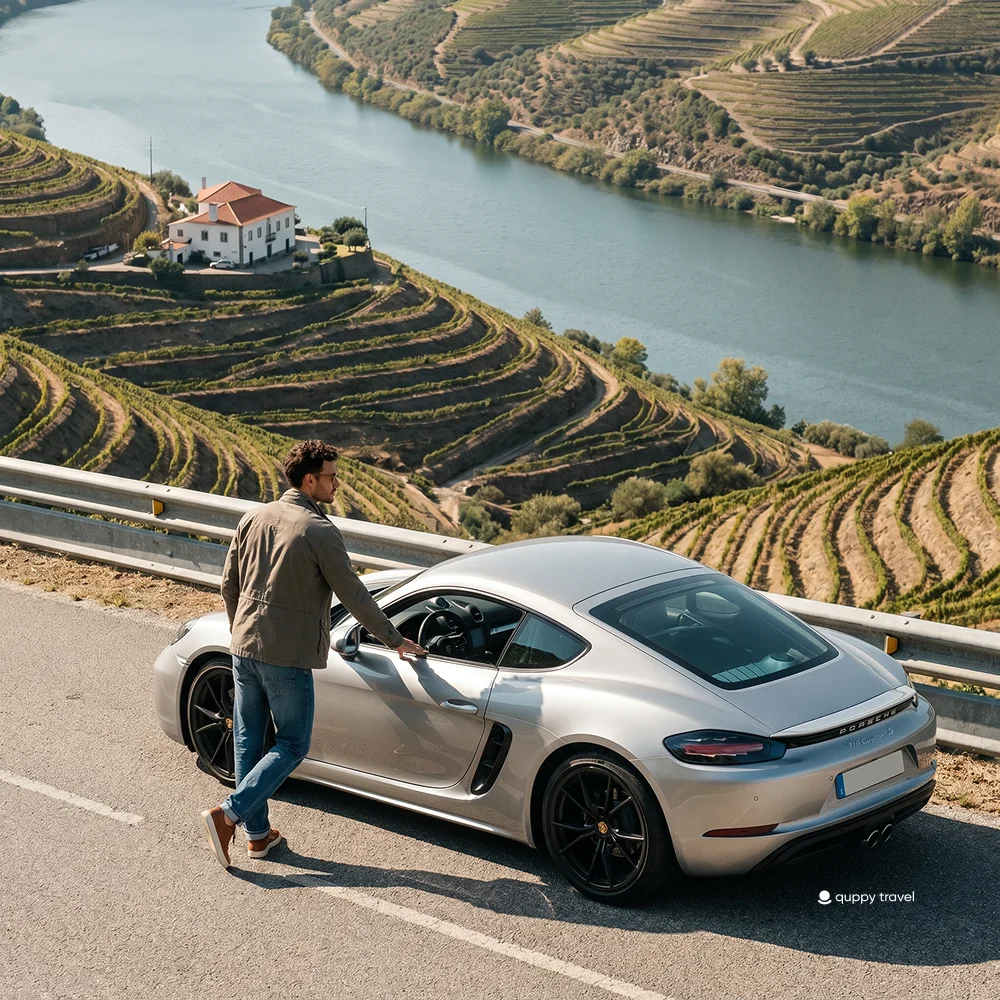
I took the airport. Sixt Premium at Sá Carneiro keeps a rotating handful of driver-focused cars — a 718 Cayman S was on the board, so I took it. Not a 911. Not a Taycan. A Cayman is the one where the badge isn’t doing the talking; the chassis is.
The paperwork breaks down into four numbers you actually care about: a €3,000 authorization hold on the card, a day rate of €420 that covered Saturday and Sunday, a 400-km mileage allowance with €0.85/km over that, and a full-to-full fuel policy on 98 octane. Everything else — insurance tiers, additional-driver fees, the young-driver surcharge that does not apply to me anymore — is negotiable around those four.
The deposit is where most nomads waste the first hour. The rental agency wanted €3,000 in euros, right there at 9 AM in a fluorescent sub-level (the kind of lighting that guarantees a bad decision). I held the euros in Quppy already — so it was one tap, the authorization cleared to my card, and we moved on. NO panicked conversion. No frozen transaction because my main card thought Porto looked suspicious.
The pre-auth released on the Tuesday, unused. Single friction point resolved.
The Via Verde transponder was already stuck to the windshield — Sixt bundles it for €2.21/day, capped at €22.14 per rental. On Portuguese electronic-only highways this isn’t optional; if you skip it, fines arrive at your home address three months later. Pay the twelve euros. Move on.
The Route
The A4 east out of Porto is the boring bit: 110 km toward Amarante and Vila Real, Exit 11 for Régua, 80 minutes with one toll tunnel through the Marão massif, about €8.30 settled on the Via Verde. Worth it. The alternative is three hours of secondary roads pretending to be scenic while mostly being lorries. Drop down the switchback connector to the river, cross the bridge into Peso da Régua, and pick up the N-222 eastbound along the Douro. That’s where the actual road begins.
You know the road has started when the river appears on your right and the vineyards start stacking. Terraces above you, terraces below you, and a tarmac ribbon cut into the hill at an angle that was clearly decided by the vines, not the highway department.
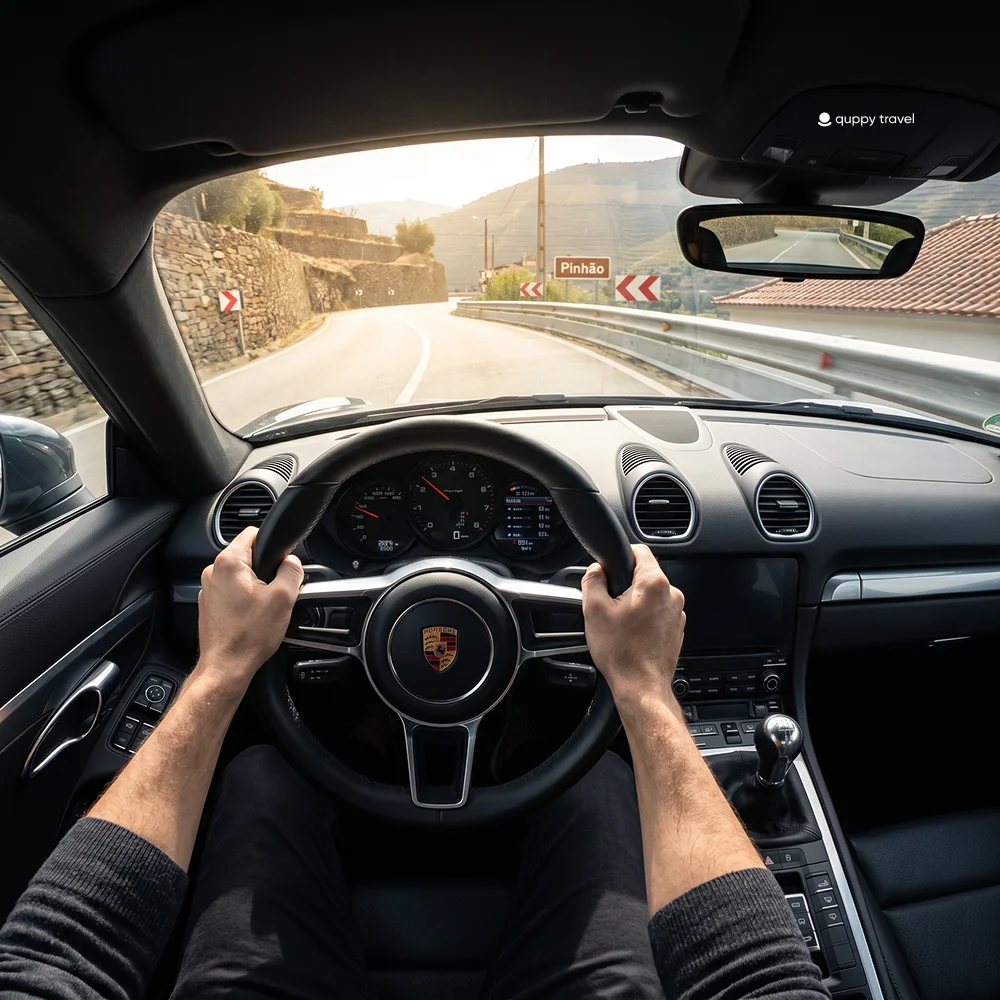
The speed limit is 70 km/h. The road enforces it on you whether you want it or not. There are no long straights to mask an over-ambitious entry speed; every corner is either blind or rising or falling, usually two of those, occasionally all three. The rhythm is: brake gently, trail off, roll on, look through. Repeat. 93 times.
The Cayman is overqualified and that’s the point. It’s small (4.39 m long), honest through the steering rack, and settles into a corner in a way that makes the sim years feel like flashcards — you had the vocabulary, but not the sentences. A Golf R would have done it. A base Cayman T would have done it better. I don’t think anything bigger would have fit.
The Economics
A summary, because this is my format:
- Sixt Premium 718 Cayman S, 2 days: €840
- Via Verde package: €22.14 (capped)
- A4 tolls (both directions): €16.60
- Fuel: one full tank, 64 L × €1.95 (98 octane) = €125 (returned it three-quarters)
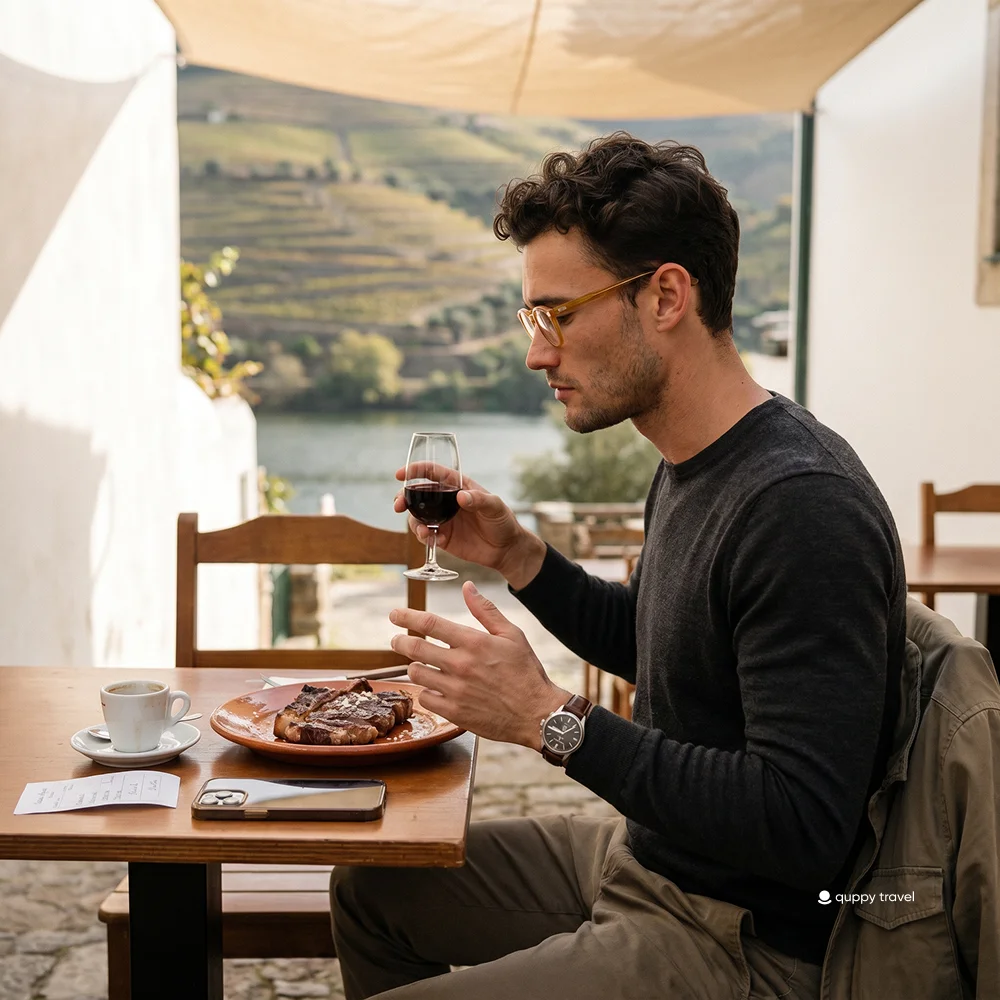
- Lunch at Veladouro in Pinhão (grilled posta arouquesa, a glass of Duas Quintas tinto, sparkling water, espresso): €28
- Parking at Pinhão station: €3 for the afternoon
Total for the weekend, door-to-door including the coffee I bought Oscar when I got back: about €1,050.
For a one-off Douro lap in a proper driver’s car, that’s the number. Skip the Cayman, take a Golf R or a Cupra Leon on a weekend rate (~€180/day), and the total drops to around €580. Skip the Porto return and stay in Pinhão overnight at the Vintage House, and you add €220 for the room but save the fuel and toll of the return leg. The numbers compose cleanly.
One thing the spreadsheet doesn’t catch: the N-222 will punish a rental compact economy car. Rear visibility matters on the blind crests. Steering precision matters on the 70-km/h corners that the map shows as gentle. If your rental budget is “whatever Hertz has on the lot today,” the road will still be beautiful, but it will be work.
The Part I Didn’t Plan
This is the part I keep thinking about.
Around bend 60-something, somewhere past the Quinta do Crasto viewpoint, I realized I’d stopped counting. I’d stopped checking speed. I’d stopped running the telemetry loop in my head — apex, exit, throttle, line — and started just driving.
The road was doing something to my attention that the sim never had. It wasn’t focus. It was the OPPOSITE of focus. A kind of not-thinking that was also not distraction.
Mia would call it presence. She’s probably right. I’d call it the same thing I noticed in Kakheti at Oscar’s supra, and the same thing Lena the Berlin designer tried to name in Batumi when she said the city hadn’t decided what it wanted to be — the data model runs out and you’re just somewhere, in it, not processing it.
I don’t know what to do with that observation yet. I don’t think my spreadsheet has a column for it. Oscar texted me a photo of Dona Ermelinda’s tripe pot about the time I was passing Pinhão; I texted back a photo of a switchback with the Douro behind it. We’re having the same weekend through different equipment. That’s the whole Quppy Travel thesis in one exchange, I think.
Who This Is For
If you already drive and you want a specific road to drive well, go — rent something honest, the N-222 is the real thing. If you’re new to manual transmissions or rear-wheel-drive or anything genuinely sporty, start easier; take the EN-101 coastal road north of Porto first, then step up to this one. If you want the scenery without the driving, take the Douro train from São Bento to Pinhão: it follows the same river, costs €30 return, and the view from the carriage window is better than from behind the wheel. Genuinely.
Quick-Reference
- Rental pickup: Sixt Premium, Sá Carneiro airport (24/7 desk)
- Route: Porto → A4 east → Exit 11 Régua → N-222 east to Pinhão (21 km, 93 bends) → same road back or loop via N-323 through Alijó
- Speed limit: 70 km/h the whole N-222 section — enforced by the road, not by cameras
- Lunch stop: any tasca in Pinhão within 300 m of the station; I liked Veladouro
- Fuel: fill in Peso da Régua on the way in; prices drop off-motorway
- Via Verde: let the rental company bundle it; €22 cap
- Best time: April–June or September–October. July/August the vineyards are beautiful but the road gets slow with tour vans
Portugal is in the book. Transfăgărășan next, probably in October, when the road opens back up. The rule holds.