Ourense is the only province in Galicia without a coastline. It also cooks the best octopus in Galicia. Nobody here treats those two sentences as a contradiction, and getting over that is most of the trip.
Then there is the water. It comes out of the rock in the old town at sixty-seven degrees, and this city has put it to work for six hundred years. Bakers set their ovens over it in the fourteenth century. By the fifteenth the tanners had the pools, and the tripe-dressers, and the washerwomen — free heat in a town that otherwise had to buy its firewood.
It never once cooked the octopus.
It took me a week to work out why, and the answer turned out to be a monastery, a mule road, and a pot that somebody still has to light a fire under.
The rent was paid in octopus
In the twelfth century the Cistercians of Santa María de Oseira — a monastery so enormous that Galicians call it their Escorial — held property down on the Rías Baixas coast. Their tenants paid rent the way tenants did: in kind. What the coast had was octopus.
Fresh octopus does not travel. Cured and dried, it travels beautifully. So it came up over the hills on mules, and the parishes that hauled it, soaked it and sold it on were Oseira’s own — the ones around O Carballiño, under thirty kilometres from here. A town with no sea, no port and no boats.
That was the better part of nine hundred years ago and it never stopped. The pulpeiras took the pots out to the markets, and the muleteers pushed the trade further, on into Castile. Á feira. At the fair. The dish is not named after the sea at all. It is named after market day.
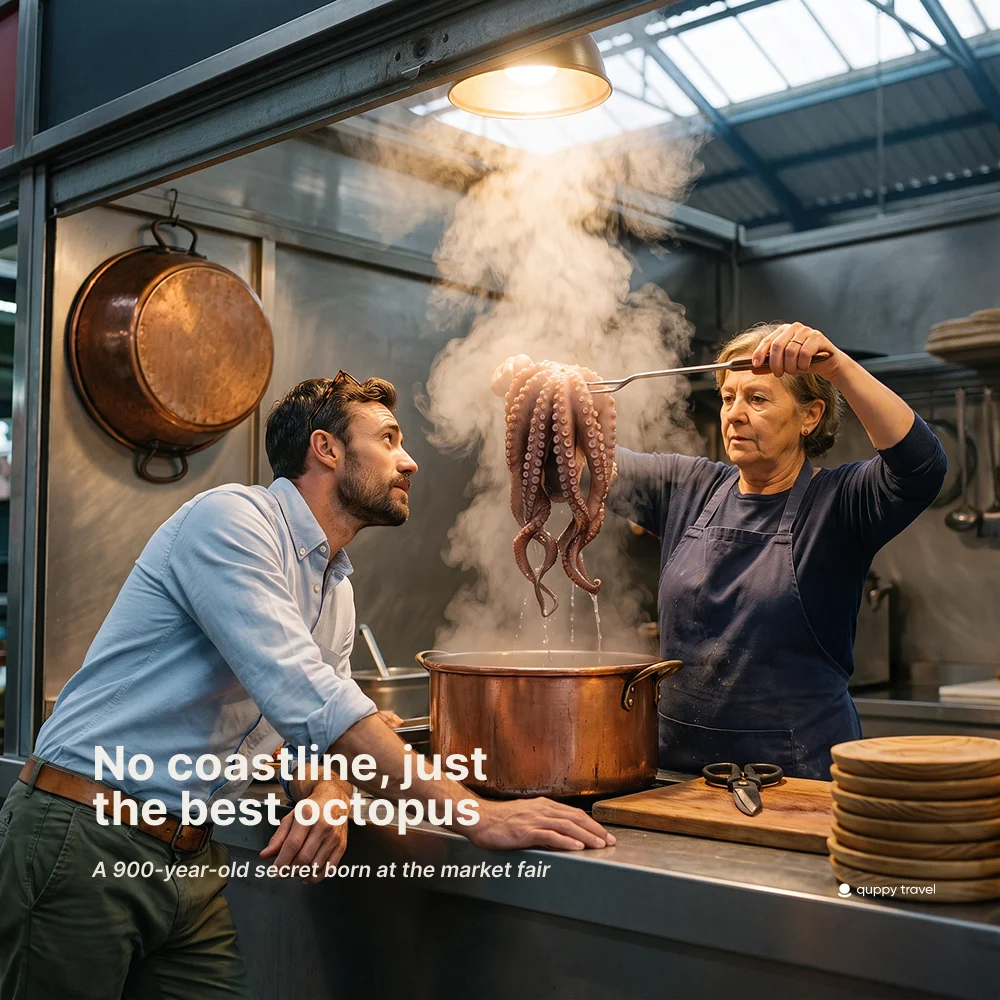
The woman at the pot was called Amparo, and she had been doing it thirty-one years, which she told me before her surname. The pot was stainless steel. I asked about copper — every photograph of this dish for a hundred years has a copper cauldron in it — and she tipped her head at the wall, where one hung, retired.
“O cobre é para as fotos,” she said. Copper is for the photographs. Then, after a moment, in Spanish, so that I would definitely get it: “It cooked fine. They said it was bad for us. Maybe it was.”
What she does instead is much older than her pot. She takes the octopus by the head and dips it into the boil three times, lifting it clear between each one. It is called asustar — to scare it. The tentacles flinch and curl on the third dip, the skin tightens over the meat, and if you skip it you get something grey that chews like a belt. Then it goes under properly and bubbles for most of an hour.
She hooked it out on a long fork, laid it across a board, and cut it with scissors. Not a knife. Scissors, straight down the tentacle, into coins about as thick as your thumb.
They go onto a round wooden plate, and the wood is not decoration. It pulls the wet off the underside and holds the heat in the meat; china gives you a puddle and a cold third slice. Then olive oil, poured with no restraint. Then pimentón, a heavy red dust of it. Then coarse salt, from a bowl she never once looked at. Cachelos underneath if you want them — potato boiled in the same water, which is where half the flavour of that pot ends up.
I ate the first coin too fast and burnt the roof of my mouth, which is the correct way to start. The second one I gave the attention it wanted. It is not tender the way meat is tender; there is a give to it, a fraction of resistance that lets go all at once. Tender. Smoky. Salted. The salt lands a half-second behind the rest of it.
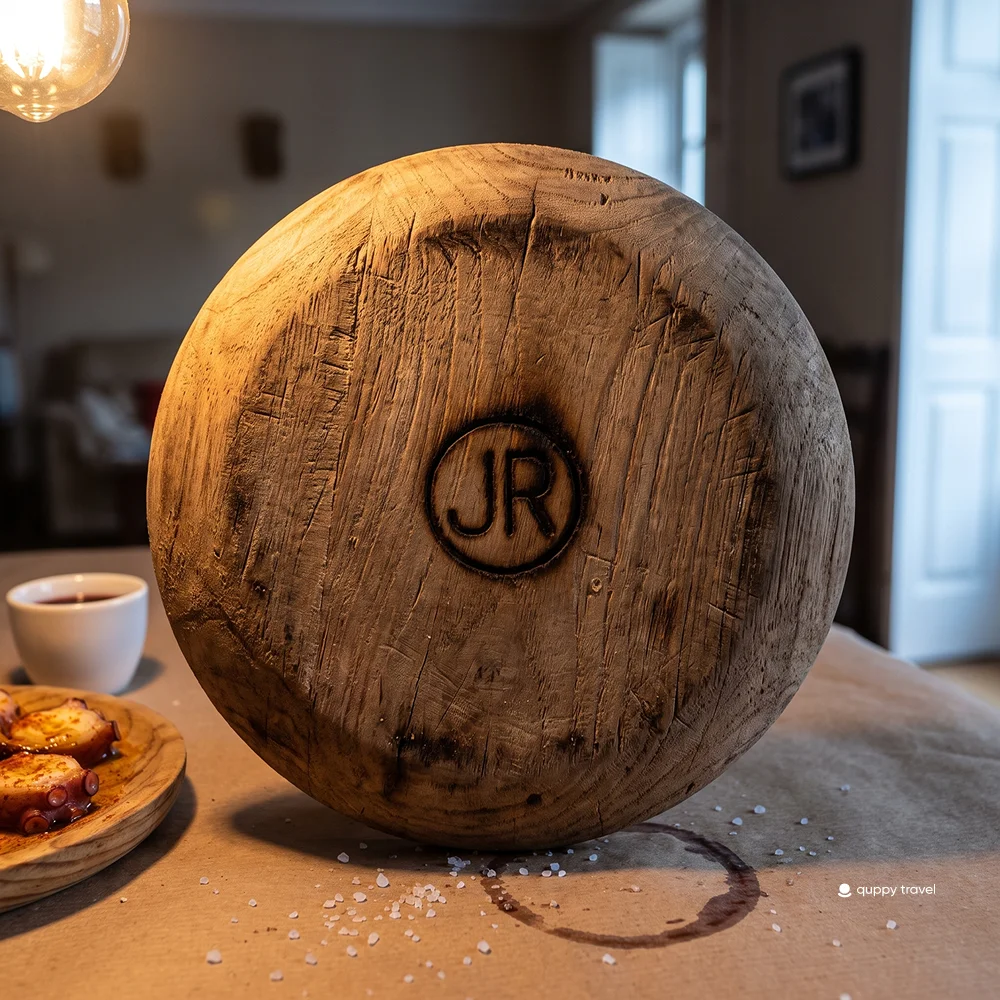
You do not eat this standing up. Lisbon eats on its feet and it is right to, but here you sit: long boards, benches, strangers at both elbows, every plate branded on the back with the mark of whoever cooked it so it finds its way home at closing. I sat between a man in a bank shirt with his tie folded into his pocket and two women in from Cea who spent forty minutes establishing which of their brothers-in-law was the bigger disappointment.
The one in the green cardigan watched me work through the plate and delivered her verdict to her friend rather than to me. “Come ben, o estranxeiro.” He eats well, the foreigner.
I have been paid worse compliments by people who meant them more.
Bread with a scar
Cea comes up again about an hour later, because the bread does too.
The loaf on that bench comes from the same council as the monastery. San Cristovo de Cea has baked it since the thirteenth century, in the village’s own wood-fired ovens — Cea supplied bread to Oseira, not the other way round, which is the right order for a place that later put the loaf on its coat of arms. In 1286 Sancho IV granted the coto a church and a monthly fair. That is the licence that matters here: not a right to bake, a right to hold a market. The bread and the octopus were both waiting for the same thing, which was somewhere to be sold. In 2005 it became the first bread in Spain to be given a protected geographical indication.
You know it by the scar. One deep cut across the top, made before it goes in, so the loaf opens along a single line instead of splitting where it likes. Two hours in the oven. The crust comes out thick enough to knock on and it tears in sheets rather than crumbs, and the crumb underneath is dense, faintly sour and still edible three days later. Which is why it exists in that shape: this is bread for people who came in on market day and would not be back for a week.
I tore off the end and ate it dry, then used the next piece to get the last of the paprika oil off the wood.
So: the same monastery, the same fair, twice over. The account book that decided what this city eats is seven hundred years old, and it is still, more or less, the menu.
The one thing that is actually from here
Everything so far arrived on somebody’s mule. The wine went the other way.
The Ribeiro starts inside Ourense’s own municipality and runs west down the river to Ribadavia, half an hour away, on terraces above the Miño and the Avia. It is the oldest denomination of origin in Galicia — 1932, long before anybody had heard of Rías Baixas — and by the fifteenth century the wine was the region’s main export, going out through the ports to Brittany, to Flanders and above all to England. Treixadura is the grape that matters. A good one tastes of pear skin with something bitter under it, like the pith. I drank the first bowl faster than I meant to and asked for another.
Bowl, because it does not come in a glass. It comes in a cunca — small, white, ceramic, no stem, no pretension. You hold it in your fingers the way you hold a boiled egg, and it is very hard to swirl a cunca and talk about legs, which I suspect is the entire idea.
You drink it in the run of lanes they call Os Viños, which begins at Praza do Ferro — the old market for farm tools — and climbs towards the cathedral through Fornos, Viriato, Lepanto. The rule is one thing per bar, then you move on. Not a crawl for the sake of drinking. A crawl because no bar in there makes more than one thing worth stopping for, and everybody involved knows it.
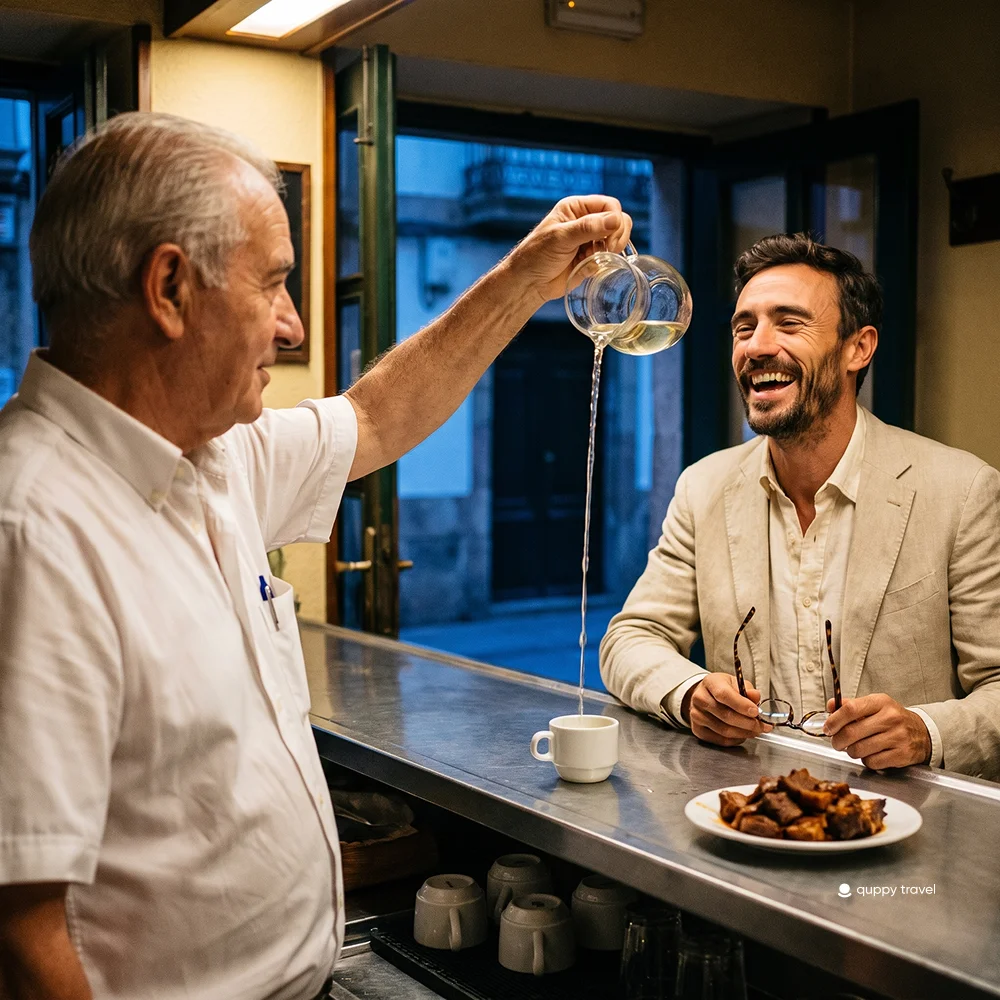
Suso is somewhere past sixty, in a short-sleeved white shirt with a biro in the pocket, and he pours from a height without watching the cunca, because after forty years the hand knows where the cup is. The wine comes out cloudy for a second and then clears. His one thing is zorza — pork marinated in paprika and garlic, fried hard so the edges crisp and the fat drips onto the bread underneath. I asked what else he made. “Nothing else,” he said. “Two doors up they do the ear.” Two doors up they do orella, pig’s ear, sliced thin and hit with more pimentón, and somewhere in the same fifty metres there is an empanada with a lid so thin it bends when you lift the slice.
The receipt printed in Galician. Viños, 2. Zorza, 1. Eleven-something, in a language I can read about a third of, out of a till that has stood in that corner longer than the euro has existed. I paid it with Quppy, and neither the machine nor Suso looked up. The slip is still in my jacket, and it is the only thing I carried out of that bar written in the language they were actually speaking.
The water that did everything else
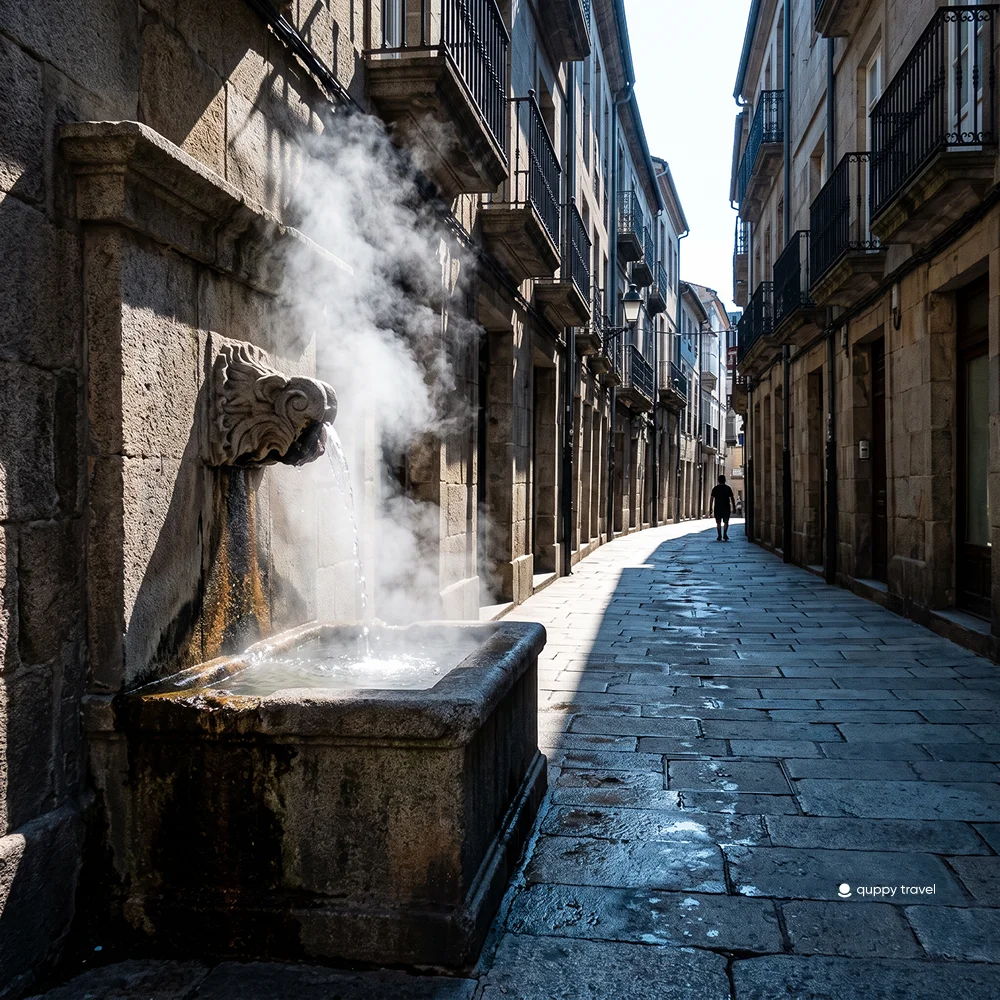
Walk five minutes downhill from Praza do Ferro and there is a stone basin pushing out water at sixty-seven degrees, steaming into a street where the July afternoon is already thirty-one. As Burgas. The Romans built a settlement around these springs and called it Aquis Aurienses, which is less a name than an address: the waters at Auria.
Sixty-seven degrees is working heat, and this city worked it. The bakers came first, ovens set where the heat cost nothing. Then the tanners, soaking hides. Then the tripe-dressers — and I enjoy that more than I should, because I spent last spring in a city that named itself after its tripe, and here the tripe-dressers had a hot spring to work in and never thought to mention it to anybody.
In six hundred years of using that water for everything, nobody put the octopus in it.
They couldn’t. The octopus was thirty kilometres away in a market town, in a pot over a fire somebody had paid to light, because it had come up the road as another man’s rent. The free heat was here. The dish was not.
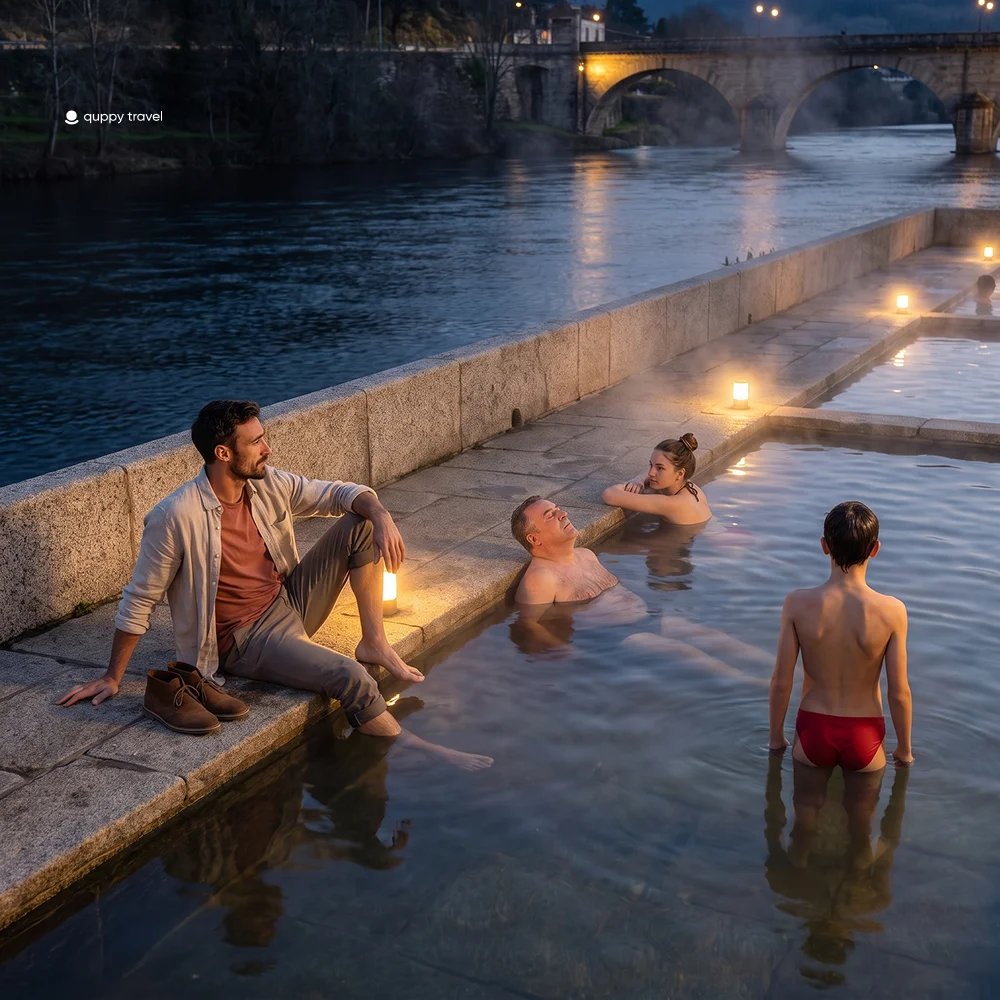
The trades are gone now. What the water does instead is hold people: there is a free public pool at the spring itself, on the basin the tanners used, and then it goes on down the Miño for five kilometres of them — A Chavasqueira, Muíño da Veiga, Outariz. Some charge, some are free — stone pools cut into the bank, the cold river running a metre away, steam coming off the surface in ribbons. A wheeled train leaves the Praza Maior and rattles down the whole line of them, which is the least dignified way to arrive at a hot spring, and you should take it.
Here is the part I could not stop turning over. The average July afternoon here is thirty-one degrees; the record is forty-four. And in the last hour before they clear the pools, with the granite still handing back the day’s heat, there were perhaps forty people sitting in the water. In hot water. On purpose. In a Galician summer.
Put that beside the pot and it looks like bad planning. It isn’t. A city ends up eating whatever kept arriving at its gate, and it goes on eating it long after the carts stop coming — which is how a town with no coast ends up serving the best octopus in Galicia on a wooden plate to four people who have never met.
What the road left behind
Mia was forty kilometres upriver this month, in the Sil canyon, where the vines are cut into rock too steep to drive and some of the fruit still comes down by boat. Up there the river decides everything. Down here it decided nothing that ever reached a plate. The road did, and the mules have been gone a century without anybody noticing the difference.
Porto, last spring, named itself after what it kept when the good meat went out on ships — the tripe, the beans, the pot you do not clear. Ourense had its dinner sent to it, cooked it anyway, and has been feeding strangers off a wooden plate ever since.
The festival is three weeks out: the second Sunday of August, over in O Carballiño, fifty-odd pulpeiras and tonnes of the stuff, one of the biggest octopus feasts in Europe thrown by a town that has never landed a boat. I intend to be on a bench somewhere in it.
Because that is what nine hundred years of freight and rent and monastic bookkeeping comes down to. A round of wood with the cook’s mark burnt into the back of it. Eight coins of octopus going soft under oil and red dust, salt you can hear between your teeth, and somebody’s elbow against yours because the bench seats three and there are four of you.
Not one of us at that board could have told you why a town with no sea eats the sea. We passed the oil down anyway, and the plate went round, and the bigger disappointment of a brother-in-law got another mention.
— O.