

I have a very low tolerance for friction. Whether in software architecture or international travel, bottlenecks kill momentum.
Most people travel to Japan for the ancient temples or the cherry blossoms. I come here to study the infrastructure. Tokyo is a metropolis of 37 million people that operates with the precision of a compiled code. But experiencing the true luxury of Japan today isn’t just about booking five-star suites—it’s about leveraging technology to make your movement, and your capital, completely borderless.
Here is my personal blueprint for hacking the Tokyo travel experience, where time is the ultimate currency and crypto is the key.
The Gran Class Hack: Your Mobile Headquarters
Domestic flights in Japan are a rookie mistake. The airport commute, the security lines—it’s dead time. My strategy is strictly the Shinkansen (bullet train), specifically the Gran Class.
Last week, traveling from Tokyo to Kanazawa, I bypassed the airport entirely. Gran Class is essentially First Class aviation on rails. You get active suspension for a zero-vibration ride, absolute silence, and a dedicated attendant. But the real value? It’s two and a half hours of uninterrupted deep work at 320 km/h.
- Alex’s Tip: Skip the Japan Rail Pass if you are doing point-to-point business travel. Book Gran Class individual tickets online in advance. It is mathematically the most efficient way to cross the country while keeping your workflow intact.
Frictionless Capital: Checking In With Crypto
The biggest friction point in international travel has always been banking: frozen cards, terrible exchange rates, and carrying cash. Japan is historically a cash-heavy society, but the high-end sector is rapidly shifting, and this is where Web3 changes the game.
I don’t deal with physical currency exchanges anymore. For this trip, my entire budget was held in USDT in my Quppy Wallet.
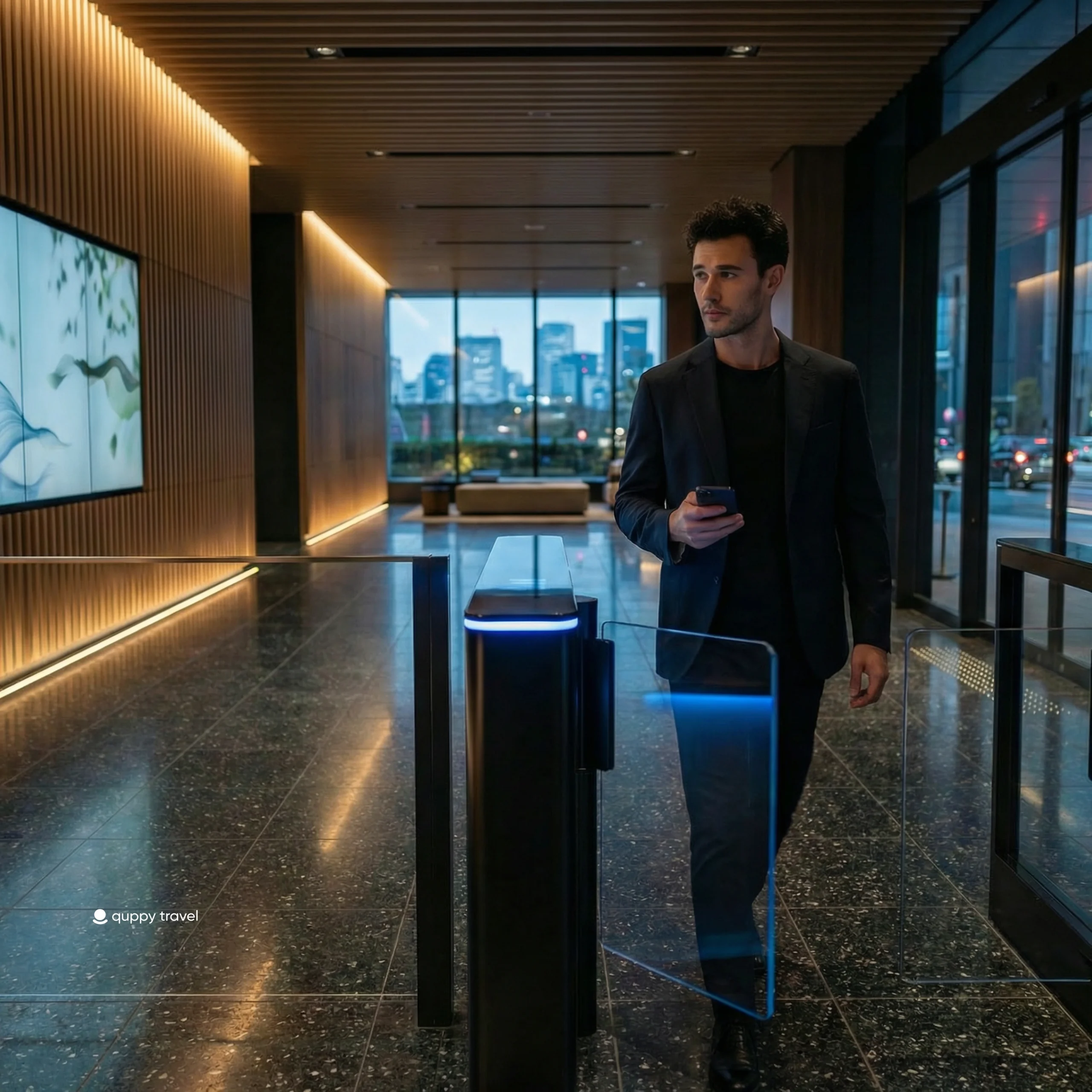
Arriving at a tech-forward hotel in Shinjuku, I didn’t stop at a traditional reception desk. My check-in was verified via a subtle biometric scan. The payment for the suite? Executed seamlessly using my Quppy virtual card, converting crypto to JPY at real-time interbank rates the exact second the transaction hit the terminal. No banking holds, no international friction. Just walking straight to the elevator while the backend handled the fiat gateway. This is what financial freedom actually looks like.
Systematizing Luggage: The Takuhaibin Network
There is nothing less elegant than dragging a Rimowa through the Tokyo subway system. The Japanese solved this decades ago with Takuhaibin (smart luggage delivery), yet 90% of tourists ignore it.
- How I use it: I drop my bags at the airport counter upon arrival, scan a QR code, and pay a flat fee (often directly from my Quppy app). I then head into Tokyo empty-handed for a business lunch or a gallery visit. By the time I biometric-scan into my hotel room that evening, my luggage is already waiting in the closet. You aren’t just paying for delivery; you are buying back your physical freedom.
The Verdict: The Architecture of Modern Travel
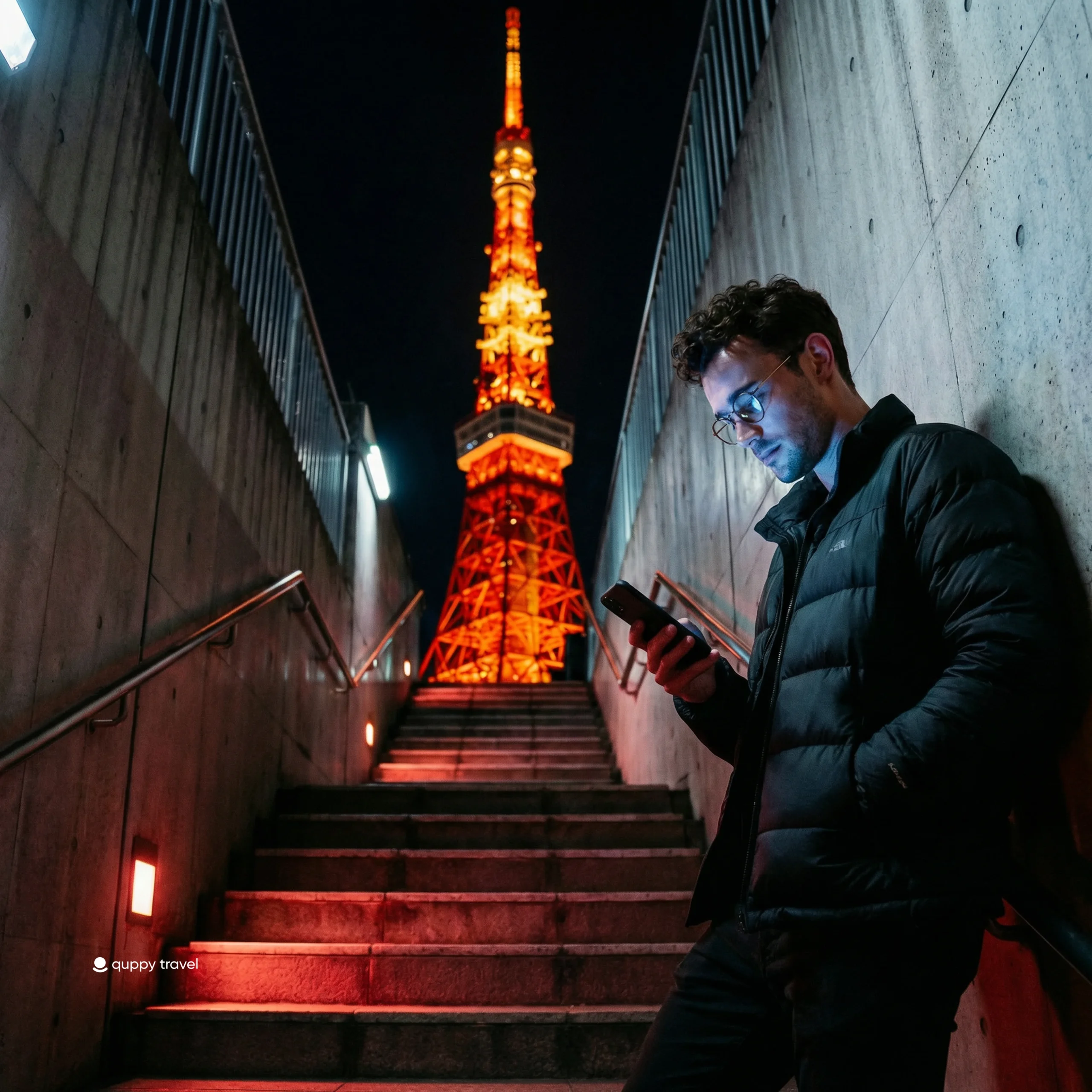
Late at night, standing on the concrete steps beneath the glowing Tokyo Tower, checking the Asian market open on my phone, the parallel is obvious.
Japan proves that massive, complex systems—whether a mega-city’s transit grid or a global blockchain—can operate flawlessly if engineered correctly. At Quppy, we are building the financial equivalent of the Shinkansen: fast, secure, and entirely frictionless.
When you travel, demand the same efficiency from your money that you demand from your transport.